Running a business in South Africa means competing for visibility in a crowded digital space where local relevance carries far more weight than global reach. For many local business owners, showing up on Google when customers search for “best florist Durban” or “accountant Sandton” can feel nearly impossible. The real struggle lies in overcoming the unique challenges of local SEO, where your actual location, business reputation, and online accuracy decide whether you get found. Understanding these distinct local SEO obstacles is the first step to building a stronger digital presence that brings more feet through your door.
Table of Contents
- What Defines Local SEO Challenges
- Types Of Local Search Obstacles
- Key Factors Impacting Google Rankings
- Critical Issues: Reviews And Trust Signals
- How Algorithm Changes Affect SMEs
- Avoiding Common Mistakes in Local SEO
Key Takeaways
| Point | Details |
|---|---|
| Local SEO is Unique | Local SEO differs significantly from general SEO, requiring a focus on geographic relevance and competition from nearby businesses. |
| Maintain Consistency | Ensure consistent business information across all platforms to avoid confusion and enhance local visibility. |
| Prioritize Reviews | Actively encourage and manage customer reviews, as they are crucial for building trust and improving local rankings. |
| Continuous Adaptation | Regularly monitor and adjust strategies in response to algorithm changes and local competition to maintain visibility. |
What Defines Local SEO Challenges
Local SEO challenges are fundamentally different from general search engine optimisation because they require businesses to appear prominently when potential customers search for products or services within their geographic area. When someone in Johannesburg searches “plumber near me” or a Cape Town resident looks for “coffee shop close by,” they’re making what’s known as a location-based search query. The complexity here is that you’re not just competing against thousands of websites nationally or globally—you’re competing against local businesses in your specific area, and Google’s algorithm prioritises results based on geographic proximity, relevance, and business prominence. This is where the real challenge begins for small and medium-sized South African businesses trying to get noticed.
The heart of local SEO challenges revolves around three interconnected problems. First, you need to ensure your business appears in local search results where proximity and relevance matter most. This means optimising your website and online presence for geographic signals—things like ensuring your business address appears consistently everywhere online, managing your Google My Business profile properly, and getting your business listed in local directories. Second, maintaining accurate information across multiple platforms becomes a juggling act. Your contact details, business name, and address need to match perfectly on Google My Business, your website, local directories, social media profiles, and review sites. Even a single inconsistency can confuse search engines and harm your rankings. Third, you’re dealing with the reputation management component—managing customer reviews on Google, managing ratings, and responding appropriately to feedback all affect how Google perceives your business authority in your local area.
What makes these challenges particularly frustrating for South African business owners is that many of the tools and strategies used internationally don’t translate directly to the local context. For instance, traditional SEO optimisation focuses on content, backlinks, and website technical performance, but local SEO introduces a completely different layer where your physical location, opening hours, service areas, and customer testimonials become ranking factors. A restaurant in Sandton can’t simply rank for “restaurant” nationally and expect local foot traffic—they need to dominate “best restaurants in Sandton” or “lunch spots near Sandton.” This geographic specificity means your strategy must be hyper-local, your content must address local interests and pain points, and your online listings must reflect your actual business operations accurately.
Another defining characteristic of local SEO challenges is that they’re ongoing. Unlike a website redesign that’s a one-time project, local SEO requires constant attention. Customer reviews arrive regularly and need responses. Local directories update occasionally, requiring verification. Competitors in your area are also optimising their local presence, so you’re in a continuous race for visibility. Google’s algorithm updates affect local results differently than broader search results, meaning what worked last quarter might need adjustment this quarter. The challenge isn’t just getting ranked locally—it’s maintaining and improving that ranking against increasing local competition while managing reputation, staying compliant with business information standards, and proving to Google that your business remains relevant and trustworthy in your specific geographic area.
Professional tip: Start by auditing your current local presence across Google My Business, local directories, and review sites to identify inconsistencies in your business information—fixing these foundational issues first will unlock better local visibility before you invest in other SEO tactics.
Types Of Local Search Obstacles
Local search obstacles come in several distinct categories, and understanding what you’re up against is the first step toward overcoming them. The most common obstacles fall into four main areas: data quality issues, competitive pressures, technical limitations, and algorithmic challenges. Each of these creates its own friction for South African business owners trying to rank in local search results. A plumbing company in Durban might have perfect Google My Business information but still struggle because competitors have stronger review profiles. A retail shop in Pretoria could have consistent business information across all platforms yet fail to rank because of weak website technical performance. These aren’t random problems—they’re systematic obstacles embedded in how local search works, and they require different solutions.
Data quality obstacles are often the most frustrating because they seem simple on the surface but create cascading problems. Your business name, address, and phone number (what marketers call NAP data) must be consistent everywhere: your website, Google My Business, local directories, Facebook, Instagram, review sites, and industry-specific listings. This sounds straightforward until you realise you might be listed across 50 different platforms and updating all of them simultaneously is impractical. Many business owners don’t even know where they’re listed. Beyond NAP consistency, incomplete local listings represent another major obstacle. Perhaps your Google My Business profile lacks photos, detailed service descriptions, or business hours. Maybe your website doesn’t clearly specify your service areas or has outdated information about your offerings. These incomplete listings signal to Google that your business information is unreliable, which directly impacts your local search visibility rankings). A salon in Johannesburg with five photos on Google My Business will outrank one with no photos, even if both offer identical services.
Competitive obstacles are equally challenging. In saturated markets, you’re competing against established businesses with years of review history, stronger citation profiles, and bigger marketing budgets. A new coffee shop opening in the same shopping centre as a well-established competitor starts with a significant disadvantage. These established competitors have accumulated customer reviews, location history, and trust signals that Google weighs heavily in local rankings. Additionally, managing user reviews becomes an obstacle in itself. Negative reviews damage your reputation, and ignoring them makes matters worse. Responding professionally to every review takes time and consistency that many small business owners simply don’t have. Another competitive obstacle involves citation building—getting your business listed on quality local directories, business listing sites, and industry-specific platforms. This requires time, coordination, and often fees for premium listings.
Technical and algorithmic obstacles form the third category. Your website’s mobile responsiveness, page load speed, and overall technical health directly affect local rankings. Google prioritises businesses with fast, mobile-friendly websites when determining local pack results. Many small business websites built five years ago don’t meet current standards, creating an invisible penalty. Algorithmic complexity adds another layer. Google’s local ranking system considers proximity (how close you are to the searcher), relevance (how well your business matches the search query), and prominence (your overall reputation and citation authority). Balancing these factors is tricky. You might be perfectly relevant but lose rankings to a competitor who is slightly closer. You might be prominent but not optimised for the specific search terms your customers use. Managing these obstacles requires understanding algorithmic constraints that even Google doesn’t fully disclose.

One more practical obstacle deserves mention: inconsistent review management strategies. Some businesses never respond to reviews. Others respond only to negative ones. Some respond unprofessionally, damaging their reputation further. Google’s systems analyse review patterns and business responses, and inconsistency signals poor management. A business that actively manages reviews and responds thoughtfully to both positive and negative feedback demonstrates commitment to customer satisfaction, which improves local rankings.
Here’s a summary of how common local SEO obstacles impact South African businesses:
| Obstacle Type | Typical Example | Impact on Local Rankings | Suggested Priority Fix |
|---|---|---|---|
| Data quality issues | Inconsistent business info | Causes Google ranking drops | NAP data audit and update |
| Competitive pressures | Established rivals nearby | Lower new business visibility | Target citation building |
| Technical limitations | Slow/mobile-unfriendly site | Penalised in mobile search results | Improve site speed/mobile UX |
| Algorithmic challenges | Sudden ranking losses | Requires constant strategy shifts | Monitor rankings regularly |
Professional tip: Conduct a NAP audit first by searching your business name across Google, local directories, and review sites, documenting every inconsistency you find, then prioritise fixing the top 10 platforms where you appear—this targeted approach removes your biggest obstacle without overwhelming your resources.
Key Factors Impacting Google Rankings
Google’s ranking system isn’t a single lever you pull. It’s a complex machine with dozens of moving parts, and understanding which factors matter most will help you allocate your limited resources wisely. The algorithm weighs factors across three broad categories: content quality and relevance, technical performance and user experience, and authority through links and citations. For local businesses in South Africa, this means you can’t just focus on one area and expect results. A Cape Town accounting firm with exceptional content but a slow website will still lose rankings to a competitor with mediocre content and fast page speeds. A Johannesburg plumbing company with strong backlinks but confusing site navigation will struggle to convert local traffic. The ranking game requires balance across all three categories.
Content relevance and quality form the foundation of your ranking strategy. Google needs to understand what your business does, where it operates, and whether your content answers what local searchers are looking for. When someone searches “accounting services Cape Town,” Google examines your website to confirm you actually provide accounting services in Cape Town. This sounds obvious, but many businesses fail this basic test. Your page titles, headings, and body content should naturally include location references and service descriptions without keyword stuffing. Your Google My Business description should clearly explain what you do in plain language. Beyond basic relevance, content depth matters. A 200-word page about your services ranks lower than a 1500-word comprehensive guide because Google interprets depth as expertise. However, quality backlinks remain essential ranking signals that validate your authority to Google. A link from a respected local news publication or industry association carries more weight than hundreds of low-quality directory links. Think of backlinks as votes of confidence. The more reputable the source, the more that vote matters.
Technical performance and user experience have become increasingly important ranking factors. Google now uses user experience metrics including site speed and mobile responsiveness to determine rankings. When you’re competing for local search results, every 0.5-second delay in page load time costs you rankings. Many South African business websites built on outdated platforms or cheap hosting simply can’t compete technically. Your website must load quickly on 3G connections (which many South Africans still use), display properly on mobile devices (where 70 percent of local searches happen), and provide intuitive navigation that helps visitors find what they need. Google measures this through engagement signals: how long people stay on your site, whether they click to your contact page, how many pages they visit before leaving. A site that loads slowly, looks broken on phones, or confuses visitors sends negative signals to Google, regardless of how good your content is.
Local authority factors create another crucial ranking dimension. Beyond general backlinks, local citations (mentions of your business name, address, and phone number on directories, review sites, and industry platforms) signal local relevance to Google. A plumbing business listed on 30 local directories and industry-specific plumbing sites will outrank one listed on just five platforms, all else being equal. Customer reviews and ratings carry surprising weight. Businesses with numerous positive reviews and engagement with those reviews rank higher than those with few or no reviews. Google’s algorithm interprets review activity as a sign of a real, active business serving real customers. Additionally, Google My Business optimisation directly impacts local rankings. A complete profile with regular updates, photos, services list, and accurate business hours performs better than a bare-minimum listing.
The Balance Between Factors
What frustrates many business owners is that these factors don’t work in isolation. You could have perfect content relevance but weak technical performance. You could have excellent user experience but minimal backlinks. You might have strong local citations but outdated website content. The businesses that dominate local search results in South Africa typically perform well across all three categories. They have content that answers real customer questions. They operate fast, mobile-friendly websites. They’ve built citation authority and earned customer reviews. They’ve attracted quality backlinks from relevant sources.
Professional tip: Audit your website against all three ranking categories using free tools like Google PageSpeed Insights and Search Console, identifying which category is weakest (usually technical performance or backlinks for small businesses), then focus 60 percent of your effort there while maintaining baseline performance in the other two areas.
Before tackling advanced local SEO techniques, compare these three foundational ranking factors:
| Ranking Factor | Importance for SMEs | Common Mistake | Quick Boost Tip |
|---|---|---|---|
| Content relevance | Explains local services | Too generic/no location terms | Add suburb-specific pages |
| Technical performance | Affects mobile users most | Slow loading/no mobile site | Use Google PageSpeed Insights |
| Local authority signals | Trust & community presence | Few citations, no reviews | Request reviews after each job |
Critical Issues: Reviews And Trust Signals
Reviews and trust signals have become non-negotiable ranking factors in local SEO, yet many South African business owners treat them as optional extras. Google’s algorithm now recognises that real customers leaving genuine feedback indicates a real, trustworthy business. A plumbing company with 47 five-star reviews and active responses to customer feedback ranks higher than an identical competitor with zero reviews, regardless of technical optimisation or backlink quality. This isn’t a minor ranking boost—it’s often the difference between appearing first or appearing on page two. The challenge is that reviews don’t happen automatically. You need a strategy to encourage satisfied customers to leave feedback, systems to monitor what’s being said about your business, and processes to respond appropriately. More critically, you must distinguish between authentic customer feedback and fake reviews, which damage your credibility and violate Google’s policies.
The impact of authentic consumer ratings and reviews on local search visibility cannot be overstated. When potential customers search for a service in their area, Google displays star ratings directly in search results. A business with 4.8 stars out of 78 reviews commands attention. A business with 3.2 stars out of 12 reviews raises red flags. These visible ratings influence click-through rates dramatically. Studies show that businesses with higher star ratings receive 25 to 50 percent more clicks in local search results compared to competitors with lower ratings. Beyond the visible star count, the volume of reviews signals business activity. A dentist in Pretoria with 150 reviews demonstrates sustained customer satisfaction over time. A new dentist with three reviews suggests recent opening or limited customer base. Google weighs both recency and cumulative review history when calculating trust. A business receiving consistent reviews over months indicates ongoing operations and genuine customer relationships, whereas sudden review spikes might trigger fraud detection filters.
Fake reviews and misleading trust signals create serious problems. Not only do they violate Google’s policies and potentially expose your business to legal issues, but they also undermine genuine customer trust. When someone reads obviously fake reviews (“Best accountant in the world!!!” with no detail), they assume the business is desperate or dishonest. Conversely, authentic reviews that acknowledge minor imperfections (“Great service, but they took two weeks to respond”) appear credible because they feel real. Transparent and honest consumer feedback maintains trust and credibility, whilst fake endorsements or undisclosed paid reviews damage both your SEO rankings and your reputation. Google’s detection systems catch fake reviews with increasing sophistication, filtering them out and potentially penalising the business that posted them.
Responding to reviews—both positive and negative—is equally critical. Many businesses ignore negative reviews, assuming silence makes them disappear. The opposite is true. Ignoring a negative review signals to Google and potential customers that you don’t care about feedback. Responding professionally and constructively demonstrates accountability. A restaurant receiving a review saying “food was cold and service was slow” and responding with “we’re sorry to hear that, please call us so we can make it right” looks infinitely better than silence. These responses don’t need to be lengthy. A simple, genuine acknowledgement works wonders. What matters is that you’re engaging with your community and showing you take customer experiences seriously. Google’s algorithm recognises this engagement as a positive trust signal.
Building A Review Generation System
The most successful local businesses treat review generation as an ongoing process, not an afterthought. After completing a project or service delivery, send a follow-up email or text asking satisfied customers to leave a review. Make it easy by providing a direct link to your Google Business profile review page. You might offer incentives (a discount on their next service, entry into a raffle), but never pay directly for reviews or offer incentives conditional on positive reviews—this violates Google’s policies. Train your staff to ask happy customers in person to leave feedback. A simple request during checkout or at appointment completion increases review rates significantly. Timing matters too. Ask for reviews when the customer experience is fresh and positive, not weeks later.
Professional tip: Create a simple Google Sheet tracking your review dates and ratings month-by-month, identifying when you receive reviews and which services generate the most feedback, then focus your review generation efforts on the highest-converting services and timing patterns in your business cycle.
How Algorithm Changes Affect SMEs
Google updates its search algorithm hundreds of times per year. Most changes are minor tweaks, but several times annually, Google rolls out major updates that fundamentally reshape how websites rank. For small and medium-sized businesses in South Africa, these algorithm changes feel like playing a game where the rules change without warning. A local business that ranked first for “electrician Durban” for two years might suddenly drop to page three after a single algorithm update. The rankings don’t fall because the business got worse. The rules changed. This unpredictability creates immense stress for SME owners who invested money and effort into SEO strategies that suddenly stop working. Unlike large corporations with dedicated SEO teams monitoring algorithmic shifts in real-time, most South African SMEs lack the resources to pivot quickly when Google changes its criteria.
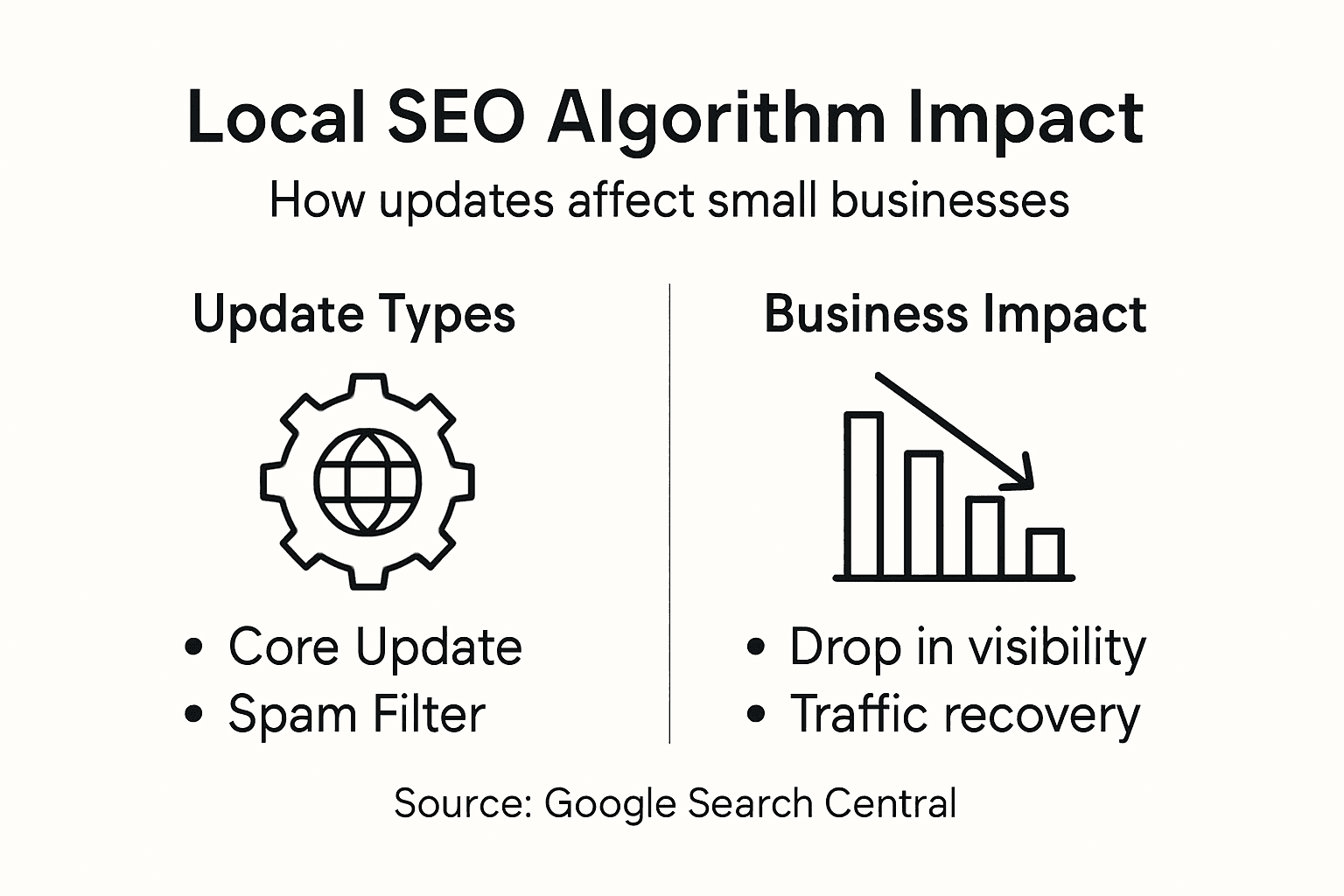
The core problem is that algorithm changes require SMEs to adapt digital strategies continuously, yet many lack the expertise or budget to do so effectively. A major algorithm update in 2024 shifted emphasis toward user experience signals like page speed and mobile responsiveness. Businesses that hadn’t optimised their websites for mobile suddenly lost rankings despite having strong content and backlinks. Another update prioritised websites with high topical authority, meaning a general home services company lost visibility to specialists who focused exclusively on plumbing or electrical work. Each update requires different responses. Optimising for one update might actually hurt your rankings in the next update if the priorities shift again. This creates a frustrating cycle where SME owners feel like they’re always chasing a moving target.
Resource constraints amplify the impact of algorithmic changes for SMEs. A large corporation can hire an SEO agency to analyse updates, adjust strategy, and implement changes across hundreds of pages. An SME owner juggling multiple responsibilities often can’t dedicate time to understanding algorithm changes, let alone implementing solutions. SMEs struggle with rapid technological ecosystem changes, making it difficult to maintain visibility after algorithmic shifts. A coffee shop owner in Cape Town can’t spend 40 hours rewriting website content or restructuring site architecture because Google changed what it values. They have a business to run. This knowledge and resource gap means SMEs are disproportionately affected by algorithm updates. Large companies can absorb ranking fluctuations because they have multiple traffic channels and marketing budgets. SMEs often depend entirely on organic search for customer acquisition, making algorithm volatility existential.
What many SME owners don’t realise is that some algorithm changes actually benefit small businesses. Recent updates have emphasised local relevance and business authenticity, which should favour genuine local businesses over massive corporations. A real family-run accounting firm in Johannesburg now has better ranking potential than a faceless national corporation if the local business properly optimises for local signals. Updates emphasising user experience reward businesses that invest in good website design and fast loading times, regardless of size. Updates prioritising helpful, original content favour businesses with genuine expertise and local knowledge. The challenge is distinguishing between updates that benefit you and updates that harm you, then strategically responding to each category.
Practical Responses To Algorithm Volatility
The most effective strategy for SMEs isn’t trying to predict algorithm changes (impossible) but building resilience. Focus on fundamentals that rarely change: authentic customer reviews, accurate business information, high-quality original content addressing real customer questions, and fast, mobile-friendly website performance. These factors have remained ranking signals across dozens of algorithm updates. Beyond fundamentals, diversify your customer acquisition channels so you’re not entirely dependent on organic search. Email marketing, social media, and referral programs create revenue streams that aren’t affected by Google algorithm changes. Monitor your rankings weekly to catch drops early, but don’t panic at every fluctuation. Some drops are temporary, and overreacting can waste resources on unnecessary changes. Finally, consider working with an SEO professional who understands local SEO and can advise on algorithm responses specific to your industry and location, rather than trying to handle everything alone.
Professional tip: Set up a simple monthly tracking system documenting your top 10 keyword rankings, then compare month-to-month changes to identify patterns aligned with Google’s announced updates, allowing you to distinguish between real algorithm impacts requiring strategy changes and normal ranking volatility requiring patience.
Avoiding Common Mistakes in Local SEO
Most local SEO failures aren’t caused by doing everything wrong. They’re caused by overlooking what seems like small details that cascade into ranking problems. A business owner might perfectly optimise their Google My Business profile but fail to claim their listings on local directories. Another might have consistent business information everywhere but neglect mobile optimisation. A third might have great content but ignore customer reviews. Each mistake alone wouldn’t destroy rankings, but combined they create a weak local presence that Google deprioritises. Understanding the most common mistakes and actively avoiding them is often more valuable than pursuing advanced tactics, because you’re not starting from a hole.
The foundational mistake is inconsistent or missing NAP data (name, address, phone number). This seems almost too basic to mention, yet it remains the most common local SEO error. Your business might be listed as “Smith’s Plumbing” on your website, “Smith Plumbing” on Google My Business, “Smiths Plumbing Services” on Facebook, and “Smith Plumbing Durban” on local directories. Google’s systems get confused by these variations and can’t reliably connect all these listings to your actual business. This inconsistency directly damages your local rankings because Google can’t aggregate all your citations and reviews into a unified business profile. Common local SEO mistakes like inconsistent NAP information significantly damage search visibility. Another foundational error is failing to claim and properly complete your Google My Business profile. Many businesses claim their listing but leave it incomplete. Missing business hours, outdated photos, blank service descriptions, or no website link all signal to Google that your business doesn’t take its online presence seriously. A complete, well-maintained Google My Business profile with regular posts and customer responses performs substantially better than a bare-minimum listing.
Another cluster of mistakes involves ignoring mobile optimisation and page speed. Most local searches happen on mobile devices, yet many South African business websites still aren’t mobile-friendly. A website that looks fine on desktop but displays broken on phones sends potential customers away before they even contact you. This user experience problem translates to ranking penalties because Google measures how visitors interact with your site. Similarly, slow page load times hurt rankings directly. If your website takes 4 seconds to load (common for South African businesses on slow hosting), you lose ranking points to competitors with 1-second load times. Slow page load times and poor website structure significantly impact local search rankings. Beyond technical issues, many businesses neglect local content. Creating location-specific content that addresses your local community’s needs is crucial. A plumber serving multiple suburbs should have service pages for each area, blog posts addressing local challenges, and content mentioning local landmarks or community events. A generic website saying “we serve the greater Johannesburg area” ranks lower than one with detailed pages for “plumbing in Sandton,” “plumbing in Midrand,” and “plumbing in Fourways.”
Finally, many businesses make the mistake of ignoring reviews entirely. They don’t actively encourage customers to leave feedback, don’t respond to negative reviews, and don’t track what’s being said about them online. This passive approach means your business gets fewer reviews than competitors, and when negative reviews do appear, you look unresponsive and uncaring. Other common mistakes include creating duplicate listings across platforms (confusing Google about which is your real profile), neglecting local backlinks (not pursuing links from local news sites, community organisations, or industry associations), and failing to optimise meta tags and page titles for local keywords. These elements individually seem minor, but they accumulate into a competitive disadvantage.
Mistakes Specific To Your South African Context
Some mistakes are particularly damaging for South African businesses. Many assume that national or international SEO strategies will work locally without adaptation. Your competitor in a nearby suburb might rank higher simply because they optimised specifically for “accountant in [specific suburb]” rather than “accountant in Johannesburg.” Another context-specific mistake is underestimating the importance of WhatsApp and local payment methods in local SEO. Google increasingly values businesses that are easily contactable and show local payment acceptance. A business making it difficult for customers to reach you via WhatsApp or showing no local payment options loses trust signals that affect rankings.
Professional tip: Conduct a NAP audit this week by searching your business name on Google, Google Maps, local directories, and review sites, creating a spreadsheet documenting every variation you find, then prioritise fixing inconsistencies on your top 5 platforms where you receive the most traffic and customer inquiries.
Overcome Your Local SEO Challenges with Expert Support
Local SEO challenges such as inconsistent business information, managing customer reviews, and staying ahead of evolving Google algorithms can leave your South African business struggling to gain the visibility it deserves. If you feel overwhelmed by the complex demands of maintaining a strong local presence that drives real traffic and leads, you are not alone. These issues require focused expertise to solve effectively with strategies that include NAP audits, review management, and technical website optimisation.
Take control of your local search rankings today by partnering with a trusted digital marketing agency that understands these unique challenges. At Local SEO Agency, we provide customised, ethical solutions including content creation, backlink building, and ongoing management of your Google My Business profile. Don’t let inconsistent listings or algorithm shifts hold you back. Start your journey to improved local visibility and increased conversions now by reaching out. Visit our contact page to schedule a consultation and build a resilient local SEO strategy tailored to your business needs.
Frequently Asked Questions
What are the main challenges of local SEO for small businesses?
The main challenges of local SEO for small businesses include ensuring consistent business information across various platforms, managing customer reviews, and dealing with ongoing competition in the local market.
How can I improve my local search visibility?
To improve local search visibility, ensure your business name, address, and phone number are consistent across all platforms, fully optimize your Google My Business profile, and actively seek and respond to customer reviews.
Why is managing customer reviews crucial for local SEO?
Managing customer reviews is crucial because positive reviews improve your business’s authority and rankings in local search results, while negative reviews can damage your reputation and visibility.
What role does technical performance play in local SEO?
Technical performance significantly affects local SEO as factors like page load speed and mobile responsiveness are critical for retaining users and improving rankings in search results.
Recommended
- Why You Need a Local SEO Optimization Service Today – LSA SEO Agency
- Improving Local Search Visibility for Small Businesses
- Maximize Your Visibility with a Local SEO Agency Today – LSA SEO Agency
- Local Listings Optimisation for Boosting SME Visibility
source https://localseoagency.co.za/local-seo-challenges-south-africa/



No comments:
Post a Comment