Finding real answers about how search engines actually work can feel confusing for many small business owners in South Africa. With platforms like Google Search dominating the internet, understanding the difference between web crawlers and ranking myths is key for those wanting to grow online. This guide highlights the way search engines operate and clears up common misconceptions, helping you make practical decisions that increase your website’s visibility.
Table of Contents
- Defining Search Engines And Common Myths
- Main Types Of Search Engines Explained
- The Crawling, Indexing, And Ranking Process
- Key Factors Influencing Search Result Visibility
- SEO Challenges And Mistakes Local Businesses Make
Key Takeaways
| Point | Details |
|---|---|
| Search Engine Functionality | Search engines operate through crawling, indexing, and ranking to provide relevant results based on user queries. Understanding these processes is crucial for optimising visibility. |
| Types of Search Engines | There are different types of search engines including crawler-based engines, human-powered directories, and specialised search engines. Each type requires tailored optimisation strategies. |
| Key Visibility Factors | Content quality, technical optimisation, keyword strategy, and user experience significantly influence search result visibility and should be prioritised in SEO efforts. |
| Common SEO Challenges | Local businesses often face challenges like technical limitations and content deficiencies. Developing a comprehensive SEO strategy is essential for overcoming these obstacles. |
Defining search engines and common myths
Search engines are sophisticated software systems that function as digital gatekeepers of online information, continuously exploring the vast landscape of the internet to deliver relevant results. These complex platforms operate by deploying web crawlers that systematically explore and index billions of webpages, creating an intricate map of digital content that can be quickly retrieved when users input specific queries.
The fundamental process of search engines involves three primary stages:
- Crawling: Web crawlers navigate through websites, discovering and analysing content
- Indexing: Collected information is organised and stored in massive databases
- Ranking: Algorithms determine the most relevant results based on multiple factors
Contrary to popular belief, search engines are not simply popularity contests or paid advertising platforms. Search engines spread complex information dynamics that involve sophisticated algorithmic processes considering numerous ranking signals. These signals include content quality, user engagement, website authority, and contextual relevance.
Common myths about search engines often misrepresent their fundamental operational principles. Many people incorrectly assume that search results are entirely objective or that being listed first guarantees credibility. In reality, search engine algorithms are continually evolving, designed to provide the most relevant and valuable information while combating misinformation and low-quality content.
Pro tip: Understand that search engine rankings are dynamic and require consistent effort to maintain visibility and relevance.
Main types of search engines explained
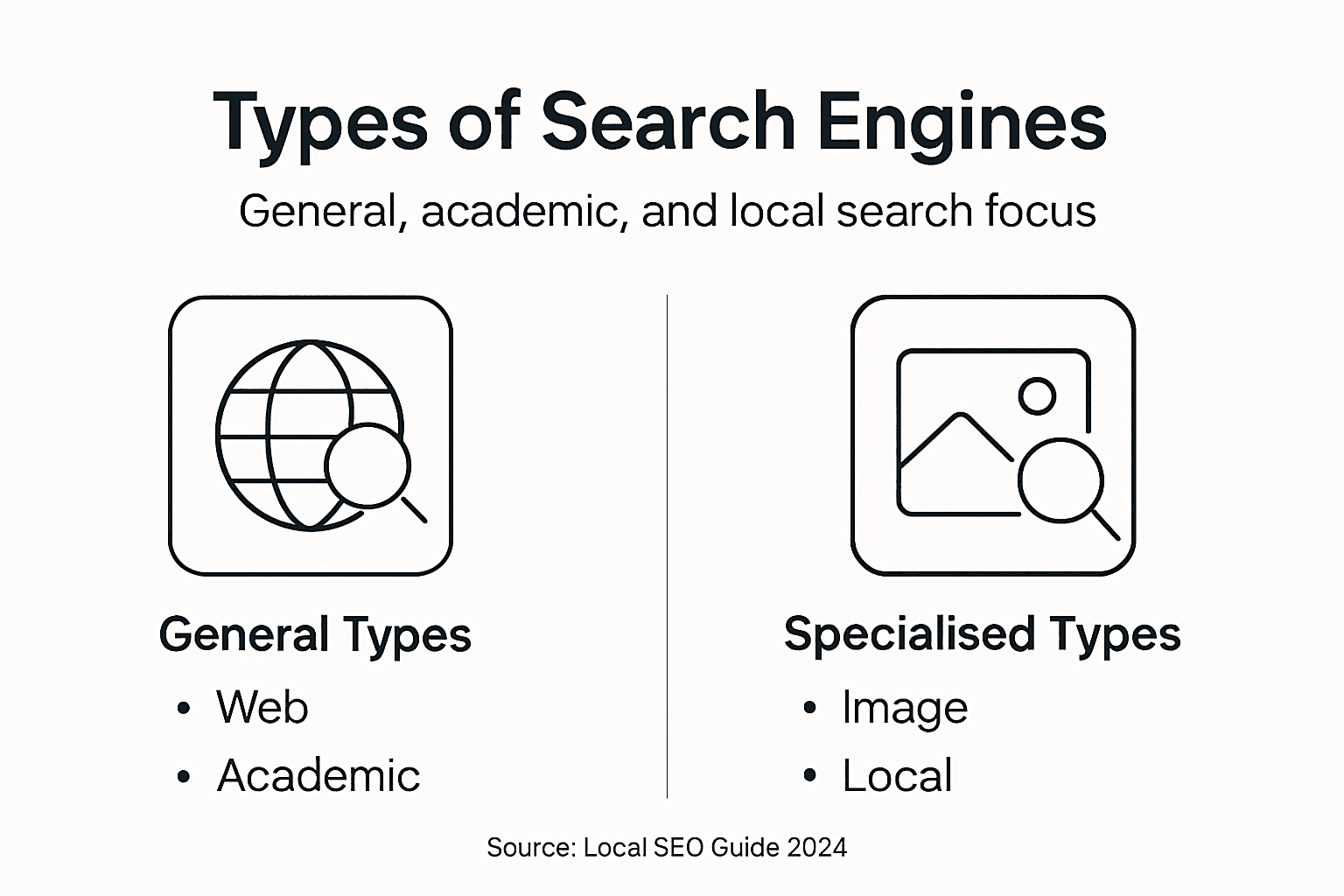
Search engines have evolved into sophisticated platforms with distinct operational approaches, primarily categorised into two fundamental types: crawler-based search engines and human-powered directories. Crawler-based search engines use automated bots to systematically explore and index web content, representing the most prevalent model in modern digital information retrieval.
The key characteristics of different search engine types include:
- Crawler-based Engines
- Utilise automated web crawlers
- Continuously update their database
- Examples: Google, Bing, Yahoo
- Human-powered Directories
- Rely on manual website submissions
- Curated by human editors
- Typically smaller in scope
- Specialised Search Engines
- Focused on specific content domains
- Targeted search capabilities
Beyond traditional web search, specialised search engines have emerged to serve niche information needs. Academic search engines, for instance, focus exclusively on scholarly content, providing researchers with targeted resources. These platforms offer unique features like citation tracking, peer-reviewed content filtering, and advanced academic research tools.
Here’s a quick comparison of search engine types and their suitability for different use cases:
| Search Engine Type | Best For | Key Limitation |
|---|---|---|
| Crawler-based Engines | General web searches | May miss emerging niche content |
| Human-powered Directories | Niche, curated sites | Limited scope, slow to update |
| Specialised Search Engines | Academic, vertical content | Lower coverage of general topics |
The complexity of search engine technologies continues to expand, with machine learning and artificial intelligence increasingly influencing how information is discovered, indexed, and presented to users. Local businesses and digital marketers must understand these nuanced mechanisms to effectively optimise their online visibility and search rankings.
Pro tip: Recognise that different search engine types require distinct optimisation strategies to improve your online discoverability.
The crawling, indexing, and ranking process
Search engines operate through a sophisticated three-stage process that transforms the vast digital landscape into organised, searchable information. Crawling involves systematic web exploration where automated bots, known as web crawlers, systematically navigate websites, discovering and analysing new and updated content across the internet.
The three critical stages of search engine functionality include:
- Crawling
- Web bots discover new web pages
- Follow hyperlinks between pages
- Detect content changes and updates
- Indexing
- Organize discovered content
- Store information in massive databases
- Create searchable content repositories
- Ranking
- Evaluate page relevance and quality
- Determine search result order
- Apply complex algorithmic assessments
Once web pages are indexed, search engines employ intricate ranking algorithms to determine the most relevant results for user queries. These algorithms consider numerous factors, including content quality, website authority, user engagement metrics, and contextual relevance. Local businesses must understand these mechanisms to optimise their online presence and improve search visibility.

Modern search technologies continuously evolve, integrating machine learning and artificial intelligence to refine their content discovery and presentation processes. This dynamic environment requires ongoing adaptation from digital marketers and website owners to maintain competitive search rankings.
Pro tip: Regularly update your website content and ensure technical optimisation to support effective crawling and indexing.
Key factors influencing search result visibility
Search result visibility is a complex interplay of strategic elements that determine how prominently websites appear in digital searches. Effective keyword optimisation significantly impacts search rankings, requiring businesses to develop nuanced approaches to content development and technical website management.
Critical factors influencing search result visibility include:
- Content Quality
- Original, valuable information
- Comprehensive topic coverage
- Regular content updates
- Technical Optimization
- Fast page loading speeds
- Mobile-friendly design
- Clean, structured HTML
- Keyword Strategy
- Relevant keyword integration
- Natural language usage
- Contextual keyword placement
- User Experience Signals
- Low bounce rates
- High engagement metrics
- Intuitive website navigation
Local businesses must understand that search engines evaluate multiple interconnected signals to determine content relevance. Sophisticated algorithms analyse website performance, user interaction patterns, and contextual information to rank search results. This means simply stuffing keywords or creating superficial content will not guarantee improved visibility.
The digital landscape continually evolves, with search engines becoming increasingly sophisticated in understanding user intent. Successful online visibility requires a holistic approach that combines technical excellence, high-quality content, and genuine user value.
Pro tip: Focus on creating comprehensive, user-centric content that naturally addresses audience needs and questions.
SEO challenges and mistakes local businesses make
Local businesses often struggle with digital visibility, facing numerous obstacles in their search engine optimization efforts. Digital transformation challenges impact small business online strategies, creating significant barriers to effective online presence.
Common SEO challenges and critical mistakes include:
- Technical Limitations
- Inadequate website infrastructure
- Poor mobile responsiveness
- Slow page loading speeds
- Content Deficiencies
- Lack of targeted keyword strategies
- Insufficient high-quality content
- Inconsistent content updates
- Resource Constraints
- Limited digital marketing knowledge
- Budget restrictions
- Minimal technical expertise
- Strategic Misconceptions
- Overreliance on social media
- Neglecting local search optimization
- Ignoring technical SEO fundamentals
Many South African small businesses mistakenly believe that having a basic online presence is sufficient. In reality, sophisticated search engine algorithms require comprehensive, strategic approaches to achieve meaningful digital visibility. Simply creating a website or social media page does not guarantee search ranking success.
Successful local SEO demands a holistic strategy that combines technical optimization, high-quality content creation, and continuous performance monitoring. Businesses must invest time in understanding search engine mechanisms and adapting their digital strategies accordingly.
To help local businesses improve SEO, consider this overview of common mistakes and suggested solutions:
| Common Mistake | Impact on Visibility | Recommended Solution |
|---|---|---|
| Slow website speed | Lower search rankings | Optimise images and hosting |
| Lack of mobile optimisation | Poor mobile user reach | Implement responsive design |
| Superficial content | Low user engagement | Develop in-depth, useful topics |
| Ignoring local search terms | Missed local customers | Target region-specific keywords |
Pro tip: Develop a systematic approach to SEO by prioritising technical website health, consistent content quality, and local search optimization.
Unlock Your Local Business Potential with Expert SEO Support
Understanding how search engines crawl, index and rank your website is critical for local businesses aiming to boost their online visibility. The challenges detailed in the article highlight common pitfalls such as technical limitations and ineffective keyword strategies that can hold back your search rankings. At Local SEO Agency we specialise in transforming these challenges into growth opportunities by offering tailored SEO solutions including technical optimisation, content creation and local search strategies designed specifically for South African SMEs.

Take control of your search engine presence today and stop missing out on valuable local customers. Our team combines in-depth knowledge of crawling and ranking processes with proven tactics to improve your website’s authority and user engagement. Visit Local SEO Agency now to request a consultation and start building a digital footprint that delivers real business results. Don’t wait for your competitors to outrank you – let us help you make your website the first choice for local searches.
Frequently Asked Questions
How do search engines rank websites?
Search engines rank websites using complex algorithms that evaluate factors such as content quality, user engagement, website authority, and contextual relevance to determine the order of search results.
What is the role of keywords in local SEO?
Keywords play a crucial role in local SEO as they help search engines understand the content and relevance of a page. Effective keyword strategies ensure that your website is discoverable when users search for specific local services or products.
How can local businesses improve their search visibility?
Local businesses can improve their search visibility by optimising their website for speed, creating high-quality content, using relevant keywords, and ensuring technical aspects like mobile-friendliness and structured HTML are in place.
What common SEO mistakes should local businesses avoid?
Local businesses should avoid common SEO mistakes like having slow website speeds, neglecting mobile optimisation, creating superficial content, and ignoring local search terms to ensure better search rankings and user engagement.
Recommended
- Why You Need a Local SEO Optimization Service Today – LSA SEO Agency
- Local SEO Optimization: A Game Changer for Small Businesses – LSA SEO Agency
- Local SEO Services That Drive Traffic to Your Door – LSA SEO Agency
- Why Local SEO Optimization Is a Game Changer for You – LSA SEO Agency
- Home Service Marketing Agency | ServiceLine – National Experts in Growth
- How To Get More Traffic To Your Website: 5 Effective Ways – Your Solo Business
source https://localseoagency.co.za/how-search-engines-work-sa/



No comments:
Post a Comment