TL;DR:
- PPC is affordable and effective for South African small businesses with modest budgets.
- Success depends on relevance, Quality Score, and mobile-friendly landing pages.
- Combining PPC and SEO creates a powerful strategy for sustained online growth.
Pay-per-click advertising is one of the most misunderstood tools available to South African small business owners. Many assume it is reserved for big brands with massive budgets, but that could not be further from the truth. PPC stands for Pay-Per-Click, a digital advertising model where you pay a fee each time someone clicks your ad. It is fast, targeted, and measurable in ways that traditional advertising simply cannot match. This guide breaks down exactly how PPC works, why it matters for South African SMBs, and how you can use it to generate real leads and grow your visibility online.
Table of Contents
- What is PPC advertising?
- How does PPC advertising work?
- Why use PPC advertising for your South African business?
- PPC advertising vs SEO: Which one should you choose?
- Why most businesses miss out on PPC’s full potential
- Next steps: Boost your online results with expert help
- Frequently asked questions
Key Takeaways
| Point | Details |
|---|---|
| PPC basics simplified | PPC lets you pay only when someone clicks your ad, giving you control and measurable results. |
| Auction system secrets | Winning with PPC is about more than high bids—ad quality and targeting make costs lower and results better. |
| South African SMB advantage | Smart PPC strategies—like geo-targeting and ad scheduling—can quickly grow your local business leads. |
| PPC vs SEO clarity | Combine PPC’s speed with SEO’s longevity to maximize your online impact over time. |
| Expert improvement tips | A/B testing and focusing on mobile experience help turn clicks into customers efficiently. |
What is PPC advertising?
PPC, which stands for Pay-Per-Click, is a digital advertising model where you only pay when someone actually clicks on your ad. You are not paying for impressions or airtime. You are paying for a real person who showed interest and took action. That distinction matters enormously when you are working with a limited budget.
PPC ads appear in several places across the internet. The most familiar is the top of Google search results, where ads appear above the organic listings. But PPC also covers display ads on websites, video ads on YouTube, and sponsored posts on social media platforms like Facebook, Instagram, and LinkedIn. Wherever your audience spends time online, there is likely a PPC channel for it.
Here are the main PPC platforms available to South African businesses:
- Google Ads — the largest search and display network globally
- Meta Ads (Facebook and Instagram) — ideal for visual products and local audiences
- LinkedIn Ads — best for B2B services and professional targeting
- YouTube Ads — effective for brand awareness and video-driven industries
- Microsoft Advertising — covers Bing and partner sites, often cheaper CPC
If you are still getting familiar with marketing terminology, PPC is one of the first concepts worth mastering because it underpins so much of modern digital advertising.
“PPC gives businesses direct control over who sees their ads, when, and at what cost. For fast lead generation, no other channel delivers results as immediately or as measurably.” — Digital Marketing Institute
The biggest myth is that PPC is only for large companies. In reality, a local plumber in Pretoria or a boutique accountant in Cape Town can run a profitable campaign on a modest budget. The system is built to reward relevance, not just spending power.
How does PPC advertising work?
Now that you know what PPC is, let’s see exactly how it works behind the scenes.
Every time someone types a search query into Google, an auction happens in milliseconds. Advertisers who have bid on that keyword compete for the available ad slots. But here is the part most people miss: the highest bidder does not always win. Google uses a metric called Quality Score, rated from 1 to 10, which measures how relevant your ad and landing page are to the search query. PPC operates via an auction system where bid amount, Quality Score, and other factors combine to determine your Ad Rank and final position.
Here is how the process unfolds step by step:
- You set a bid — the maximum amount you are willing to pay per click on a specific keyword.
- Google evaluates quality — your ad’s expected click-through rate, relevance to the search, and landing page experience are scored.
- Ad Rank is calculated — your bid multiplied by your Quality Score determines your position.
- You pay the minimum needed — the actual cost per click is often lower than your maximum bid.
This system means a well-crafted ad with a strong landing page can outrank a competitor spending twice as much. That is great news for South African SMBs who are strategic about their approach.

| Industry | Typical SA CPC range | Recommended monthly budget |
|---|---|---|
| Legal services | R50 to R200 per click | R5,000 to R15,000 |
| Insurance | R40 to R150 per click | R4,000 to R12,000 |
| Home services | R10 to R50 per click | R2,000 to R6,000 |
| Low-competition niches | R5 to R20 per click | R1,000 to R5,000 |
Pro Tip: Improving your Quality Score is the single most cost-effective move in PPC. Write ads that directly match what your audience is searching for, and make sure your landing page delivers exactly what the ad promises. A Quality Score jump from 4 to 8 can cut your cost per click in half.
Mobile optimization is non-negotiable. Most South Africans browse and search on mobile devices. If your landing page loads slowly or looks broken on a phone, your PPC spend is largely wasted. A fast, mobile-friendly page is not optional. It is the baseline.
Why use PPC advertising for your South African business?
Once you know the mechanics, it is time to understand why PPC is a smart move, especially in the SA market.
PPC delivers results fast. Unlike SEO, which can take months to show traction, a well-set-up PPC campaign can start generating leads within hours of going live. For a business that needs bookings, enquiries, or sales now, that speed is invaluable. SA cases show 17 to 50% conversion uplift and up to 45% lead growth when PPC campaigns are properly managed. Globally, SMBs average $2 in revenue for every $1 spent on PPC, with an average ROAS of 3.5:1.
Here are the specific benefits that make PPC especially powerful for South African SMBs:
- Geo-targeting — show your ads only to people in Johannesburg, Durban, or your specific suburb
- Ad scheduling — run ads only during business hours or peak buying times
- Negative keywords — exclude irrelevant searches so you stop paying for clicks that will never convert
- Budget control — set a daily cap so you never overspend, no matter what
- Audience targeting — reach people by age, income level, interests, or device type
PPC works across a wide range of South African industries. Plumbers, electricians, attorneys, insurance brokers, auto repair shops, tutors, and local consultants all see strong returns when campaigns are set up correctly. The key is matching your service to the right search intent.
Pro Tip: Always connect your PPC campaigns to Google Analytics 4 (GA4) and set up conversion tracking from day one. Without this, you are flying blind. You need to know which keywords and ads are actually generating leads, not just clicks. See how digital marketing examples from SA businesses illustrate this in practice.
For budget guidance, SA SMBs should start with R2,000 to R15,000 monthly depending on competition and geo-targeting. Pairing PPC with strong SA SEO tips gives you both short-term leads and long-term organic growth.
PPC advertising vs SEO: Which one should you choose?
With PPC’s value clear, many ask how it compares to SEO and whether a blend is best.
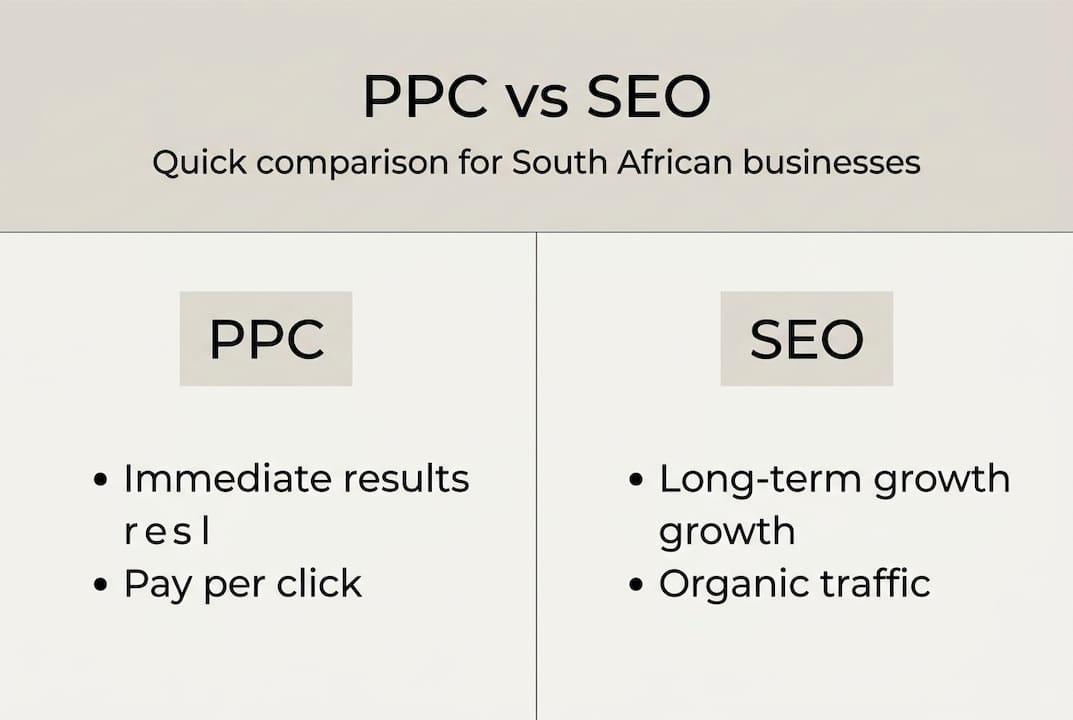
PPC delivers immediate results with precise control, but traffic stops the moment you pause your budget. SEO builds long-term, free organic traffic but takes time to gain momentum. Understanding when to use each is the real skill.
| Factor | PPC | SEO |
|---|---|---|
| Speed to results | Hours to days | Months |
| Cost structure | Ongoing per click | Time and content investment |
| Traffic longevity | Stops when budget stops | Continues after work is done |
| Scalability | Instant with budget increase | Gradual |
| Control | High, precise targeting | Lower, algorithm-dependent |
| Best for | Fast leads, product launches | Long-term brand authority |
Here is a practical breakdown of when each approach makes sense:
- Use PPC alone when you need leads immediately, are launching a new product, or testing a new market.
- Use SEO alone when you have time to build and your niche has lower competition.
- Use both together when you want to dominate search results and build sustainable growth.
The hybrid approach is where the real magic happens. You can use PPC data to discover which keywords convert best, then invest in SA SEO techniques to rank organically for those same terms. This creates a compounding effect where paid and organic traffic reinforce each other.
“Smart businesses use PPC to test what converts, then use SEO to own those keywords for free. Treating them as separate strategies leaves serious money on the table.” — Search Engine Journal
For a deeper breakdown of how these two channels stack up, the PPC vs SEO comparison guide covers the specifics for South African business owners in detail.
Why most businesses miss out on PPC’s full potential
Most South African SMBs approach PPC the same way: set a budget, pick some keywords, write a basic ad, and hope for the best. The results are predictably average. The conventional wisdom says spend more to get more. But that is not how the system actually rewards you.
The businesses that get outsized returns from PPC focus obsessively on tight ad groups, where each group targets a very specific theme, and they work relentlessly on Quality Score. A business spending R3,000 per month with a Quality Score of 9 will consistently outperform a competitor spending R10,000 with a score of 4. Budget is not the lever. Relevance is.
Mobile landing page speed is the silent killer of PPC ROI. If your page takes more than three seconds to load on a mobile connection, most users will leave before they ever see your offer. All that ad spend evaporates. Fixing page speed is often more impactful than any bid adjustment.
Ad waste is rampant among SMBs. Most do not use negative keywords, meaning their ads show up for searches that have nothing to do with their business. They also run ads 24 hours a day when their customers only convert during business hours. Scheduling and negative keyword lists are free tools that most businesses simply ignore.
The real opportunity lies in combining PPC feedback with an essential SEO strategy. Your best-performing PPC keywords become your SEO content priorities. Your SEO rankings reduce your dependence on paid traffic over time. That feedback loop is what separates businesses that grow from businesses that just spend.
Pro Tip: Treat your ad account like a scientific experiment. Run A/B tests on headlines, descriptions, and landing pages constantly. Small improvements compound into significant gains over weeks and months.
Next steps: Boost your online results with expert help
Ready to put PPC and SEO to work? Here is how we can support your growth.
Understanding PPC is one thing. Executing it profitably is another. At Local SEO Agency, we help South African SMBs build advertising and search strategies that generate real leads, not just traffic. Whether you are starting your first campaign or want to fix a costly one, our team knows the SA market inside out.
Explore our local SEO strategies to see how organic and paid search work together for maximum impact. Our local SEO services are built specifically for South African businesses that want measurable growth. If you are still weighing your options, our guide on understanding PPC vs SEO will help you make the right call for your budget and goals.
Frequently asked questions
How much should a small business in South Africa spend on PPC advertising?
Most SMBs start with R2,000 to R15,000 monthly, depending on industry competition, geo-targeting scope, and campaign goals. Starting conservatively and scaling based on results is the smartest approach.
What is the difference between CPC and CPM in digital advertising?
CPC means you pay per click on your ad, while CPM charges you per 1,000 impressions your ad receives. PPC campaigns typically use CPC billing, which ties your spend directly to user interest.
How fast can I see results from PPC advertising?
PPC provides immediate results and can generate leads within hours of launching a campaign, making it the fastest paid channel for driving targeted traffic compared to SEO’s longer timeline.
Is PPC advertising just for search engines?
PPC ads appear on SERPs, but also on social media platforms, display networks, video channels like YouTube, and partner sites, giving businesses multiple ways to reach their audience.
How can I measure PPC advertising success?
Key metrics include click-through rate, cost per conversion, and return on ad spend. Global benchmarks show an average CTR of 6.11%, conversion rate of 7.04%, and ROAS of 3.5:1 across industries.
Recommended
- Boost Your Business Visibility with Press Release Backlinks – LSA SEO Agency
- Local Listings Optimisation for Boosting SME Visibility
- Elevate Your Brand with Expert SEO Optimization Pretoria – LSA SEO Agency
- 7 Key Differences Between PPC vs SEO for SA Business Owners
- PPC Advertising Guide: AI Strategies & Local Lead Generation | Digital Marketing All
source https://localseoagency.co.za/what-is-ppc-advertising-boost-business-visibility/



No comments:
Post a Comment