TL;DR:
- Improving local SEO helps South African SMEs compete for visibility without large budgets.
- Regular audits of site speed, NAP consistency, and local keywords are essential for ranking improvements.
- Community engagement and regional content significantly boost local authority and search presence.
You built your business from the ground up, but when locals search for what you offer, your competitors show up and you don’t. It’s a frustrating reality for thousands of South African small business owners. The good news is that improving your Google ranking isn’t reserved for big brands with massive budgets. With the right local SEO strategy, you can compete and win in your area. Over 90% of South Africans access the web via mobile, which means local search is more powerful than ever. This guide gives you clear, SA-focused steps to move your business up the rankings and in front of the customers who matter most.
Table of Contents
- Assess your current SEO standing
- Research and select the right local keywords
- Optimize your website for local search
- Boost authority with local content and citations
- Track your progress and adjust for long-term success
- Our perspective: What most advice misses about SA SEO rankings
- Ready to rank higher? Get expert help
- Frequently asked questions
Key Takeaways
| Point | Details |
|---|---|
| Consistency is critical | Your business’s NAP must be identical across every directory and your website for local SEO success. |
| Local keywords win | Geo-specific, dialect-friendly keywords and voice-friendly phrases give SA SMEs an edge in search results. |
| Mobile experience matters | With over 90% mobile search share in South Africa, optimize speed and responsiveness first. |
| Quality beats quantity | A handful of high-quality backlinks and citations work better than dozens of low-quality ones for boosting rankings. |
| Track and adjust | Monitoring progress and tweaking regularly sets leaders apart from laggards in the SEO race. |
Assess your current SEO standing
Before you can improve anything, you need to know where you stand. Think of this as a health check for your online presence. A simple site audit doesn’t require expensive tools or a technical background. It just requires honesty about what’s working and what isn’t.
Start by checking your site speed using Google’s free PageSpeed Insights tool. A slow site kills rankings and drives visitors away. Next, test your mobile experience. Open your website on your phone and ask yourself: is it easy to read, navigate, and use? If not, Google notices that too.
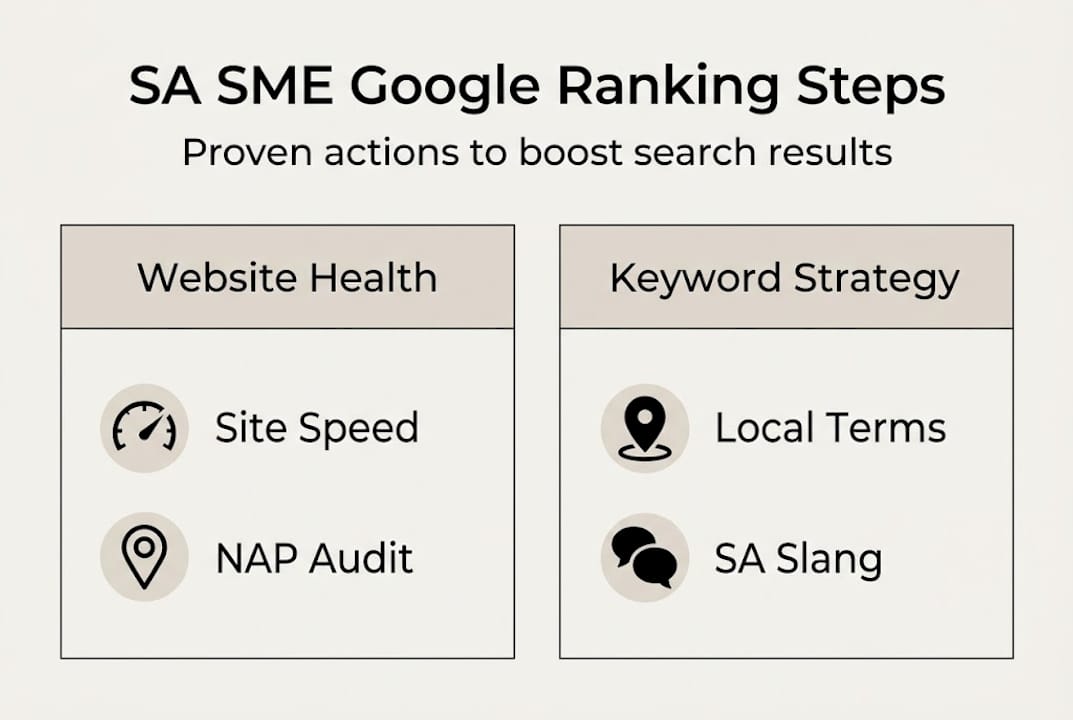
Then check your NAP consistency. NAP stands for Name, Address, and Phone number. NAP consistency across directories is one of the most overlooked but critical local ranking factors. If your business name is listed differently across platforms, Google gets confused and your rankings suffer.
Here are the key South African directories where your business should be listed:
- ShowMe SA
- HelloPeter
- Snupit
- Brabys
- Yellow Pages SA
- Google Business Profile
You can audit NAP across directories using tools like BrightLocal to catch inconsistencies before they cost you rankings. Also check for duplicate listings, which confuse both Google and potential customers.
Here’s a quick snapshot of what to audit and why it matters:
| Audit area | What to check | Why it matters |
|---|---|---|
| Site speed | Load time under 3 seconds | Affects bounce rate and rankings |
| Mobile usability | Responsive design | 90%+ SA users are on mobile |
| NAP consistency | Same details everywhere | Core local ranking signal |
| On-page basics | Title tags, meta descriptions | Tells Google what each page is about |
| Directory listings | Accurate and active | Builds local prominence |
For a deeper look at what a proper audit covers, the SEO audit essentials guide walks you through what SA SMEs often miss.
Google ranks local businesses based on three factors: relevance (does your business match the search?), distance (how close are you to the searcher?), and prominence (how well-known and trusted is your business online?). Your audit should flag gaps in all three areas.
Pro Tip: Set a recurring calendar reminder every 60 days to manually check your NAP details across your top five directory listings. It takes 15 minutes and prevents ranking drops caused by outdated information.
Research and select the right local keywords
Once your foundation is clear, ensure you’re targeting the right local search terms. Choosing the wrong keywords is like putting up a billboard in the wrong neighbourhood. You might have great content, but if it doesn’t match what your customers are actually typing into Google, it won’t reach them.
Local intent is what separates a keyword that drives foot traffic from one that attracts visitors from another country. A person searching “plumber” could be anywhere. A person searching “emergency plumber Soweto” is your customer.
Here’s a step-by-step process to find the right local keywords:
- Open Google Keyword Planner and set your location to South Africa or your specific city.
- Type in your core service or product and review the suggested terms.
- Filter for keywords with local modifiers like city names, suburbs, or neighbourhood names.
- Note the search volume and competition level for each term.
- Build a shortlist of 10 to 15 keywords that are specific enough to be winnable.
One thing most guides miss is the power of South African slang and regional language. Searching for “spaza shop Johannesburg” returns very different results than “convenience store Johannesburg.” If your customers use local terms, your content should too. The same applies to terms like “braai equipment Cape Town” versus “barbecue equipment Cape Town.” Speak your customer’s language.
Here’s how different keyword types compare for SA SMEs:
| Keyword type | Example | Search volume | Competition | Best use |
|—|—|—|—|
| Short-tail | “plumber” | Very high | Very high | Brand awareness only |
| Long-tail | “affordable plumber in Pretoria” | Medium | Low to medium | Service pages |
| Geo-specific | “burst pipe repair Sandton” | Low | Low | Location pages |
For more on building a keyword strategy that fits the SA market, explore these local SEO strategy tips and SA SEO techniques that go deeper into regional targeting.
Once you have your keywords, place them in your page titles, meta descriptions, H1 headings, and any location-specific pages you create. Don’t stuff them in unnaturally. One well-placed keyword in a title does more than five awkward mentions in a paragraph.

Pro Tip: Voice search is growing fast in South Africa, especially on mobile. Optimise for natural, conversational phrases like “where can I find a reliable electrician near me in Durban?” rather than just “electrician Durban.” Think how people talk, not just how they type.
Optimize your website for local search
With keywords selected, it’s time to fine-tune your site to send the right signals to Google and users. This is where technical improvements meet real-world results. A well-optimised site doesn’t just rank better. It converts more visitors into paying customers.
Follow these steps to get your site locally optimised:
- Make your site mobile-responsive. Use a responsive theme or template that automatically adjusts to any screen size. Test it with Google’s Mobile-Friendly Test tool.
- Fix your page speed. Compress images, reduce unnecessary plugins, and enable browser caching. Aim for a load time under three seconds.
- Add your NAP to the footer. Every page of your site should display your business name, address, and phone number in the footer. This reinforces your location signals.
- Embed a Google Map on your contact page. This is a simple but effective local SEO signal that many SA businesses skip.
- Add local schema markup. Schema is a small piece of code that tells Google exactly what your business is, where it’s located, and what it does. Use Google’s Structured Data Markup Helper to generate it without coding.
- Optimise for Core Web Vitals. These are Google’s performance benchmarks covering loading speed, interactivity, and visual stability.
“Over 90% of South Africans access the internet via mobile.”
This statistic should shape every decision you make about your website. If your site isn’t fast and mobile-friendly, you’re invisible to the majority of your potential customers. The mobile page indexing implications for SA businesses are significant, and getting this right gives you an edge over competitors who are still thinking desktop-first.
For voice search, add a FAQ section to your key pages. Write questions the way people actually ask them out loud. “What time does [your business] open in Johannesburg?” is more valuable than a keyword-stuffed paragraph.
For practical guidance on website design best practices tailored to the SA market, you’ll find detailed advice on structure, speed, and local relevance.
Pro Tip: Run your site through Google Search Console and check the Core Web Vitals report. It shows you exactly which pages are failing and gives you specific fixes. Most competitors aren’t doing this, so even small improvements can move you ahead.
Boost authority with local content and citations
With your site primed for search, leverage local content and reputable links to boost trust and rank. Google doesn’t just look at your website in isolation. It looks at how the wider web talks about your business. This is where local citations and content strategy come in.
A local citation is any mention of your business name, address, and phone number on another website. It doesn’t need to be a link. Just the mention tells Google your business is real, active, and locally relevant.
Here are the top South African directories and platforms where SA SMEs should build citations:
- Google Business Profile (most important)
- ShowMe SA
- Brabys
- Snupit
- Yellow Pages SA
- Hotfrog SA
- SA Yellow Web
- HelloPeter (especially valuable for reviews)
Beyond directories, locally relevant content that addresses SA culture, local events, and customer pain points builds your authority in ways generic blog posts never will. Write about local events you sponsor, community stories, or how your service solves a problem specific to your city or region.
Here’s a practical breakdown of citation sources, content ideas, and what you can expect:
| Source type | Example | Expected result |
|---|---|---|
| Directory listing | Brabys, Snupit | Improved local prominence |
| Local media mention | Community newspaper feature | High-authority backlink |
| Event sponsorship content | Blog post about local event | Topical relevance signal |
| Customer review response | HelloPeter replies | Trust and engagement signals |
Quality links beat quantity every time.
This is especially true in the SA context. One mention from a respected local media outlet or a well-known SA business blog carries more weight than 50 low-quality directory submissions. Local citations and quality backlinks from SA directories and media are among the strongest ranking signals you can build.
For a full approach to building authority, the SA SEO backlink strategies and link building strategies pages cover advanced tactics. You can also learn how SEO for bio pages can extend your reach across social platforms.
Encourage happy customers to leave Google reviews. Respond to every review, positive or negative. Ask local journalists or bloggers to mention your business when you host events or launch new services. These small actions compound over time.
Track your progress and adjust for long-term success
Once your strategy is in motion, smart tracking and quick adjustments will help you outpace your competition. SEO without measurement is just guesswork. You need to know what’s working, what isn’t, and where to focus your energy next.
Here are the core tools every SA SME should use:
- Google Search Console: Free, powerful, and shows you exactly which keywords drive clicks to your site.
- Google Analytics 4: Tracks visitor behaviour, traffic sources, and conversion actions.
- Google Business Profile Insights: Shows how many people found you via Maps, called you, or requested directions.
- BrightLocal: Paid but worth it for tracking local rankings and measuring local ranking progress over time.
Here’s a simple routine to keep your SEO on track:
- Weekly: Check Google Search Console for any manual actions, crawl errors, or sudden drops in impressions.
- Monthly: Review your top-ranking keywords. Are you moving up, holding steady, or slipping? Compare month-on-month traffic.
- Quarterly: Run a full audit. Check NAP consistency, review your backlink profile, update any outdated content, and assess your Core Web Vitals scores.
- When rankings drop: Immediately check for NAP inconsistencies, lost backlinks, or content that may have become outdated or irrelevant.
Key metrics to monitor include organic site visits, your presence in the Google Maps pack (the top three local results), local keyword rankings, and actual conversions like calls, form submissions, or store visits.
Avoid these common pitfalls that derail SA SME SEO efforts:
- Ignoring your Google Business Profile after the initial setup
- Publishing content without local keyword intent
- Letting directory listings go stale with old addresses or phone numbers
- Chasing rankings without tracking conversions
- Treating SEO as a once-off task rather than an ongoing process
For a structured approach to reporting, the SEO reporting essentials guide helps you build a simple dashboard that shows real business impact. And if you want a broader view of how to position your business for sustained growth, the SA SEO strategy framework is a strong next step.
Our perspective: What most advice misses about SA SEO rankings
Most SEO advice you’ll find online was written for US or UK markets. The tactics aren’t wrong, but they’re incomplete when applied to South Africa. The SA digital landscape has its own rhythms, and businesses that understand this have a real advantage.
Voice search is growing faster here than most guides acknowledge. Mobile-only communities in townships and peri-urban areas are searching in ways that don’t fit neatly into standard keyword research tools. Local languages, dialects, and culturally specific search behaviour are rising in influence. If your keyword strategy doesn’t account for this, you’re leaving a significant portion of your potential audience untouched.
Generic blog content won’t beat a competitor who writes about the specific challenges of running a business in Khayelitsha or servicing clients in the East Rand. Street-smart, regionally tailored content wins because it matches real search intent from real SA customers.
We also believe that community influence is an underused shortcut to authority. A mention from a respected local journalist, a community Facebook group, or a well-followed township influencer can do more for your local rankings than months of generic link building. These are signals Google increasingly values.
The digital marketing guide for South Africa goes deeper into how SA businesses can build strategies that reflect local realities rather than imported playbooks. Real growth comes from embracing what makes your market unique, not from copying tactics designed for a different context entirely.
Ready to rank higher? Get expert help
With the right plan, any SA business can improve rankings, but some journeys are faster with a proven partner.
DIY SEO is absolutely possible, and this guide gives you a strong starting point. But the SA digital landscape moves fast. Algorithm updates, shifting search behaviour, and increasing local competition mean that staying ahead requires consistent effort and expertise. Implementing everything correctly, measuring it accurately, and adjusting quickly is a full-time commitment.
That’s where professional guidance makes a real difference. Whether you need a full strategy or just want someone to handle the technical side, working with an experienced team accelerates your results and reduces costly mistakes. Explore the best SEO optimization service options available, review SEO packages for growth that fit SME budgets, or get in touch to discuss tailored local SEO services built specifically for South African businesses like yours.
Frequently asked questions
What is the fastest way to improve my Google ranking in South Africa?
NAP consistency across directories and mobile optimisation are your quickest wins. Fixing these two areas sends immediate trust signals to Google and can show results within weeks.
How important are local backlinks and citations for SA SME rankings?
Local citations and quality backlinks from SA directories and media are among the strongest ranking signals Google uses for local results. They’re not optional if you want to compete.
Do I need to use SA slang or dialects in my keywords?
Yes. Targeting regional dialects and slang in your keywords helps you attract more relevant South African search traffic that generic English terms simply won’t capture.
How long does it take to see ranking improvement?
Most SA SMEs notice meaningful changes within 2 to 3 months, though this depends heavily on your competition level, keyword selection, and the consistency of your content and link-building efforts.
What’s a common SEO mistake for SA businesses?
Ignoring mobile optimisation is the biggest mistake, given that over 90% of South Africans search via mobile. A site that isn’t mobile-friendly is effectively invisible to most of your potential customers.
Recommended
- Understanding search rankings: boost your South African SMB SEO
- Mastering South African SEO Techniques for Competitive Edge – LSA SEO Agency
- 7 SEO Best Practices Every South African SME Should Know
- Improving Local Search Visibility for Small Businesses
- How to rank on Google: expert strategies for Boca Raton businesses
source https://localseoagency.co.za/improve-google-rankings-proven-seo-steps-sa-smes/



No comments:
Post a Comment