TL;DR:
- SEO reporting helps South African SMEs measure search visibility and business growth effectively.
- Focus on core metrics like organic traffic, local visibility, and conversions for actionable insights.
- Regularly review and act on data to improve online presence and avoid vanity metrics.
Most South African small business owners have stared at an SEO report and felt nothing but confusion. Numbers, percentages, graphs pointing in every direction, and not a single clear answer to the question that matters most: is my website actually growing? That frustration is completely normal. SEO reporting is often presented as a technical exercise for specialists, when in reality it should be a straightforward business tool. This guide strips away the jargon and walks you through what SEO reporting actually means, which numbers deserve your attention, and how to turn those numbers into decisions that grow your business in the South African market.
Table of Contents
- Why SEO reporting matters for South African small businesses
- The core components of an effective SEO report
- Choosing the right metrics: What should SMEs in South Africa measure?
- Best practices: How to interpret, present, and act on SEO reports
- What most businesses get wrong with SEO reporting (and how to fix it)
- Take the next step: Make SEO reporting work for your business
- Frequently asked questions
Key Takeaways
| Point | Details |
|---|---|
| Focus on KPIs | Start by identifying a handful of clear business and SEO goals before preparing any report. |
| Prioritize local SEO | Metrics linked to your local market matter most for South African SMEs. |
| Use visual dashboards | Visual reporting tools make it easier to spot trends and share progress with your team. |
| Act on insights | The value in SEO reports comes from the actions and decisions you make as a result, not just from tracking. |
Why SEO reporting matters for South African small businesses
Running a small business in South Africa means every rand you spend on marketing needs to count. Whether you are a plumber in Pretoria, a boutique in Cape Town, or an accounting firm in Durban, your customers are searching for you online before they ever pick up the phone. SEO reporting is the process of measuring whether your website is showing up for those searches, and whether the people who find you are actually taking action.
Without reporting, you are essentially driving with no dashboard. You might be moving, but you have no idea how fast, in which direction, or whether the engine is about to give out. SEO reporting drives visibility and links your marketing efforts directly to real business outcomes. That connection between activity and result is what makes reporting so valuable for SMEs with limited budgets.
For South African businesses specifically, the local market context changes what you should be measuring. A national retailer might care about broad keyword rankings across the country. But if you serve a specific neighbourhood or city, you need to know whether people in your area are finding you. That means tracking local search visibility, Google Maps appearances, and mobile search performance, because most South Africans browse on their phones.
Here is what effective SEO reporting helps you understand:
- Which pages on your website attract the most visitors from search engines
- Which keywords are bringing people to your site and which ones are slipping
- How many visitors are converting into leads, calls, or purchases
- Whether your local listings are showing up in map results for nearby searches
- Where your competitors might be outranking you and why
Think of your SEO report as a monthly health check for your online presence. Just as a doctor tracks blood pressure and cholesterol over time to spot problems early, your SEO report tracks the vital signs of your website. Trends matter more than single readings.
“What gets measured gets managed.” This old business principle applies directly to SEO. If you are not tracking your search performance, you cannot improve it intentionally.
The SEO reporting essentials that matter most are the ones tied to real business goals, not abstract digital metrics. When you connect your reporting to outcomes like phone calls, form submissions, and foot traffic, the data becomes genuinely useful. And when you start using local SEO insights to understand your community search presence, you gain a competitive edge that larger national brands often overlook.
Reporting also reveals where your marketing budget is working hardest. If one blog post is driving 40% of your organic traffic, that tells you something important about what your audience wants. If a page you spent money creating gets zero visits from search, that is equally valuable information.
The core components of an effective SEO report
Not all SEO reports are created equal. Some are 40-page documents full of charts that nobody reads. Others are a single screenshot of Google Analytics sent in an email. Neither extreme is useful. A good SEO report is structured, focused, and built around decisions you can actually make.
An SEO report should include an overview, performance data, activities completed, trends over time, and clear action plans. That structure gives you context, shows you what changed, explains why, and tells you what to do next.
Here is how those components break down in practice:
- Executive summary: A short paragraph or bullet list that answers the key question: did performance improve or decline this period, and what is the most important thing to know?
- KPIs (key performance indicators): The specific numbers you agreed to track, like organic traffic, keyword rankings, or conversion rate. These should be set before the reporting period begins.
- Traffic and ranking data: How many people visited your site from search engines, which keywords drove them, and where your pages rank for target terms.
- Activities completed: What SEO work was done during the period, such as new content published, technical fixes applied, or backlinks earned.
- Recommendations: What should happen next based on what the data shows.
The tools that feed this data are Google Analytics 4 (GA4) for website traffic behaviour, Google Search Console (GSC) for keyword and ranking data, and rank tracking tools for monitoring keyword positions over time. You can explore SA SEO tools that work well in the local market to find the right combination for your budget.

Simple vs. advanced reporting frameworks
| Framework | Best for | Tools needed | Time investment |
|---|---|---|---|
| Basic | New to SEO, limited budget | GA4, GSC (free) | 1-2 hours/month |
| Intermediate | Growing businesses | GA4, GSC, rank tracker | 3-4 hours/month |
| Advanced | Scaling businesses | Full suite with automation | 6+ hours/month |
If you are just starting out with SEO basics for businesses, the simple framework is more than enough. The goal is consistency, not complexity.
Pro Tip: When you first start reporting, pick three to five core metrics and track only those for the first three months. Adding too many metrics too soon leads to analysis paralysis, where you spend more time reading data than acting on it.
Choosing the right metrics: What should SMEs in South Africa measure?
This is where many business owners go wrong. They either track everything and drown in data, or they track nothing meaningful and miss the signals that matter. The right approach is somewhere in the middle, and it depends on your business model and goals.
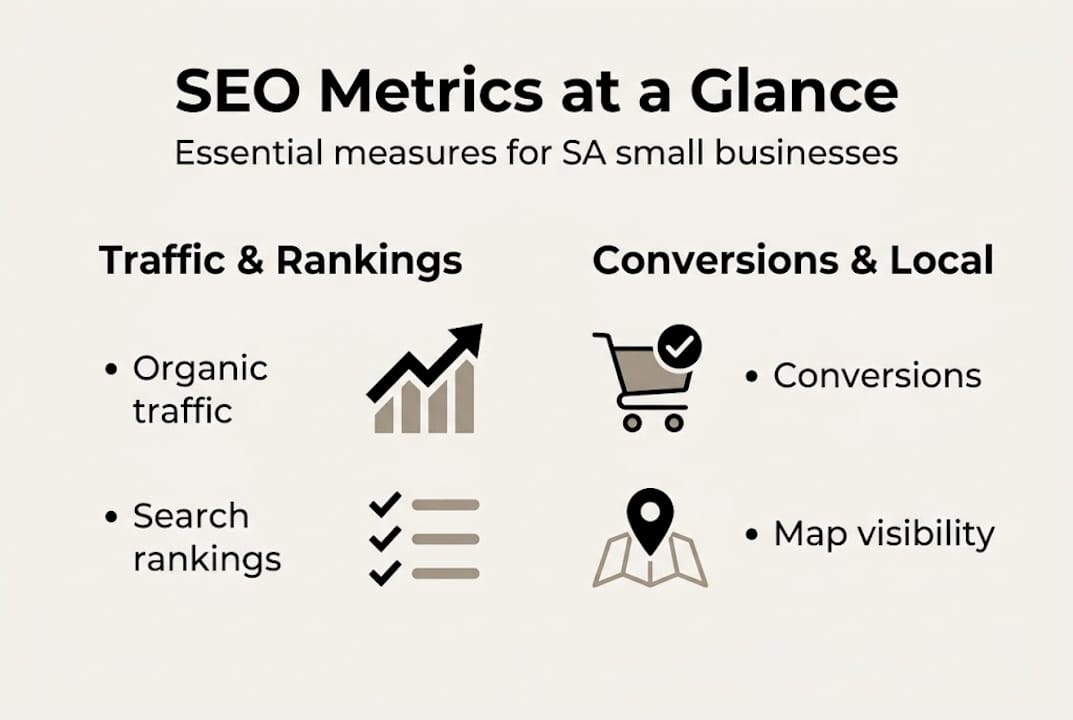
Experts recommend starting with traffic, rankings, and conversions as your foundation, before adding more complex frameworks. For most South African SMEs, these three form the core of a useful reporting setup.
The metrics that matter most for SA SMEs
| Metric | What it tells you | Where to find it |
|---|---|---|
| Organic traffic | How many people find you via search | GA4 |
| Keyword rankings | Where you appear for target searches | GSC, rank tracker |
| Conversion rate | What % of visitors take action | GA4 |
| Local pack visibility | Whether you appear in map results | GSC, Google Business Profile |
| Page speed | How fast your site loads | Google PageSpeed Insights |
| Mobile usability | Whether your site works on phones | GSC |
For neighbourhood businesses, local SEO for SA businesses data is arguably more important than national rankings. Appearing in the Google Maps local pack for searches like “electrician near me” or “best coffee shop in Sandton” can drive more customers than ranking on page one for a broad national keyword.
Here are the metrics South African SMEs should prioritise:
- Organic sessions: The raw count of visits from search engines each month
- Top landing pages: Which pages people arrive on first from search
- Click-through rate (CTR): How often people click your result when it appears in search
- Average position: Where your pages typically rank for their target keywords
- Goal completions: Phone calls, form fills, bookings, or purchases tracked in GA4
- Local search impressions: How often your business appears in map and local searches
Technical signals also deserve a place in your reporting, even if they feel less exciting. Page speed, mobile readiness, and schema markup (structured data that helps Google understand your content) all affect whether your site ranks well. Understanding search rankings means looking at both content performance and technical health together.
For SA SMBs, local SEO consistently outperforms chasing global or national rankings in terms of actual business impact. A plumber ranking first in their suburb will get more calls than one ranking fifth nationally.
Best practices: How to interpret, present, and act on SEO reports
Data without action is just noise. The real value of an SEO report comes from what you do with it. Many business owners receive monthly reports, glance at the graphs, and file them away without making a single change. That cycle produces no growth.
Evaluating trends, creating action plans, and using dashboards for automation are the habits that separate businesses that grow from those that stagnate. Here is how to build those habits practically.
Step-by-step process for acting on your SEO report
- Compare this period to the last: Is organic traffic up or down? Are rankings improving or slipping? Context is everything.
- Identify the biggest mover: What changed the most, positively or negatively? That is where your attention should go first.
- Ask why before you act: A traffic drop might be a technical issue, a Google algorithm update, or a seasonal pattern. Diagnose before you prescribe.
- Set one or two priorities for the next period: Do not try to fix everything at once. Focus on the change most likely to move the needle.
- Document your decisions: Write down what you decided to do and why. This creates a learning record that improves your strategy over time.
Visual dashboards make this process much faster. Tools like Google Looker Studio (free) let you pull GA4 and GSC data into a single visual report that updates automatically. Instead of exporting spreadsheets every month, you open a dashboard and see the story at a glance.
Here are the habits that make reporting genuinely useful:
- Review your report on the same day each month to build consistency
- Share the report with anyone involved in your marketing or website updates
- Compare year-over-year data during seasonal periods to avoid false alarms
- Flag pages that are declining in traffic for content refreshes
- Celebrate wins, even small ones, to keep your team motivated
For a broader view of how reporting fits into growth, your SEO strategy for SA growth should treat reporting as the feedback loop that guides every other decision.
Pro Tip: Create a one-page action plan after every report review. List the top three things to fix or improve before the next review. Share it with your web developer or marketing contact so nothing falls through the cracks.
What most businesses get wrong with SEO reporting (and how to fix it)
After working with South African SMEs across industries, the same reporting mistakes appear again and again. The most common one is obsessing over vanity metrics. Page views and social shares feel good to look at, but they rarely connect to revenue. A business can have 10,000 monthly visitors and zero customers if those visitors are not the right people or the site does not convert.
The second mistake is treating SEO reporting as a passive activity. Receiving a report is not the same as using it. Real improvement requires reading the data, asking hard questions, and making changes based on what you find. Reports that sit unread in inboxes are a waste of everyone’s time.
There is also a tendency to chase credentials and complexity over practical local knowledge. Avoid E-E-A-T pitfalls by not focusing on credentials alone. What Google actually rewards in 2026 is genuine experience, real helpfulness, and local relevance. A business that consistently publishes useful content for its specific community will outperform a competitor with impressive-sounding credentials but generic content.
Technical signals like Interaction to Next Paint (INP), which measures how responsive your site feels to users, schema markup, and mobile performance are often ignored in basic reports. But these factors directly affect your rankings and user experience. Including them in your reporting keeps you ahead of businesses that only track traffic and keywords.
The fix is straightforward: connect every metric in your report to a business question. If you cannot answer “so what?” for a given number, remove it from your report. Focus on SA-specific SEO techniques that reflect how your local customers actually search, and build your reporting around those signals. Adapt quickly when the data shows a shift. That agility is what separates growing businesses from stagnant ones.
Take the next step: Make SEO reporting work for your business
Understanding SEO reporting is one thing. Setting it up correctly, interpreting it consistently, and turning it into a growth engine for your business is another challenge entirely. That is where having the right partner makes a real difference.
At Local SEO Agency, we work specifically with South African SMEs to build reporting systems that are clear, actionable, and tied to your actual business goals. Whether you need help setting up your first dashboard or want a full monthly reporting service, we have options that fit your budget and growth stage. Explore our best SEO optimization service to see how we approach results-driven SEO, check out our local SEO services for community-focused visibility, or browse our affordable SEO service options if you are working with a tight budget. Let us turn your data into growth.
Frequently asked questions
What are the most important SEO metrics for South African SMEs?
Focus on organic traffic, search rankings, conversions, and local map visibility for the best results. For SA SMBs, local SEO consistently delivers more business impact than chasing broad national rankings.
Are free SEO reporting tools enough?
Yes, starting with GA4 and GSC is sufficient for most SMBs to track the basics and spot trends. Free tools like GA4 cover the essentials well, while paid tools add precision for more advanced users.
How often should I review my SEO report?
Monthly reviews help you track progress and catch issues early, while quarterly sessions are better for guiding bigger strategy shifts. Regular trend evaluation and recurring action plans are what make reporting genuinely useful over time.
What common mistakes should I avoid in SEO reporting?
Avoid tracking too many insignificant metrics and make sure you actually act on the trends your report reveals. Most SEO failures stem from chasing vanity metrics or failing to adapt when the data shows a clear performance shift.
Recommended
- SEO reporting essentials for measurable SMB growth
- Understanding search rankings: boost your South African SMB SEO
- Track SEO progress for small businesses in SA 2026
- Essential South African SEO Tools Every Business Needs – LSA SEO Agency
- Digital Marketing Strategy Guide: Small Business Growth
source https://localseoagency.co.za/seo-reporting-basics-guide-south-african-small-businesses/



No comments:
Post a Comment