You invest time and money into SEO, but how do you know which leads actually come from those efforts? Many South African business owners struggle to connect their SEO work with real customer inquiries. Without accurate tracking, you’re essentially flying blind, unable to prove ROI or optimize your strategy. This guide walks you through practical methods and tools to track SEO leads effectively, so you can measure what matters and make informed decisions about your marketing spend.
Table of Contents
- Key takeaways
- Why tracking leads from SEO is essential for your business
- Effective tools and methods to track SEO leads
- Common pitfalls and how to avoid errors in SEO lead tracking
- How to analyze and use your SEO lead tracking data for business growth
- Explore professional SEO support to enhance your lead tracking
- Frequently asked questions
Key Takeaways
| Point | Details |
|---|---|
| Lead ROI tracking | Accurate SEO lead tracking reveals which channels drive conversions and justifies marketing spend. |
| Core tools | Use Google Analytics to track conversions and implement call tracking to attribute phone leads to SEO sources. |
| Tracking methods | Employ UTM parameters, phone number attribution, and CRM integration to capture precise attribution across touchpoints. |
| Data driven optimization | Regularly analyze lead data to compare SEO with other channels and refine strategies based on evidence. |
Why tracking leads from SEO is essential for your business
Without knowing where your leads originate, you’re guessing about which marketing channels deserve more investment. South African SMEs face unique challenges because customer journeys often span multiple touchpoints before conversion. Someone might discover your business through organic search, call after seeing a social post, then convert weeks later. If you can’t track these paths, you’ll misallocate budget to channels that look effective but aren’t driving results.
Accurate lead tracking enables informed marketing investment decisions, especially when budgets are tight. When you know SEO generates 40% of your qualified leads, you can confidently invest more in content creation and technical optimization. Without this data, you might cut SEO spending based on gut feeling, losing a profitable channel.
Tracking also reveals which SEO tactics work best for your specific business. You might discover that local service pages convert at triple the rate of blog posts, or that mobile searchers convert faster than desktop users. These insights let you refine your approach continuously rather than following generic best practices that may not suit your market.
Consider these critical benefits of proper SEO lead tracking:
- Identify high-value keywords that attract ready-to-buy customers
- Measure conversion rates at each stage of the customer journey
- Compare SEO performance against paid advertising and other channels
- Justify marketing budgets with concrete revenue attribution data
- Spot technical issues that prevent lead capture before they cost you sales
Pro Tip: Set up tracking before launching new SEO campaigns. Retrofitting tracking systems is messy and often results in data gaps that make analysis unreliable.
“The difference between guessing and knowing where your leads come from is the difference between wasting money and growing profitably.” — Digital marketing strategist
Many business owners assume tracking is too technical or expensive. The reality is that basic tracking requires minimal investment and can be implemented in an afternoon. The cost of not tracking is far higher when you consider wasted spend on ineffective tactics and missed opportunities to scale what works.
Effective tools and methods to track SEO leads
Google Analytics remains the foundation for tracking website leads from SEO. Set up goals to track form submissions, quote requests, and other conversion actions. Configure source/medium reports to isolate organic search traffic and see which pages drive the most leads. The platform is free and integrates with most website builders, making it accessible for businesses of all sizes.

UTM parameters add precision to your tracking by tagging URLs with campaign details. When you share content or build links as part of SEO outreach, append UTM tags to track which specific efforts generate traffic and leads. For example, a guest post link might use utm_source=guestpost&utm_medium=referral&utm_campaign=industrysite to show exactly which publication drove results. This granular data helps you focus on high-performing tactics.
Phone calls represent a significant lead source for service businesses, yet many owners fail to track them properly. Call tracking software attributes phone leads to SEO sources by assigning unique numbers to different marketing channels. When someone finds you through organic search and calls, the system logs that lead as SEO-generated. Dynamic number insertion takes this further by showing different numbers to visitors from different sources, enabling precise attribution.
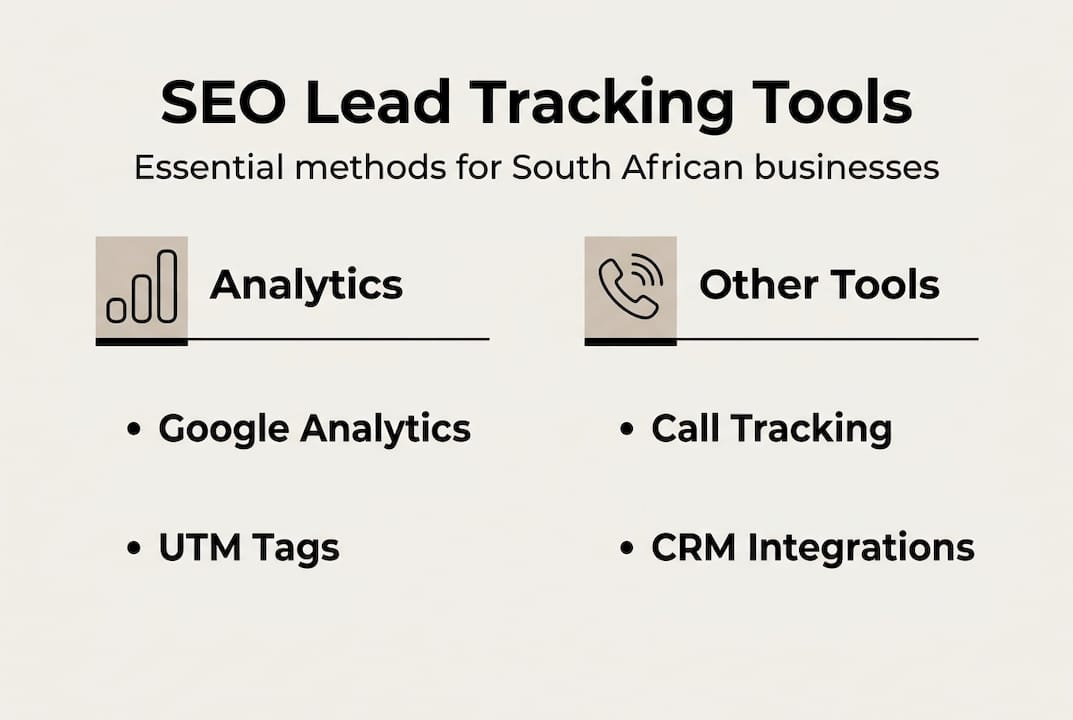
CRM integration completes the tracking picture by following leads from initial contact through to sale. When you connect your analytics and call tracking to a CRM like HubSpot or Zoho, you can see which SEO leads convert to paying customers and calculate actual revenue per channel. This closed-loop tracking proves SEO value in financial terms that stakeholders understand.
Here’s a comparison of popular tracking tools for South African SMEs:
| Tool | Primary function | Cost range | Best for |
|---|---|---|---|
| Google Analytics | Website behavior and conversion tracking | Free | All businesses tracking web leads |
| CallRail | Phone call tracking and recording | R500-R2000/month | Service businesses with phone inquiries |
| HubSpot CRM | Lead management and attribution | Free-R4000/month | Growing businesses needing full funnel visibility |
| SEMrush | Keyword tracking and competitive analysis | R2000-R8000/month | Agencies and data-driven marketers |
Implement these tracking methods systematically:
- Install Google Analytics and configure goals for all lead capture points
- Create UTM templates for consistent campaign tagging across all SEO efforts
- Set up call tracking with dedicated numbers for organic search traffic
- Connect all tracking tools to your CRM for unified lead data
- Test each tracking element monthly to catch configuration errors early
Pro Tip: Create a tracking documentation sheet that lists all your UTM conventions, goal configurations, and phone numbers. This prevents confusion when multiple team members manage marketing and ensures consistent data collection.
Many businesses use specialized SEO tools to enhance tracking capabilities. Platforms like Ahrefs and Moz track keyword rankings alongside traffic data, helping you correlate ranking improvements with lead volume increases. When you see a keyword jump from position 8 to position 3 and leads double the following month, you have clear cause and effect.
Common pitfalls and how to avoid errors in SEO lead tracking
Mixing up traffic sources in reports creates misleading conclusions about what drives results. This happens when you don’t properly tag campaigns or when analytics filters are misconfigured. Always verify that organic search traffic is separated from direct, referral, and paid traffic in your reports. A single miscategorized campaign can skew your entire understanding of channel performance.
Incorrect UTM tagging represents the most frequent technical mistake. If you tag some links but not others, or use inconsistent naming conventions, your campaign data becomes fragmented and unreliable. Establish clear UTM standards from the start. Use lowercase, avoid spaces, and stick to simple descriptive names like “blog-outreach” rather than changing between “Blog_Outreach”, “blog outreach”, and “blogoutreach” across different campaigns.
Misconfigured tracking leads to misleading results that can derail your entire marketing strategy. For instance, if your call tracking number isn’t properly linked to organic search traffic, you might conclude that SEO doesn’t generate phone leads when it actually drives most of them. Test every tracking element after setup and monthly thereafter.
Common tracking errors to watch for:
- Analytics not installed on all website pages, creating blind spots
- Goals triggered multiple times per session, inflating conversion numbers
- Call tracking numbers not rotating properly between traffic sources
- CRM fields not mapped correctly, losing source attribution data
- Cross-domain tracking not configured for multi-site businesses
Regular audits catch problems before they corrupt your data. Schedule quarterly reviews where you test form submissions, make test calls, and verify that data flows correctly from analytics through to your CRM. Check that conversion numbers match across platforms. If Google Analytics shows 50 form submissions but your CRM only received 30, you have a tracking gap to investigate.
Pro Tip: Create a test lead monthly by filling out your own forms and calling your tracking numbers from different devices. Follow this test lead through your entire system to confirm data accuracy and identify breaks in the tracking chain.
“Clean data is the foundation of smart marketing decisions. One hour spent auditing your tracking setup saves countless hours of analyzing bad data and making wrong choices.” — Analytics consultant
Avoid the temptation to overcomplicate tracking with too many custom dimensions or excessive segmentation. Start with core metrics like lead volume, source, and conversion rate. Add complexity only when you have specific questions that basic tracking can’t answer. Overly complex setups are harder to maintain and more prone to configuration errors.
How to analyze and use your SEO lead tracking data for business growth
Raw data means nothing without analysis that reveals patterns and opportunities. Start by establishing baseline metrics for your current SEO performance. How many leads does organic search generate monthly? What’s the conversion rate from visitor to lead? Which pages and keywords drive the most valuable traffic? These baselines let you measure improvement over time and spot anomalies quickly.
Follow this process to extract actionable insights from your tracking data:
- Export monthly lead data showing source, landing page, and conversion outcome
- Calculate conversion rates for different traffic segments and content types
- Identify your top 10 lead-generating pages and analyze what makes them effective
- Compare lead quality across sources by tracking which leads become customers
- Map keyword rankings to lead volume to find optimization opportunities
- Create monthly reports showing trends and highlighting areas needing attention
Key metrics tell different parts of your SEO lead story:
| Metric | What it reveals | How to use it |
|---|---|---|
| Organic traffic volume | Overall SEO visibility and reach | Track growth trends and seasonal patterns |
| Lead conversion rate | How effectively your site turns visitors into leads | Identify pages needing better calls to action |
| Cost per lead | SEO efficiency compared to paid channels | Justify SEO investment to stakeholders |
| Lead to customer rate | Quality of SEO traffic | Refine targeting to attract better-fit prospects |
| Time to conversion | How long the SEO sales cycle takes | Set realistic expectations and follow-up timing |
Data-driven decisions from SEO lead tracking improve marketing ROI by showing exactly where to focus efforts. When you discover that service pages convert at 8% while blog posts convert at 2%, you know to prioritize creating more service-focused content. If mobile traffic converts poorly despite high volume, you have a clear mobile optimization project to tackle.
Use tracking insights to refine your keyword strategy. If you rank well for high-volume keywords that generate traffic but few leads, shift focus to more specific, intent-driven terms. A plumber might find that “emergency plumber Johannesburg” converts far better than “plumbing tips”, even with lower search volume. This intelligence lets you target keywords that drive business, not just traffic.
Communicate results to stakeholders in terms they care about. Business owners want to know revenue impact, not just ranking positions. Show how SEO leads convert to customers and calculate the revenue attributed to organic search. When you demonstrate that SEO generated R150,000 in new business last quarter at a fraction of the cost of paid ads, you’ll have no trouble securing continued investment.
Regularly review which content formats and topics generate the most leads. You might discover that comparison guides outperform how-to articles, or that video content drives higher engagement and conversion. Double down on what works and test variations to improve results continuously. SEO is not set-and-forget; it’s an ongoing optimization process informed by solid tracking data.
Explore professional SEO support to enhance your lead tracking
Implementing robust lead tracking takes expertise and ongoing management that many business owners lack time for. Professional SEO agencies build comprehensive tracking systems that capture every lead source accurately and integrate seamlessly with your existing tools. You get reliable data without the learning curve or technical headaches.
Outsourcing to specialists ensures your tracking setup follows best practices and adapts as platforms evolve. When Google Analytics updates or call tracking APIs change, your agency handles the technical adjustments. You focus on running your business while experts ensure your data stays accurate and actionable.
Tailored SEO packages suit various SMB sizes and industries across South Africa. Whether you need basic tracking setup or advanced attribution modeling, professional services scale to your needs and budget. Many agencies offer local SEO solutions that include tracking as part of comprehensive optimization programs, delivering both visibility improvements and the data to prove results.
Frequently asked questions
How can I track phone calls generated by my SEO efforts?
Use call tracking software that assigns unique phone numbers to your website and marketing channels. Dynamic number insertion shows different numbers to visitors from organic search versus other sources, automatically attributing calls to SEO. Most platforms also record calls and integrate with your CRM for complete lead tracking.
What are UTM parameters and how do they help in tracking SEO leads?
UTM parameters are tags you add to URLs that tell analytics tools where traffic comes from. They track source, medium, campaign name, and other details that help you see which specific SEO efforts drive results. When someone clicks a link with UTM tags and converts, you know exactly which content or outreach activity generated that lead.
Can I track SEO leads without a CRM system?
Yes, basic tracking works with Google Analytics and call tracking alone. You can see which pages generate form submissions and which traffic sources drive phone calls. However, CRM systems help you manage leads efficiently and track them through to final sale, giving you complete ROI visibility. As your business grows, CRM integration becomes increasingly valuable.
How often should I review my SEO lead tracking data?
Review key metrics weekly to spot sudden changes or issues requiring immediate attention. Conduct deeper monthly analysis to identify trends and optimization opportunities. Quarterly audits should verify tracking accuracy and ensure all systems are properly configured. Regular review keeps you informed and lets you adjust strategy based on current performance.
What’s the difference between tracking SEO leads and tracking overall website traffic?
Website traffic measures all visitors regardless of whether they take action, while lead tracking focuses specifically on people who express interest by filling forms, calling, or requesting quotes. Lead tracking reveals conversion effectiveness and business impact, not just visibility. You need both metrics, but lead data directly connects SEO to revenue and justifies marketing investment.
Recommended
- Track SEO progress for small businesses in SA 2026
- Mastering South African SEO Techniques for Competitive Edge – LSA SEO Agency
- Effective South African SEO Tips for Competitive Edge – LSA SEO Agency
- South African SEO Keywords That Will Drive Traffic to You – LSA SEO Agency
source https://localseoagency.co.za/track-seo-leads-effectively-south-african-business/



No comments:
Post a Comment