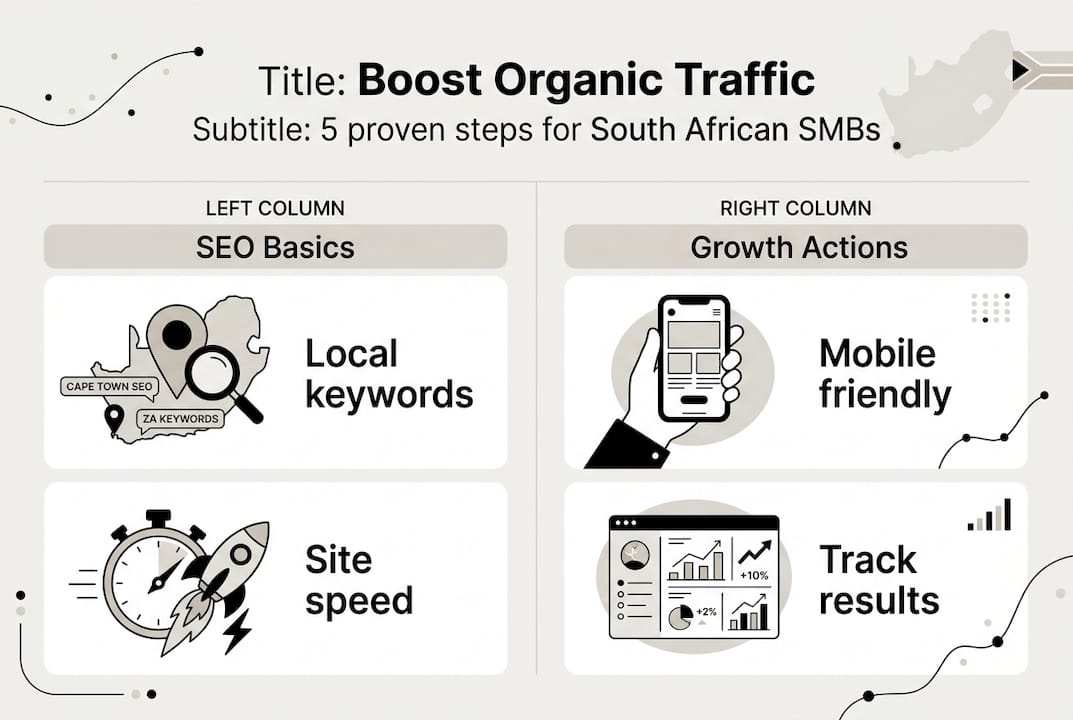
You built the website. You paid for the design. You even wrote some content. But the visitors? They’re just not showing up. This is one of the most common frustrations for South African small and medium business owners, and it’s not because SEO doesn’t work. It’s because most businesses skip the local fundamentals that actually move the needle. This guide walks you through five practical steps to grow your organic traffic, from keyword research to measuring results, using strategies built specifically for the South African market.
Table of Contents
- Why organic traffic matters for South African SMBs
- Essentials you need before boosting traffic
- Step 1: Nail local keyword research
- Step 2: Create authentic, locally relevant content
- Step 3: Prioritize mobile experience and page speed
- Step 4: Build and manage your local signals
- Step 5: Measure, learn, and refine for ongoing growth
- Take your SEO further with expert help
- Frequently asked questions
Key Takeaways
| Point | Details |
|---|---|
| Think local first | Focusing on niche, suburb-level keywords makes it easier for South African SMBs to rank and reach target customers. |
| Keep business info consistent | Exact business details everywhere online build strong local SEO signals and avoid ranking drops. |
| Mobile and speed are critical | Sites must be fast and mobile-friendly since most SA searches happen on smartphones. |
| Content should reflect your area | Successful South African SEO highlights local stories, locations, and user needs. |
| Ongoing tracking drives results | Regularly monitoring and updating your strategy leads to continual growth in organic traffic. |
Why organic traffic matters for South African SMBs
Organic traffic means visitors who land on your website through unpaid search results. No ad spend. No boosted posts. Just your website showing up when someone searches for what you offer. That’s powerful, especially when you consider that over 90% of consumers search online before making a purchase in South Africa.
South African buyers are increasingly digital-first. Whether they’re in Johannesburg, Cape Town, or a smaller town like Polokwane, they open Google before they open their wallets. Organic traffic captures these buyers at exactly the right moment, when they’re already looking for a solution.
The real advantage for SMBs is cost. Unlike paid advertising, organic traffic compounds over time. A well-optimized page can bring in leads for months or even years without additional spend. That’s a return on investment that paid ads simply can’t match.
Here’s why organic search is worth prioritizing:
- It builds long-term brand authority in your local market
- It attracts buyers with high purchase intent
- It reduces your dependence on paid advertising budgets
- It levels the playing field against larger competitors
“The businesses winning in local search aren’t always the biggest. They’re the ones who show up consistently for the right searches.”
Exploring SEO services in South Africa gives you a clearer picture of what a structured approach looks like. With an understanding of the opportunity, let’s map out what you need before ramping up your organic growth efforts.
Essentials you need before boosting traffic
Before you start chasing rankings, make sure your foundation is solid. Driving traffic to a slow, broken, or confusing website is like filling a leaking bucket. Fix the basics first.
Here’s a quick comparison of what a ready versus unready website looks like:
| Element | Ready | Not ready |
|---|---|---|
| Google Business Profile | Verified and complete | Missing or unclaimed |
| Mobile experience | Fast, thumb-friendly | Slow or desktop-only |
| NAP consistency | Identical across all platforms | Different on each directory |
| SSL certificate | Active (https://) | Missing (http://) |
| Calls-to-action | Clear and visible | Absent or confusing |
Inconsistent NAP (Name, Address, Phone) across platforms is one of the top reasons local rankings drop. Google cross-references your business information across dozens of sources. If your phone number on Facebook differs from your website, that confusion hurts your credibility in Google’s eyes.
Your checklist before going further:
- Claim and verify your Google Business Profile
- Ensure your website loads in under 3 seconds on mobile
- Match your NAP exactly on your website, Google, Facebook, and every directory
- Add an SSL certificate if you haven’t already
Pro Tip: Use Google’s free PageSpeed Insights tool to check your site speed right now. A score below 50 on mobile means you’re likely losing visitors before they even read your content.
For a deeper look at optimizing your website for local search, and a full mobile SEO guide tailored to South African businesses, both are worth bookmarking. With the basics in place, you’re ready to start increasing organic traffic through focused strategies.
Step 1: Nail local keyword research
Keyword research is where most SMBs either win or waste their time. The goal isn’t to rank for the most searched term. It’s to rank for the terms your ideal local customer is actually typing.
Here’s a simple process to find the right keywords:
- Open Google and type your service plus your city (e.g., “electrician Durban”)
- Scroll to the bottom and study the “People also search for” suggestions
- Use a free tool like Ubersuggest to check monthly search volume and competition
- Filter for long-tail phrases with local intent (e.g., “emergency electrician Durban North”)
- Build a shortlist of 10 to 20 phrases you can realistically target
Here’s why specificity wins:
| Keyword | Competition | Relevance for SMB |
|---|---|---|
| Plumber South Africa | Very high | Low |
| Plumber Johannesburg | High | Medium |
| Plumber Centurion | Medium | High |
| Emergency plumber Centurion | Low | Very high |
As the data shows, local long-tail terms consistently outperform broad national keywords for SMBs because the competition is lower and the intent is stronger. Someone searching “emergency plumber Centurion” is ready to call. Someone searching “plumber South Africa” is just browsing.
For South African SEO keywords, also consider regional language variants. Including isiZulu, Afrikaans, or Sotho terms where relevant can unlock search traffic your competitors are completely ignoring. A solid keyword research for South Africa strategy accounts for these nuances.
Pro Tip: Study your competitors’ Google Business Profiles. The categories and services they list often reveal keyword gaps you can target with SA SEO techniques that go beyond the obvious.
Focusing on location-specific, long-tail terms with manageable competition is the single most effective keyword strategy for South African SMBs. With targeted keywords ready, it’s time to create content that connects with local searchers.
Step 2: Create authentic, locally relevant content
Content is how you turn keywords into traffic. But generic content won’t cut it. South African searchers respond to content that speaks their language, references their context, and solves their specific problems.
Here’s how to structure your content for maximum local impact:
- Build a pillar page around your main service (e.g., “Plumbing services in Centurion”)
- Create supporting pages for each suburb or area you serve
- Add a community or local resources page that references nearby landmarks or events
- Include real customer testimonials with the suburb or city mentioned
- Use photos and short videos of your actual work, team, or location
Suburb-specific landing pages are one of the most underused tactics in South African SEO. A page titled “Plumber in Midrand” that mentions local streets, common plumbing issues in that area, and real client reviews will consistently outrank a generic services page.
Content ideas that work well for South African SMBs:
- “How load shedding affects [your service] in [city]”
- “Top 5 questions [suburb] homeowners ask about [service]”
- “Why [local event or challenge] makes [your service] more important this year”
- Before-and-after case studies with location details
“Content that references real local experiences builds trust faster than any generic service description ever will.”
Visuals matter too. Google rewards pages with images and videos because users engage with them longer. Use website optimization strategies to ensure your media files are compressed and don’t slow your pages down. Now that your content is relevant and local, let’s make sure it’s fast and friendly for South Africa’s predominantly mobile audience.
Step 3: Prioritize mobile experience and page speed
South Africa has one of the highest mobile internet usage rates on the continent. Most of your potential customers are searching on a smartphone, often on a mobile data connection. If your site loads slowly or looks broken on mobile, they’re gone in seconds.

Over 90% of South African consumers search online before purchasing, and the majority do it on mobile. That makes mobile performance a direct revenue issue, not just a technical one.
Here’s what to fix first:
- Compress all images to under 100KB where possible
- Remove unnecessary plugins or scripts that slow load time
- Use a caching plugin or CDN to speed up repeat visits
- Make buttons and links large enough to tap easily with a thumb
- Ensure text is readable without zooming in
Pro Tip: Avoid pop-ups or interstitials on mobile pages. Google penalizes sites that use intrusive overlays on mobile, and they frustrate users enough to leave immediately.
For a full breakdown of mobile SEO optimisation in South Africa, and a guide to website speed optimization that covers technical fixes step by step, both resources will save you hours of trial and error. With the technical basics ready and optimized, let’s secure and maintain your new search rankings.
Step 4: Build and manage your local signals
Google uses dozens of signals to decide which local businesses to show in search results. The strongest signals come from your Google Business Profile, your online reviews, and the consistency of your business information across the web.
Here’s how to build strong local signals:
- Complete every section of your Google Business Profile, including hours, photos, and services
- Ask satisfied customers to leave a Google review and respond to every review you receive
- List your business on South African directories like Brabys, Yellow Pages SA, and Hotfrog
- Make sure your NAP is identical on every platform, including punctuation and abbreviations
- Post regular updates to your Google Business Profile to show activity
Inconsistent business information across platforms is the number one silent killer of local rankings. Even a small difference like “St” versus “Street” in your address can create conflicting signals that confuse Google.
Key local directories for South African businesses:
- Google Business Profile (primary)
- Yelp South Africa
- Brabys
- Yellow Pages SA
- Hotfrog SA
- Your industry-specific association directories
“Your Google Business Profile is your most powerful local SEO asset. Treat it like a second website.”
Once your local signals are consistent, evaluating your progress and adjusting is the next crucial step.
Step 5: Measure, learn, and refine for ongoing growth
SEO without measurement is guesswork. You need to know what’s working, what’s not, and where to focus next. The good news is that the best tools are free.
Here’s a simple monthly review process:
- Open Google Search Console and check which queries are bringing impressions and clicks
- Review Google Analytics to see which pages drive the most organic sessions
- Identify your top three performing pages and create more content like them
- Find pages with high impressions but low clicks and improve their title tags and meta descriptions
- Track your Google Business Profile insights for calls, direction requests, and profile views
| Metric | What it tells you | Action if low |
|---|---|---|
| Organic sessions | Overall traffic health | Create more targeted content |
| Click-through rate | Title and description appeal | Rewrite meta tags |
| Average position | Ranking strength | Build backlinks or improve content |
| Bounce rate | Page relevance | Improve content match to search intent |
Focusing on location-specific, long-tail terms in your reporting helps you spot which areas and services are gaining traction fastest. Double down on those.
Pro Tip: Review your reports monthly, not quarterly or annually. SEO moves fast enough that a monthly check-in lets you catch problems early and capitalize on what’s working before competitors do.
With all five steps working together, you’ll soon see steady growth from organic traffic.
Take your SEO further with expert help
Implementing these five steps consistently takes time, skill, and ongoing attention. Many South African business owners see strong early results but hit a ceiling when the technical complexity increases or competition stiffens.
If you’re ready to accelerate your growth beyond what DIY strategies can deliver, working with specialists who understand the South African market makes a measurable difference. Our professional local SEO services are built specifically for SMBs competing in local search, covering everything from keyword strategy to technical fixes and content creation. Explore our SEO optimization service to see how we’ve helped businesses like yours climb the rankings and convert more visitors into paying customers.
Frequently asked questions
What makes South African SEO different from international SEO?
Local SEO for South Africa relies heavily on regional keywords, township and suburb-level targeting, and a mobile-first approach because over 90% of SA consumers search online before purchasing, mostly on mobile devices.
How long does it take to see organic traffic increases?
Most businesses notice measurable improvements within 2 to 3 months of consistent effort, but sustainable, compounding growth typically takes 6 to 12 months of ongoing optimization.
Do I need to create separate pages for different towns or suburbs?
Yes. Suburb-specific landing pages are highly effective because they match the exact search intent of local users and face far less competition than broad service pages.
What’s the biggest mistake South African SMBs make with SEO?
The biggest mistake is inconsistent NAP information across platforms. Even minor differences in your business name, address, or phone number across directories can significantly hurt your local rankings.
Is it still worth investing in SEO with strong competition?
Absolutely. By focusing on niche local long-tail keywords, smaller businesses consistently outperform larger national competitors in local search results where specificity beats budget.
Recommended
- South African SEO Keywords That Will Drive Traffic to You – LSA SEO Agency
- Effective South African SEO Tips for Competitive Edge – LSA SEO Agency
- Mastering South African SEO Techniques for Competitive Edge – LSA SEO Agency
- Discover the Power of South African SEO Backlinks Now – LSA SEO Agency
- Boost Your SEO with These Content Optimisation Tips | Kickass Online
source https://localseoagency.co.za/increase-organic-traffic-south-african-businesses/



No comments:
Post a Comment