You might assume digital marketing is too expensive or complex for your small business, but 59% of eThekwini SMEs acquired new customers via online channels last year. The reality is that effective digital marketing is within reach for South African SMEs when you understand the right strategies and frameworks. This guide walks you through the 7 Cs methodology, emerging 2026 trends like AI personalization and short-form video, and practical solutions to overcome budget and infrastructure challenges. You’ll discover how to structure campaigns that drive measurable growth and compete confidently in your local market.
Table of Contents
- Current Digital Marketing Landscape For South African SMEs
- The 7 Cs Framework: Structuring Effective SME Digital Marketing Campaigns
- Overcoming Challenges: Budget, Skills, And Infrastructure Constraints
- Emerging Digital Marketing Trends For South African SMEs In 2026
- How Local SEO Agency Can Help Your SME Thrive In Digital Marketing
- Frequently Asked Questions
Key takeaways
| Point | Details |
|---|---|
| Digital marketing drives customer growth | Most South African SMEs are already acquiring customers online, proving accessibility and effectiveness |
| 7 Cs framework structures campaigns | Customer, Content, Context, Community, Convenience, Cohesion, and Conversion guide strategic planning |
| Budget constraints are manageable | Low-cost tools, hyper-local SEO, and smart channel selection maximize ROI without overspending |
| 2026 trends reshape engagement | AI personalization, short-form video, and micro-influencers offer cost-effective reach for SMEs |
| Metrics matter more than spend | Focus on CAC, LTV, and conversion rates to measure success and optimize efforts |
Current digital marketing landscape for South African SMEs
The digital marketing adoption curve among South African SMEs reveals both promising progress and significant untapped potential. While 90% are active on social media, fewer than 5% leverage Google Ads despite its proven conversion power. This gap highlights a common pattern: SMEs gravitate toward free platforms but hesitate to invest in paid channels that could accelerate growth.
Social media dominance makes sense given zero entry costs and familiar interfaces. However, relying solely on organic reach limits your ability to target specific customer segments or track precise ROI. The businesses seeing strongest results combine social engagement with strategic paid campaigns and search optimization. Understanding what is digital marketing in the South African context means recognizing these platform dynamics and customer behaviors unique to our market.
Current adoption patterns reveal several key characteristics:
- Social platforms serve as primary customer touchpoints but lack integration with email marketing or retargeting
- Most SMEs track vanity metrics like followers rather than conversion-focused KPIs
- Mobile optimization remains inconsistent despite mobile-first browsing habits
- Local SEO is underutilized even though customers search for nearby services daily
The opportunity lies in strategic diversification. You don’t need to master every platform immediately, but understanding where your specific customers spend time online allows focused investment. A Durban-based retailer might prioritize Instagram and Google My Business, while a B2B consultancy could focus on LinkedIn and targeted search ads. The landscape rewards those who move beyond social-only approaches to build cohesive multi-channel strategies.
The 7 Cs framework: structuring effective SME digital marketing campaigns
The 7 Cs framework transforms scattered marketing efforts into coherent campaigns by addressing seven critical elements. Each C represents a strategic decision point that shapes campaign effectiveness and ROI. Understanding digital marketing terminology helps you apply this framework with precision.
Customer forms your foundation. South African markets span diverse demographics, languages, and purchasing behaviors. Define your ideal customer segments with specificity: age ranges, locations, pain points, and online behaviors. A Cape Town coffee shop targets different segments than a Johannesburg accounting firm, requiring distinct messaging and channel strategies.
Content must resonate with cultural context and customer needs. Create materials that address specific problems your audience faces, whether educational blog posts, product demonstrations, or customer testimonials. Quality trumps quantity; one well-researched guide delivers more value than ten generic posts.
Context determines timing and platform selection. Posting during commute hours captures mobile users, while B2B content performs better during business hours. Match content formats to platform norms: short videos for TikTok, detailed articles for LinkedIn, visual stories for Instagram.
Community building differentiates SMEs from larger competitors. Engage authentically with customers, respond to comments promptly, and foster conversations around shared interests. Local communities value personal connections, giving you an advantage over impersonal corporate brands.
Convenience removes friction from the customer journey. Ensure your website loads quickly, contact forms are simple, and calls to action are clear. Every additional click or confusing step loses potential customers.
Cohesion maintains consistent messaging across all touchpoints. Your brand voice, visual identity, and value propositions should align whether customers find you through search, social media, or referrals. Inconsistency erodes trust and confuses prospects.
Conversion focuses efforts on measurable actions. Define what success looks like for each campaign: newsletter signups, quote requests, purchases, or phone calls. Track these metrics religiously and optimize based on data rather than assumptions.
| Framework element | Primary focus | SME application |
|---|---|---|
| Customer | Audience definition | Segment by location, needs, and behaviors |
| Content | Value delivery | Create problem-solving materials |
| Context | Timing and placement | Match platform to customer habits |
| Community | Relationship building | Engage locally and authentically |
| Convenience | Journey simplification | Reduce friction in conversion paths |
| Cohesion | Brand consistency | Align messaging across channels |
| Conversion | Measurable outcomes | Track and optimize key actions |
Pro Tip: Prioritize Community and Convenience when competing against larger brands with bigger budgets. Your ability to build genuine local relationships and provide personalized service creates competitive advantages that money can’t buy. Respond to every customer interaction within hours, not days, and make doing business with you effortless.
Overcoming challenges: budget, skills, and infrastructure constraints
South African SMEs face distinct challenges that require creative solutions rather than increased spending. Limited skills, finances, and infrastructure issues like load shedding demand strategic approaches that maximize impact within constraints.

Budget limitations force prioritization, which often improves results by eliminating wasteful spending. Start with one or two high-ROI channels rather than spreading resources thin across every platform. A R2,000 monthly Google Ads budget targeting specific local keywords often outperforms R10,000 spent randomly across multiple channels. Free tools like Google Analytics, Canva, and Mailchimp provide professional capabilities without subscription costs.
Skills gaps close faster than you might expect with focused learning. Numerous free resources teach digital marketing fundamentals, from Google’s Digital Garage to HubSpot Academy. Invest two hours weekly in structured learning rather than random YouTube browsing. Consider these sequential steps:
- Identify your biggest knowledge gap through honest assessment of current capabilities
- Choose one specific skill to develop over the next month, such as Google Ads or email marketing
- Complete a structured free course from reputable providers rather than piecing together random tutorials
- Apply new knowledge immediately to a small test campaign, learning through doing
- Measure results objectively and adjust based on data before scaling efforts
- Share knowledge with team members or local business networks to reinforce learning
Infrastructure challenges like load shedding require planning rather than panic. Schedule social media posts in advance using free tools like Buffer or Later, ensuring consistent presence even during power outages. Create content offline during stable periods, then upload in batches. Mobile hotspots provide backup connectivity for urgent tasks.
Hyper-local SEO offers outsized returns for SMEs competing in specific geographic areas. Implementing local SEO strategies like optimizing Google Business Profile, gathering customer reviews, and creating location-specific content helps you dominate local search results. A Pretoria plumber doesn’t need to outrank national competitors, just other Pretoria plumbers.
Pro Tip: Form informal partnerships with complementary local businesses to share marketing knowledge and resources. A bakery and coffee shop might cross-promote, splitting advertising costs while doubling reach. These cooperative approaches build community relationships while stretching limited budgets further than solo efforts.
Emerging digital marketing trends for South African SMEs in 2026
The digital marketing landscape evolves rapidly, with several trends offering particular advantages for resource-conscious SMEs. AI-powered personalization improves customer engagement by up to 30%, making it a priority investment even for smaller businesses. Basic AI tools now automate email personalization, chatbot responses, and content recommendations without requiring technical expertise.
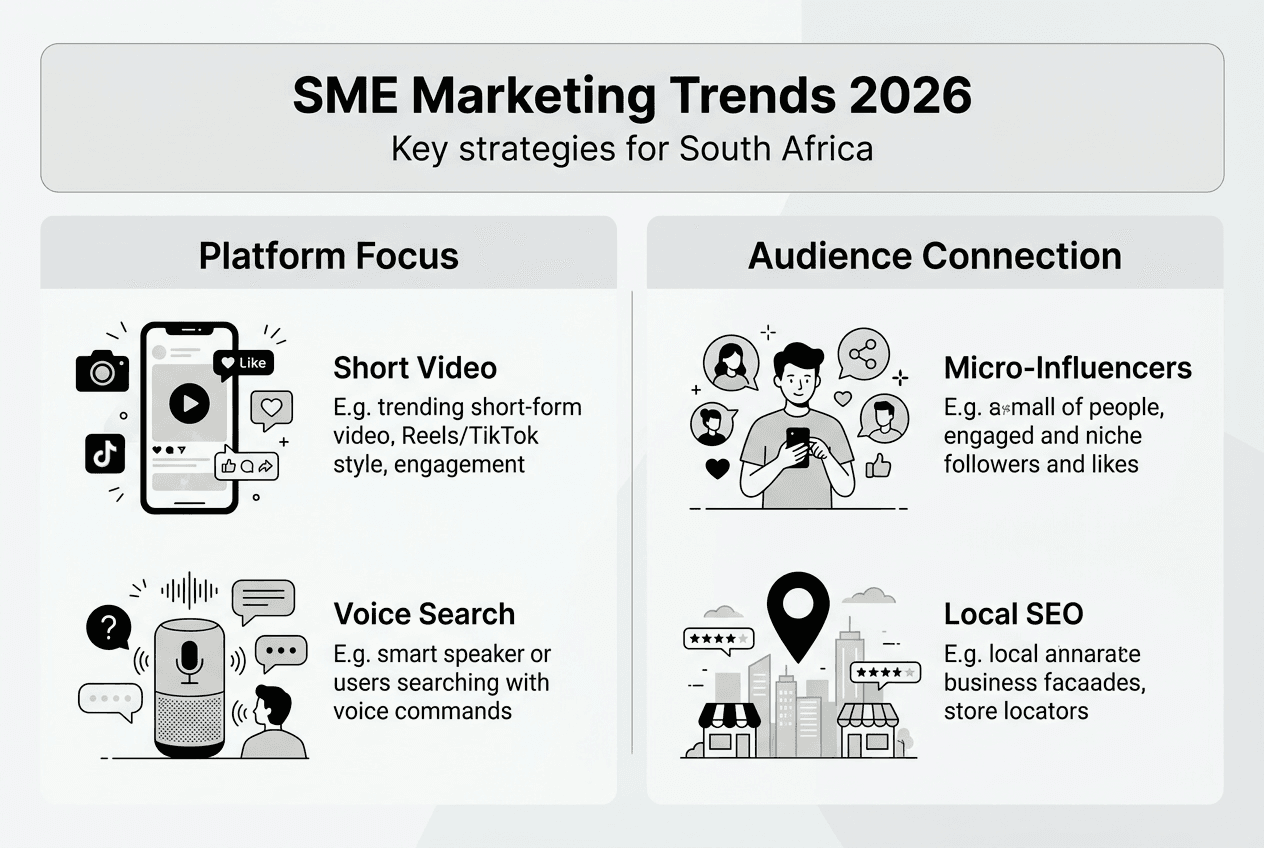
Short-form video, micro-influencers, and voice search optimization dominate 2026 strategies because they deliver high engagement at relatively low production costs. A 30-second product demonstration filmed on your smartphone often outperforms expensive traditional advertising. Platforms like TikTok and Instagram Reels prioritize authentic, unpolished content over corporate productions.
Micro-influencers with 5,000 to 50,000 followers provide authentic brand connections that resonate with local audiences. These partnerships cost a fraction of celebrity endorsements while delivering better engagement rates. A Johannesburg fashion boutique partnering with local style bloggers reaches genuinely interested prospects rather than broadcasting to disengaged masses.
Voice search and multilingual SEO address South Africa’s linguistic diversity. Optimizing for conversational queries in multiple languages expands your addressable market significantly. Consider how customers actually speak when searching: “best pizza delivery near me” rather than “pizza restaurant Durban.”
AR and VR technologies become increasingly accessible through smartphone capabilities. Furniture retailers let customers visualize products in their homes, while real estate agents offer virtual property tours. These innovations differentiate your brand without requiring massive technology investments.
| Trend | Reach potential | Cost level | Engagement rate | SME suitability |
|---|---|---|---|---|
| Short-form video | Very high | Low | High | Excellent |
| Micro-influencers | Targeted | Low to medium | Very high | Excellent |
| AI personalization | Existing audience | Low | Medium to high | Good |
| Voice search SEO | Growing | Low | Medium | Good |
| AR experiences | Medium | Medium | High | Moderate |
Adapting to emerging trends isn’t about chasing every new platform or technology. Focus on innovations that align with your customer behaviors and business model, then implement thoroughly rather than superficially. One well-executed trend delivers more value than five half-hearted attempts.
Enhancing your digital branding through these trends requires strategic selection rather than wholesale adoption. Evaluate each opportunity against your specific customer preferences and resource availability. A B2B service provider might skip TikTok entirely while investing heavily in LinkedIn thought leadership and AI-powered email campaigns.
How Local SEO Agency can help your SME thrive in digital marketing
Navigating the complexities of digital marketing while running your business daily creates genuine challenges. Local SEO Agency specializes in helping South African SMEs maximize online visibility without diverting focus from core operations. Our SEO optimization services are specifically designed for businesses seeking measurable growth through strategic digital presence.
We understand the unique challenges facing South African SMEs, from budget constraints to infrastructure limitations. Our Durban SEO services and comprehensive local SEO strategies focus on delivering tangible results: increased website traffic, higher quality leads, and improved conversion rates. Rather than generic approaches, we build customized strategies reflecting your specific market position, customer behaviors, and growth objectives. Partner with professionals who prioritize your ROI and understand the South African business landscape intimately.
Frequently asked questions
Is digital marketing suitable for all South African SMEs?
Digital marketing adapts to virtually any SME size, industry, or budget when properly tailored. Start with foundational strategies like Google Business Profile optimization and social media presence, then expand based on results and available resources. Even businesses with minimal budgets benefit from strategic digital presence.
How much should SMEs budget for digital marketing in 2026?
Allocate 7 to 12% of revenue for marketing, with at least half directed toward digital channels. New businesses might invest more aggressively to build awareness, while established SMEs can maintain presence with lower percentages. Focus on ROI rather than arbitrary spending targets.
Which digital marketing channels deliver the best ROI for South African SMEs?
Google search ads and local SEO consistently deliver strong returns for service-based businesses, while e-commerce SMEs often succeed with Facebook and Instagram ads. The best channels depend entirely on where your specific customers spend time online and how they prefer to discover products or services.
How long before SMEs see results from digital marketing efforts?
Paid advertising can generate leads within days, while SEO and content marketing typically require three to six months for significant traction. Set realistic expectations based on channel selection and competition levels. Consistency matters more than perfection when building long-term digital presence.
Can SMEs handle digital marketing internally or should they outsource?
Many SMEs successfully manage basic digital marketing internally after investing in training and tools. However, specialized areas like technical SEO, paid advertising optimization, and conversion rate improvement often benefit from professional expertise. Hybrid approaches combining internal management with strategic outsourcing balance cost control with expert guidance.
Recommended
- Digital branding tips for South African SMBs in 2026
- What Is Digital Marketing and Why It Matters for SMEs
- Optimize websites for South African businesses 2026
- Why website content matters for South African SMBs in 2026
- What Is Digital Marketing? Guide for US Business Owners 2025 – seo analytic
source https://localseoagency.co.za/digital-marketing-south-african-smes-2026-guide/



No comments:
Post a Comment