Every South African small business owner knows that standing out online can feel like a balancing act between beauty and visibility. Your website must attract local customers through search engines while also making a strong visual impression. By focusing on a mobile-first design and optimising both speed and aesthetics, you position your business to reach more people without losing your unique style. This article highlights practical ways to combine SEO and design for lasting results in South Africa.
Table of Contents
- Key Strategies For Integrating SEO And Aesthetics
- Mobile Experience And Core Web Vitals Essentials
- Common SEO-Design Conflicts And How To Fix Them
- Costly Mistakes And Sustainable Long-Term Success
Key Takeaways
| Point | Details |
|---|---|
| Mobile-First Design is Essential | Ensure your website is optimised for mobile devices, reflecting the browsing habits of most South African users. |
| Core Web Vitals are Critical for User Experience | Focus on Largest Contentful Paint, Interaction to Next Paint, and Cumulative Layout Shift to enhance site performance and SEO. |
| SEO and Design Should Harmonise | Create a seamless integration between design and SEO by prioritising site hierarchy and content structure for better engagement and rankings. |
| Sustainable SEO Requires Long-Term Strategy | Avoid quick fixes; instead, invest in understanding audience intent and maintaining consistent, quality content to secure lasting visibility. |
…content…
Key Strategies For Integrating SEO And Aesthetics
Your website needs to look good and rank well. These aren’t opposing goals—they work together when you approach them strategically.
Start with mobile-first design. Most South African users browse on phones, so your site must work beautifully on small screens. This means responsive layouts that adapt seamlessly to any device size.
Speed matters for both users and search engines. Heavy images slow down pages, frustrating visitors and damaging your rankings. Optimising images for fast loading keeps your site snappy while maintaining visual appeal.
Here’s what you should prioritise:
- Clean site hierarchy that helps search engines crawl your pages
- Fast load speeds that keep users engaged
- Mobile-responsive layouts for all devices
- High-quality visual content that resonates with your audience
- Structured data to help Google understand your content
Your aesthetics and SEO aren’t competitors—they’re partners in creating websites that convert visitors into customers.
Use structured data markup to help search engines understand your content better. This invisible code works behind the scenes, making your site more searchable without affecting how it looks.
Think about your site hierarchy carefully. A clean, logical structure helps visitors find what they need while making it easier for search engines to crawl and index your pages. This means intuitive navigation and clear labelling throughout.
Visual content like infographics and videos can boost both engagement and SEO. People spend longer on pages with quality visuals, which signals to Google that your content is valuable. Make sure these assets load quickly.
Consider using data-driven design decisions. Analytics show you what colours, layouts, and content formats your South African audience responds to best. Use this information to refine both aesthetics and user experience.
Your call-to-action buttons should be visually prominent and strategically placed. They need to catch attention while fitting naturally into your design. This balance improves conversions and user engagement metrics that affect rankings.
Pro tip: Test your design changes on actual South African users before rolling them out widely—what looks great on your monitor might not work on a visitor’s phone with a slower connection.
Mobile Experience And Core Web Vitals Essentials
Mobile users in South Africa expect websites to load fast and work smoothly. Google prioritises this experience, using mobile-first indexing to rank your site.
Core Web Vitals measure what actually matters to your visitors. These three metrics determine how well your site performs on phones and tablets.
The first metric is Largest Contentful Paint (LCP). This measures how quickly the main content appears on screen. For South African users on slower connections, slow LCP kills engagement. Your goal is loading within 2.5 seconds.
The second is Interaction to Next Paint (INP). This tracks how responsive your site is when someone clicks a button or types in a form. Sluggish responses frustrate users and damage your rankings.
The third is Cumulative Layout Shift (CLS). This measures visual stability—whether content suddenly jumps around while loading. Ads, images, or fonts that load unexpectedly create a poor experience.
Core Web Vitals measure user experience metrics that Google uses to rank mobile pages, making them essential for SEO success.
Below is a quick overview of the three Core Web Vitals metrics, what they measure, and how to improve each for mobile:
| Metric | Measures | User Impact | Mobile Optimisation Tip |
|---|---|---|---|
| LCP | Main content load speed | Perceived site speed | Compress and prioritise images |
| INP | Interaction responsiveness | Tap/click lag | Minimise JavaScript, streamline UI |
| CLS | Visual stability of content | Unintended page movement | Set size for images, stabilise ads |
Here’s how to improve these metrics:
- Optimise images aggressively—compress without losing quality
- Minimise unnecessary code and remove unused scripts
- Defer non-critical resources so main content loads first
- Use a content delivery network (CDN) to serve content faster
- Test regularly using Google’s PageSpeed Insights tool
Mobile-first design isn’t optional anymore. It’s the foundation of modern SEO success in South Africa.
Speed matters because most South African internet users access websites on mobile devices with varying connection speeds. A site that loads in three seconds on fibre might take eight seconds on 4G.
Layout stability prevents users from accidentally clicking the wrong element. Shifting content creates friction and reduces conversions.
Responsiveness keeps users engaged. Slow interactions feel broken, even if the page eventually responds.
Monitor your Core Web Vitals regularly. Google Search Console shows you exactly where your pages fall short. Use this data to prioritise improvements.
Pro tip: Test your site on actual 4G connections using Chrome DevTools throttling—what seems fast in your office might crawl for customers on slower networks.
Common SEO-Design Conflicts And How To Fix Them
Designers and SEO specialists often want different things. Your designer creates stunning visuals while your SEO expert pushes for rankings. The good news—these goals don’t have to clash.
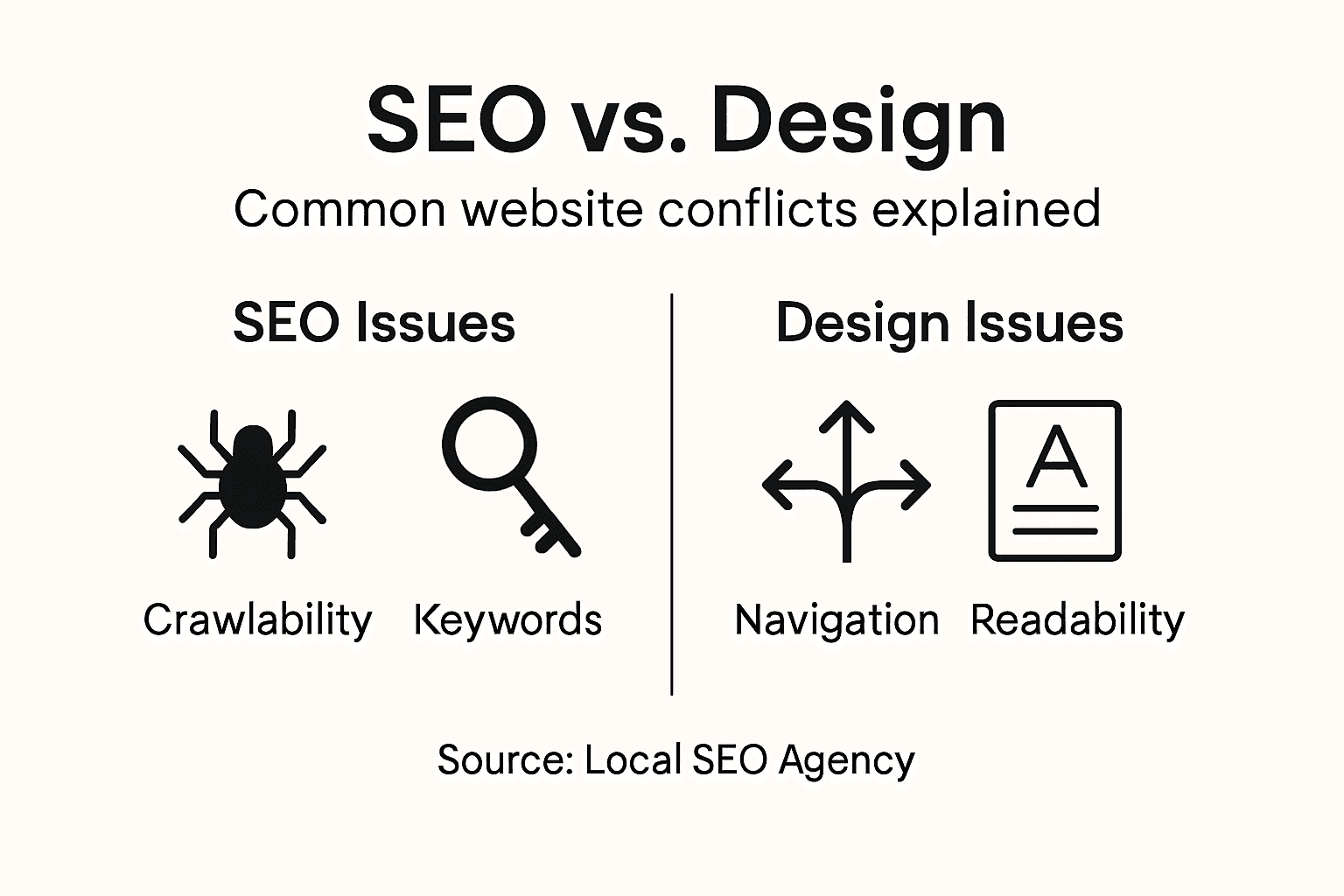
One major conflict happens with crawlability. Designers love fancy JavaScript menus and animations, but search engines struggle to read them. When Google can’t crawl your pages, it can’t rank them.
Fix this by using standard HTML for navigation. JavaScript elements should enhance experience, not control essential content. Test your site using Google Search Console to see what search engines actually crawl.
Another common issue is keyword stuffing. You need keywords for SEO, but cramming them everywhere looks spammy and reads terribly. Common SEO mistakes include poor keyword balance that hurts both user experience and rankings.
Write naturally. Readers notice keyword stuffing instantly and bounce away. One or two mentions per page section is usually enough.
Here’s how SEO and design priorities can create conflict, and which approach best resolves each issue:
| Conflict | SEO Priority | Design Priority | Optimal Solution |
|---|---|---|---|
| Navigation menus | Crawlable by search bots | Visually engaging | Use HTML with subtle enhancements |
| Image use | Fast loading, alt text | High visual impact | Compress, add descriptive alt text |
| Keywords | Higher page rankings | Natural-sounding content | Write naturally, place sparingly |
| Page structure | Hierarchical, keyword rich | Creative, flexible layout | Logical structure, clear labels |
Here’s what else commonly conflicts:
- Heavy images and videos slowing pages down whilst looking beautiful
- Missing alt text on images—needed for SEO and accessibility
- Broken links from design updates—hurts authority and rankings
- Duplicate content across similar pages confusing search engines
- Poor mobile design that looks good on desktop but fails on phones
The best design isn’t flashy—it’s invisible to the user and invisible to search engines in the right way.
Images need optimization without sacrificing quality. Compress aggressively, use modern formats like WebP, and add descriptive alt text describing the image content.
Broken links damage your credibility with both users and Google. Set up a regular link audit using tools like Screaming Frog. Fix or redirect broken links immediately.
Duplicate content confuses search engines about which version to rank. Use canonical tags to tell Google which version matters, or consolidate pages entirely.
Mobile design isn’t an afterthought. Test your beautiful desktop design on actual phones. If it doesn’t work on mobile, it doesn’t work at all in South Africa.
Pro tip: Build a checklist combining SEO and design requirements before starting projects—assign both specialists to approve final designs to catch conflicts early.
Costly Mistakes And Sustainable Long-Term Success
Many South African business owners chase quick SEO wins. They optimise for a keyword, get a traffic spike, then watch rankings plummet. This pattern repeats because they’re ignoring what actually builds lasting visibility.
Quick fixes don’t work. Keyword stuffing, buying backlinks, and ignoring mobile optimisation might boost rankings temporarily, but Google catches on. When penalties hit, recovery takes months or years.
Sustainable SEO requires consistent focus on quality content that aligns with what your audience actually searches for, not what you hope they’ll search for.
The costly mistake is misunderstanding audience intent. You optimise pages for keywords nobody is searching for. Traffic doesn’t come. You waste time and money chasing rankings that don’t convert visitors.
Spend time understanding what your South African customers actually need. Use Google Search Console to see real search queries. Look at what competitors rank for. Answer the questions your audience is asking.
Here’s what sustainable success looks like:
- Regular content updates that stay relevant to user needs
- Technical SEO maintenance checked monthly, not yearly
- Keyword research tied to actual customer intent
- Consistent publishing schedule rather than sporadic bursts
- Monitoring and adjusting strategies based on performance data
Short-term thinking costs more than long-term strategy. Quick fixes require constant firefighting; sustainable approaches build compounding growth.
Mobile optimisation isn’t optional anymore. Ignoring it costs you rankings and customers. Over 80% of South African internet users browse on mobile devices. If your site doesn’t work for them, it doesn’t exist.
Readability matters. Dense walls of text kill engagement. Break content into short paragraphs, use headings, and write for people, not algorithms.
Stay adaptable. Google changes its algorithm regularly. What worked last year might not work this year. Subscribe to Google Search Central updates and adjust your strategy accordingly.
Monitor your metrics regularly. Track rankings, traffic, conversions, and user behaviour. Use data to guide decisions, not guesses.
Pro tip: Schedule a quarterly SEO audit where you review what’s working and what isn’t, then adjust your strategy accordingly rather than waiting for rankings to crash.
Elevate Your South African Business With SEO And Design Harmony
Balancing aesthetics and SEO is no easy task for South African businesses aiming to attract mobile-first users with fast, engaging websites. The article highlights common challenges like mobile optimisation, core web vitals, and avoiding SEO-design conflicts that can hurt your rankings and conversions. If you are struggling with slow page loads, unstable layouts, or unclear site structure that fail to convert visitors into customers it is time to take action.
At Local SEO Agency we specialise in creating custom strategies that bring together stunning website design with robust SEO tactics. Our services include technical SEO optimisation, content creation, and local SEO tailored to the South African market. We understand the importance of structured site hierarchy, image compression, and aligning content with real customer intent so your site not only looks great but also ranks well and drives leads.
Ready to stop losing customers to slow or confusing websites? Contact our experts today to build a digital presence that balances stunning design with measurable SEO results. Visit Get In Touch With Our Team to start your journey to online success.
Drive your South African business forward with a website that works as beautifully as it performs. Don’t wait for your competitors to outshine you. Reach out to Local SEO Agency now at https://localseoagency.co.za/contact and let us help you create lasting impact with SEO and design perfectly aligned.
Frequently Asked Questions
How can I improve my website’s mobile responsiveness?
To enhance mobile responsiveness, prioritize a clean, responsive design that adapts to various screen sizes. Ensure fast loading times and test your site across different mobile devices to ensure a smooth user experience.
What are the Core Web Vitals, and why are they important for SEO?
Core Web Vitals are metrics that measure user experience, specifically focusing on loading speed, responsiveness, and visual stability. They are crucial for SEO as Google uses these metrics to rank websites, and a better user experience can lead to higher engagement and conversions.
How does image optimization affect SEO and design?
Optimizing images is vital as it reduces loading times without compromising visual quality, improving both user experience and SEO rankings. Use formats like WebP, compress images, and ensure all images include descriptive alt text to enhance accessibility and search visibility.
What should I consider when creating a site hierarchy for SEO?
A logical site hierarchy improves crawlability and user navigation. Create a clean structure with clear labels and intuitive navigation. This not only helps search engines index your content effectively but also makes it easier for users to find what they need.
Recommended
- Website Design Best Practices for Growing SA Brands
- Winning South African SEO Techniques Every Young Owner Needs – LSA SEO Agency
- Effective South African SEO Tips for Competitive Edge – LSA SEO Agency
- The Essential South African SEO Strategy for Business Growth – LSA SEO Agency
- SEO Services | Brainiac Media
- Optimizing Websites for Search: A Guide for Small Businesses 2025 | Ibrandmedia
source https://localseoagency.co.za/balancing-seo-and-design-sa/



No comments:
Post a Comment