Choosing the right keywords can feel like searching for a needle in a haystack when you want your South African business to stand out online. The words you select and how you structure your content directly influence who finds your site and when. By focusing on keywords that connect with real search intent and refining your message for clarity, you set your business up for genuine online growth and improved rankings.
Table of Contents
- Step 1: Assess Current Content Quality
- Step 2: Identify Relevant Keywords And Intent
- Step 3: Revise Content Structure And Language
- Step 4: Integrate Seo Elements Effectively
- Step 5: Validate Optimisation With Performance Checks
Quick Summary
| Key Insight | Explanation |
|---|---|
| 1. Conduct Thorough Keyword Research | Focus on primary, long-tail, and intent keywords to align content with audience search behaviour. |
| 2. Revise for Clarity and Readability | Improve content structure, sentence variety, and active voice to enhance reader engagement. |
| 3. Integrate SEO Elements Naturally | Use keywords in titles, meta descriptions, and headings without compromising the reading experience. |
| 4. Monitor Performance Regularly | Utilize tools like Google Search Console to assess visibility and make adjustments for SEO improvement. |
| 5. Understand Local Context in Keywords | Recognise the difference in intent for local searches to better optimise content for specific audience needs. |
Step 1: Assess Current Content Quality
…
Step 2: Identify Relevant Keywords and Intent
Keyword identification is where your SEO strategy gains real direction. You’ll uncover the exact terms your target audience uses when searching for solutions, then align your content to match their intent. This step determines whether your content reaches the right people at the right moment.
Start by understanding what your audience actually needs. Keywords reflect the core themes of your content and connect directly to search intent. Rather than guessing what might work, look at the language your customers use when describing their problems.
Your keyword research should focus on three key areas:
- Primary keywords that describe your main offerings or solutions
- Long-tail variations that capture specific customer questions or local needs
- Intent signals that reveal whether searchers want information, are ready to buy, or need local services
For South African small businesses, local context matters tremendously. Someone searching “plumber near me” has different intent than “how to fix a leaky tap.” The first person is ready to hire; the second is still researching. Recognising these differences shapes how you optimise each piece of content.
Use tools to validate what real people are searching for. Google Search Console shows actual queries driving traffic to competitors. Keyword research platforms reveal search volume and difficulty levels. But don’t get lost in data. Focus on keywords where your business can realistically rank and where customer intent aligns with what you offer.
Here’s a summary of keyword types and how they guide your content strategy:
| Keyword Type | Typical Search Intent | Example (South Africa) | Content Implication |
|---|---|---|---|
| Primary keyword | General solution or product | Small business accounting | Position main service or solution |
| Long-tail variation | Specific need or question | Affordable tax consultant CPT | Address targeted queries and locations |
| Intent signal | Ready to act or research | Book a website design demo | Align content with user readiness |
Your keywords should answer a customer question or solve a specific problem, not just describe your business.
Once you’ve identified your keyword targets, map them to content pieces. One comprehensive guide might target ten related keywords. A product page targets different keywords than a blog post about industry trends. This strategic alignment ensures every piece of content pulls its weight in your SEO strategy.
Pro tip: Research keywords your competitors rank for using free tools like Google Suggest and keyword difficulty checkers, then find gaps where your business can compete without needing massive domain authority.
Step 3: Revise Content Structure and Language
Now that you’ve drafted your content around the right keywords, it’s time to refine it. Revision isn’t about rewriting everything from scratch. Instead, you’ll strengthen clarity, improve organisation, and ensure your message resonates with both search engines and actual readers.

Start by examining your overall structure. Does your content flow logically from one idea to the next? Revising content involves critical review to enhance clarity and logical flow, making sure readers can follow your argument without confusion. Reorganise sections if needed so that information appears in the order your audience expects to find it.
Next, focus on language precision. Your sentences should be direct and conversational without unnecessary jargon. South African business owners reading your content want straightforward answers, not corporate buzzwords. Read your content aloud to catch awkward phrasing that slows readers down.
Check these specific elements:
- Paragraph length ensures readability; break up dense blocks into shorter chunks
- Sentence variety keeps readers engaged without monotonous rhythm
- Active voice makes your writing stronger and clearer than passive constructions
- Keyword placement feels natural within sentences, not forced or repetitive
Look for redundancy and filler language that doesn’t add value. Every sentence should earn its place by either informing, clarifying, or persuading your reader. Cut phrases that repeat ideas you’ve already explained.
Strong content structure guides readers through your ideas logically whilst your refined language makes each point immediately clear.
Also review your headings and subheadings. They should accurately summarise what follows and help readers scan your content quickly. Weak headings like “Additional Information” don’t help anyone understand what’s coming. Instead, use headings that promise specific value.
Finally, check that your calls to action align with your content’s purpose. If you’re writing to educate, your CTA might encourage readers to contact you for a consultation. If you’re solving a specific problem, guide them towards the next logical step.
Pro tip: Print your content and read it on paper or use a text-to-speech tool to hear how it sounds, catching awkward phrasing and rhythm problems that screen reading often misses.
Step 4: Integrate SEO Elements Effectively
You’ve identified keywords and refined your content. Now it’s time to strategically place SEO elements throughout your piece. Proper integration means these elements work invisibly to help search engines understand your content whilst keeping the reader experience smooth and natural.
Start with your page title and meta description. These appear in search results and influence whether people click through to your site. Your title should include your primary keyword naturally whilst compelling someone to click. Your meta description should summarise the page in 150–160 characters, incorporating your keyword without keyword stuffing.
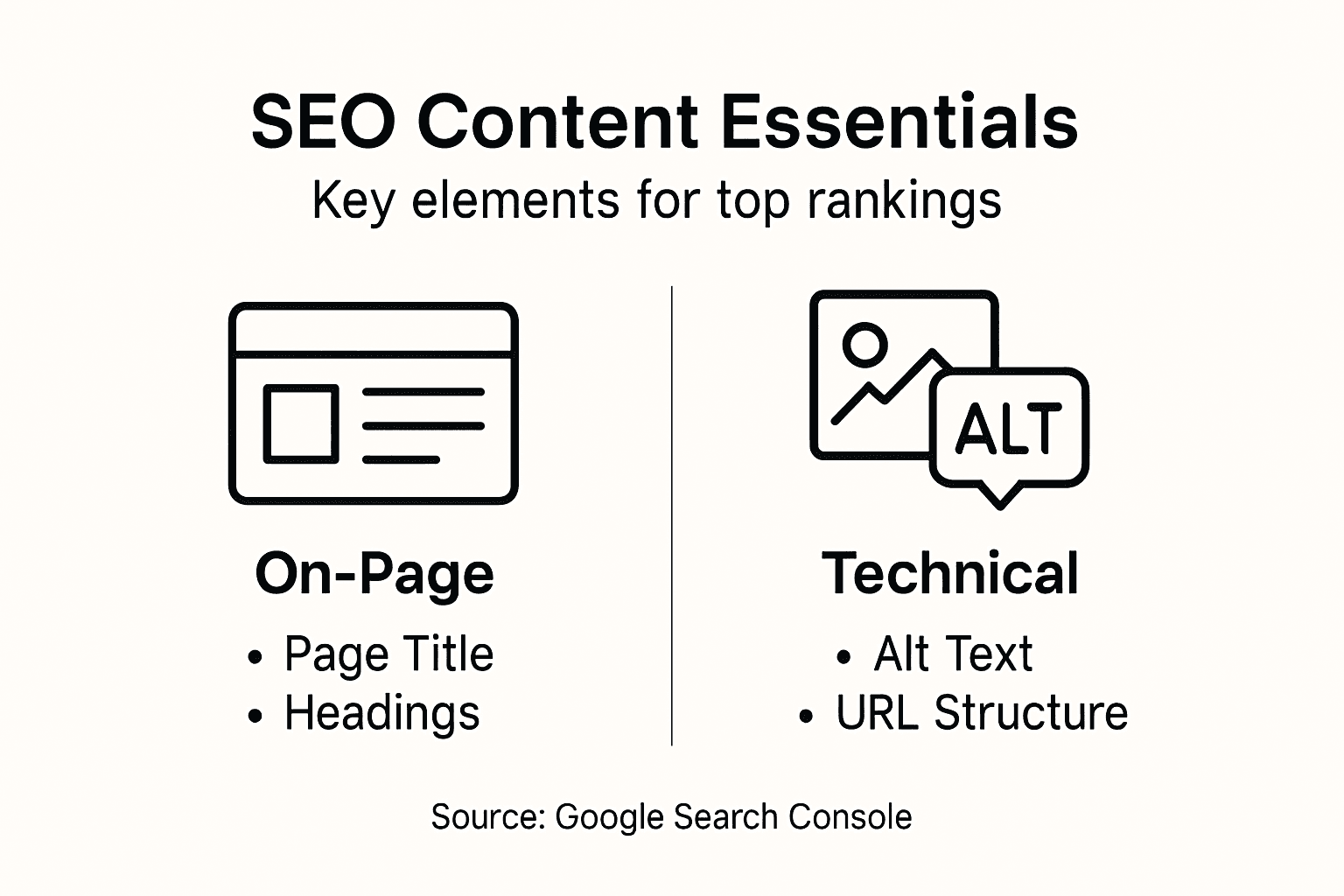
Integrating SEO effectively requires understanding key elements such as keyword placement, meta tags, and URL structure. Your URL should be clean and descriptive, reflecting your content’s topic using hyphens to separate words. Avoid lengthy URLs filled with numbers or parameters that confuse both search engines and users.
Focus on these on-page SEO elements:
- Headings should use your keywords naturally and structure content logically
- Image alt text describes what searchers see, improving accessibility and SEO
- Internal links connect related content and guide readers through your site
- First 100 words matter tremendously for relevance signals to search engines
Placement is everything. Your primary keyword should appear in your first paragraph, but it must feel conversational. Readers should never notice you’re optimising for search engines. Secondary keywords belong in subheadings and body text where they make sense contextually.
Effective SEO integration feels invisible to readers because keywords and structure work naturally with your message, never against it.
Also optimise your images. Use descriptive alt text rather than generic descriptions like “image” or “photo”. This helps search engines understand your visual content whilst improving accessibility for visually impaired users. Compress your images so they load quickly without sacrificing quality.
Finally, ensure your content loads quickly on mobile devices. Page speed is a ranking factor, and most of your South African audience accesses content on smartphones. Test your site’s speed using tools like Google PageSpeed Insights and address any issues you find.
Pro tip: Add internal links to other relevant pages on your site using descriptive anchor text rather than generic phrases like “click here”, helping search engines understand your site structure whilst improving user navigation.
Step 5: Validate Optimisation with Performance Checks
Optimisation isn’t a one-time task. You need to measure whether your efforts are actually working and identify areas that still need attention. Performance checks reveal what’s driving results and what’s holding you back from ranking higher.
Start by checking your search visibility. Google Search Console shows which queries bring traffic to your site, how often you appear in results, and your average ranking position. Look for keywords where you’re ranking in positions 4 to 10. These are prime candidates for optimisation pushes that could move you into the top three results.
Validating SEO optimisation involves performing detailed audits addressing indexing errors, content quality, and mobile SEO performance. Check whether Google can properly crawl and index your pages. Look for broken links that frustrate visitors and confuse search engines. Verify that your mobile version works seamlessly, since most of your audience uses phones.
Monitor these critical performance areas:
- Page load speed directly impacts rankings and bounce rates
- Mobile responsiveness ensures your site works across all devices
- Indexing status confirms search engines can find and understand your content
- Backlink quality shows whether other sites trust your content
- User engagement metrics reveal how long visitors stay and what they click
Use tools like Google PageSpeed Insights to identify speed bottlenecks. Check that images are optimised, code is minified, and your hosting can handle traffic spikes. Even small improvements in load time can boost rankings and conversions significantly.
This table highlights key performance areas and their impact on SEO success:
| Performance Area | What to Monitor | Impact on SEO Rankings |
|---|---|---|
| Page load speed | Mobile and desktop times | Higher speed boosts rankings |
| Mobile responsiveness | Layout on all devices | Wider reach, reduced bounce rate |
| Indexing status | Crawl errors or issues | Ensures all content is visible |
| Backlink quality | Referring domain strength | Increased trust and authority |
| User engagement | Time on page, clicks | Signals content value to Google |
Regular performance audits catch problems early before they damage your rankings, and reveal opportunities to outrank competitors.
Set up monthly tracking so you can spot trends over time. Are rankings improving? Is traffic growing? Are visitors converting into leads? Track progress against your goals rather than obsessing over daily fluctuations, which are normal and expected.
Also monitor your competitors. When their rankings drop or new competitors emerge, investigate what changed. This intelligence helps you stay ahead and adapt your strategy proactively.
Pro tip: Create a simple spreadsheet tracking your top 10 target keywords, their current rankings, and monthly changes, allowing you to spot trends and celebrate wins faster than waiting for quarterly reports.
Boost Your SEO Results with Expert Local Support
Struggling to align your content with the right keywords or unsure how to optimise your website for better search engine rankings is a common challenge. This article highlights key pain points like crafting targeted keyword strategies, refining content structure, and integrating SEO elements naturally — all essential steps to improving your site’s visibility and attracting the right audience.
Don’t let these technical details hold your business back. Our team at Local SEO Agency understands the South African digital landscape and can help you overcome these hurdles with tailored solutions including technical SEO, content creation, backlink building, and local SEO optimisation. We focus on ethical and results-driven strategies that increase traffic, boost leads, and maximise conversions for your business.
Take control of your online presence now by connecting with professionals who specialise in turning SEO theory into measurable growth. See how a comprehensive approach to SEO can elevate your business by visiting our contact page.
Ready to transform your SEO strategy and dominate local search? Start your journey today with Local SEO Agency. Reach out to us at https://localseoagency.co.za/contact for a personalised consultation and discover how specialised SEO can make all the difference. Act now to stay ahead in South Africa’s competitive digital market.
Explore proven strategies and services that match each optimisation step explained in the article. Learn more about how we can support your business growth through our expert SEO services.
Frequently Asked Questions
How can I assess the current quality of my content for SEO?
To assess the current quality of your content for SEO, review its clarity, structure, and relevancy. Identify areas that lack engagement or are confusing, and make notes for improvement so you can create a more reader-friendly and optimised piece.
What steps should I take to identify relevant keywords for my content?
Begin by researching the specific terms your target audience is using when searching for solutions. Focus on primary keywords, long-tail variations, and intent signals to ensure your content aligns with their needs and search behaviours.
How do I revise my content structure and language effectively?
Revise your content by ensuring a logical flow and using clear, direct language. Enhance readability by shortening paragraph lengths and varying your sentence structure, which encourages better engagement and understanding from your audience.
What are the key SEO elements to integrate into my content?
Key SEO elements include optimising your page title, meta description, headings, image alt text, and URL structure. Ensure these elements include your primary keywords and serve to enhance both search engine visibility and user experience.
How can I validate the optimisation of my content?
Validate your content optimisation by monitoring performance metrics like search visibility, page load speed, and user engagement. Set up monthly checks to track improvements and adapt your content strategy based on what drives the best results.
Recommended
- Proven Strategies on How to Write SEO-Friendly Content – LSA SEO Agency
- How SEO Content Writing Services Boost Online Visibility – LSA SEO Agency
- Proven SEO Content Writing Examples for Increased Visibility – LSA SEO Agency
- Maximize Your Reach with These SEO Content Writing Tools – LSA SEO Agency
- Social Media Redaktionsplan erstellen – Schritt-für-Schritt zum Erfolg – publy.ch Social Media Content-Abo: Hochwertige Posts, Reels & Carousels
- 7 Essential SEO Best Practices for Home Service Success
source https://localseoagency.co.za/how-to-optimise-content-seo/



No comments:
Post a Comment