TL;DR:
- Having a website without Google visibility is like running a shop without a sign, leaving potential customers unaware of your existence. Since over 90% of South African search queries happen on Google, optimizing for it is crucial for local business success and sustained growth. Prioritizing user-first, original content and technical SEO fundamentals ensures long-lasting visibility and trust over manipulative strategies.
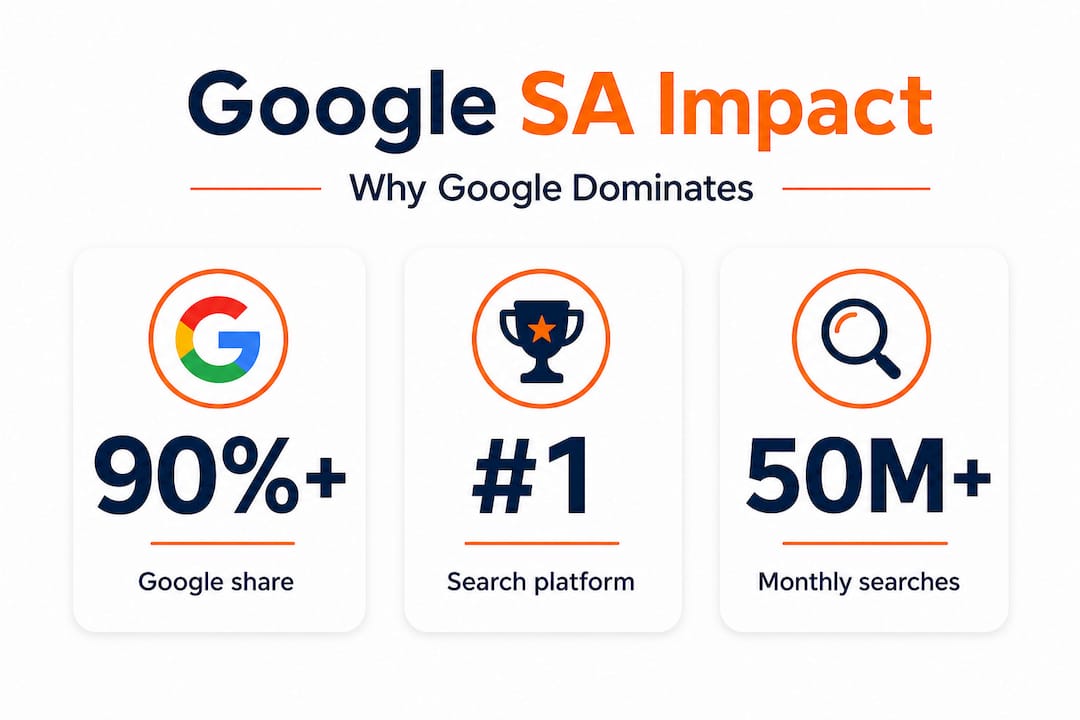
Having a website without visibility on Google is like opening a shop in the middle of the Karoo and forgetting to put up a sign. You built something real, but nobody knows it exists. In South Africa, over 90% of search queries happen on Google, which means that if your business isn’t ranking, your competitors are collecting customers you never even knew you were losing. This guide breaks down exactly why Google optimization matters, what it actually involves, how to put the right steps in place, and how to track whether those steps are working for your business.
Table of Contents
- Why Google matters for South African businesses
- What ‘optimizing for Google’ actually means
- Essential steps to optimize your site for Google
- How to measure and improve your Google SEO results
- Common mistakes and why people-first SEO wins
- Take your next step to Google-driven growth
- Frequently asked questions
Key Takeaways
| Point | Details |
|---|---|
| Google search dominates | Over 90% of South African web searches happen on Google, making it the main driver of organic online visibility. |
| User-first content matters | Optimizing for Google means providing unique, helpful, and people-oriented content, not just focusing on keywords. |
| Technical SEO is vital | Ensuring technical readiness and mobile performance increases your site’s chances of ranking in Google searches. |
| Measure and improve | Using Google Search Console and Analytics lets you track, test, and continually update your SEO strategy for better results. |
| People-first wins over shortcuts | Long-term gains come from prioritizing user value and content quality instead of chasing algorithm tricks. |
Why Google matters for South African businesses
Let’s be honest about the landscape here. When South Africans search for a plumber in Pretoria, a bakery in Cape Town, or a digital marketing agency in Johannesburg, they go to Google. Not Bing. Not Yahoo. Not DuckDuckGo. Google’s dominance in South African search is so overwhelming that optimizing for any other search engine first is simply not a practical business decision for most SMBs.
This matters because search behavior directly connects to buying behavior. When someone searches “electrician near me” at 7pm after a power surge, they are not browsing casually. They have a problem, they want a solution, and they will call the first credible result they find. If your business doesn’t appear in those results, that revenue goes elsewhere. It’s that simple.
Here’s a practical comparison of where South African search traffic actually comes from, so you can see why directing energy toward Google is not optional:
| Search engine | Approximate SA market share | Worth prioritizing? |
|---|---|---|
| 90%+ | Absolutely | |
| Bing | Under 5% | Secondary |
| Yahoo | Under 2% | Low priority |
| DuckDuckGo | Under 1% | Niche only |
The numbers tell a clear story. Every rand and hour you invest in SEO will deliver the highest return when focused on Google’s ecosystem. That includes building Google authority for your domain, earning relevant backlinks, and applying local SEO strategies that put you in front of people searching in your area.
What does missed Google optimization actually cost you? Consider this:
- Lost discovery: Customers searching for exactly what you offer find your competitor instead
- Lost credibility: Businesses that appear on page one are perceived as more trustworthy
- Lost clicks: The top three Google results capture the vast majority of all organic clicks
- Lost conversions: Organic search visitors typically have strong purchase intent
Google is not a nice-to-have for South African SMBs. It is the primary digital channel through which customers discover local businesses every single day.
Key insight: Appearing on page one of Google for a relevant local search term can be the equivalent of having a prime retail location on a busy main road, except the “foot traffic” is made up entirely of people already looking for what you sell.
What ‘optimizing for Google’ actually means
Many business owners hear “Google optimization” and immediately picture a checklist of keywords stuffed into pages. That picture is outdated and, honestly, it will get you penalized rather than rewarded. Understanding what Google actually values in 2026 is the foundation of any strategy that delivers real growth.
Google’s own guidance is refreshingly clear on this. Google’s evaluation now emphasizes people-first, helpful, original content, meaning that “optimizing for Google” effectively means aligning your site with how Google evaluates usefulness for real users, including in AI-powered search experiences. This is a fundamentally different mindset from chasing algorithmic tricks.
Let’s unpack what this means in practical terms for a South African SMB owner:
-
Usefulness comes first. Before writing any page or blog post, ask yourself: does this genuinely help the person reading it? If you run an accounting firm and you publish a guide on how to prepare for SARS tax season, that guide should actually answer the questions your clients have, not just mention “tax season” fifty times.
-
Originality matters more than volume. One well-researched, original piece of content outperforms ten thin, generic pages. Google’s systems are increasingly effective at identifying content that adds something new to a topic versus content that simply repeats what’s already out there.
-
User experience is part of the ranking signal. If your site loads slowly, is difficult to navigate on a mobile phone, or bombards visitors with pop-ups, Google interprets this as a poor user experience and ranks you accordingly. Technical readiness and content quality work together.
-
AI search changes the playing field. Google’s AI-driven search features, like AI Overviews, draw directly from content that demonstrates genuine expertise. Sites that follow technical SEO best practices and produce clear, authoritative content are better positioned to appear in these new result formats.
-
Structure helps Google understand you. Using clear headings, descriptive meta tags, properly labeled images, and logical page structure helps Google’s crawlers understand what your page is about and serve it to the right searchers.
Pro Tip: Think of Google as a very diligent librarian. It wants to match each searcher with the single most useful answer available. Your job is to be the most useful answer in your category, not just the most keyword-dense one.
The shift from “gaming the algorithm” to “genuinely serving your audience” is not just ethical advice. It’s the most durable SEO strategy you can build, because Google’s systems keep improving at filtering out manipulation and rewarding real value.
Essential steps to optimize your site for Google
Understanding Google’s intent is one thing. Implementing the right steps is where real-world results begin. Here’s a breakdown of the core areas you need to address, structured in a way that makes sense for South African SMBs working with real-world time and budget constraints.
The methodology for SMBs in South Africa centers on pairing technical readiness and on-page relevance with Google’s indexing and discovery pathways, rather than only chasing keywords. That means your site needs to be discoverable, readable, and relevant all at once.

Here’s a practical overview of the main optimization areas:
| Optimization area | What it involves | Why it matters |
|---|---|---|
| On-page SEO | Page titles, meta descriptions, headings, content quality | Tells Google and users what your page is about |
| Technical SEO | Site speed, mobile-friendliness, crawlability, schema | Ensures Google can find and understand your site |
| Content quality | Original, useful, well-structured articles and pages | Drives rankings and earns user trust |
| Image SEO | Descriptive filenames, alt text, proper sizing | Improves both image search and page performance |
| Local SEO | Google Business Profile, local citations, reviews | Critical for location-based discovery |
| Link authority | Backlinks from credible local and industry sources | Signals trustworthiness to Google |
Now let’s walk through the essential steps in order of impact:
-
Claim and complete your Google Business Profile. For any SMB with a physical location or service area in South Africa, this is step one. Your profile controls how you appear in local search results and on Google Maps. Fill in every field. Add photos. Respond to reviews. Update your hours.
-
Fix your technical foundation. Use Google’s free PageSpeed Insights tool to check how fast your site loads, especially on mobile. A site that takes longer than three seconds to load loses a significant portion of its visitors before they even read a word. Address the biggest speed issues first. Improving local search visibility often starts right here.
-
Audit and improve your page content. Every main page on your site should have a clear purpose, a focused topic, and genuine value for the reader. Write for humans, not search engines. Use natural language that reflects how your customers actually ask questions.
-
Optimize your images properly. Name your image files descriptively before uploading them. A file called “cape-town-accountant-office.jpg” tells Google a great deal more than “IMG_0034.jpg.” Add alt text that describes what the image shows. This also improves accessibility, which Google values.
-
Build relevant internal links. Connect your pages to each other in a logical way. If your services page mentions tax preparation, link it to your blog post explaining the SARS e-filing process. This helps Google understand the structure of your site and keeps visitors engaged longer.
-
Target locally relevant keywords. Use Google’s free Keyword Planner to identify search terms that South African customers are actually using. Include city or region names where relevant. “SEO agency Johannesburg” will perform very differently from “SEO agency” alone.
Pro Tip: Before publishing any piece of content, search that topic on Google yourself. Look at the top three results. Ask what your content offers that those results don’t. That gap is your opportunity.
Implementing these steps as part of a coherent strategy rooted in technical SEO basics gives you a foundation that compounds over time. Unlike paid advertising, where results stop the moment you stop spending, SEO builds an asset that keeps generating traffic long after the initial work is done.
How to measure and improve your Google SEO results
After applying the right SEO methods, how do you know they’re working? The answer lies in regular measurement and practical iteration. Without data, you’re flying blind. With data, even small improvements become visible, and you can allocate your effort to what’s actually moving the needle.
The primary tools for this are free and provided directly by Google. You can track organic performance using Google Search Console and Google Analytics, which report on organic clicks, impressions, and click-through rates (CTR) for your site. Together, these tools give you a clear picture of how your SEO is performing and where to focus next.
Here’s what to monitor regularly:
- Organic clicks: How many people clicked through to your site from Google search results. This is the most direct measure of SEO effectiveness.
- Impressions: How many times your site appeared in search results, even if users didn’t click. High impressions with low clicks signals a need to improve your meta titles and descriptions.
- Click-through rate (CTR): The percentage of impressions that result in clicks. A low CTR on a high-impression page is often an easy win to improve.
- Average position: Where your pages rank on average for the search terms that trigger them. Tracking this over time shows whether your content improvements are working.
- Landing page performance: Which specific pages are driving the most organic traffic. Double down on what’s working and improve what isn’t.
- Coverage and indexing errors: Google Search Console’s Coverage report shows whether Google can access and index all your pages. Errors here mean some of your content may be invisible to Google entirely.
Using Google Search Console insights properly means checking these reports at least once a month. Look for pages that are gaining impressions but not clicks and test different meta descriptions to improve CTR. Study your Search Console performance report to identify which search queries are bringing in traffic and whether those queries match your business goals.
Pro Tip: Set up a simple monthly spreadsheet tracking your top ten pages by organic clicks. Compare month over month. This single habit will show you more about what’s working than any paid analytics tool.
The most important mindset shift here is treating SEO as an ongoing process, not a once-off task. Google constantly updates its systems. Competitors constantly improve their sites. Customer search behavior changes over time. The businesses that consistently outperform in organic search are the ones that measure, learn, and iterate every single month.
Common mistakes and why people-first SEO wins
Here’s the uncomfortable truth most SEO guides won’t tell you: the majority of South African SMBs that invest in SEO and see poor results made the same fundamental mistake. They focused on what they thought Google wanted instead of what their customers actually needed.
We see this pattern constantly. A business owner hears that keywords matter, so they stuff every page with “best plumber Cape Town” until the content reads like it was written by a bot. They buy a hundred low-quality backlinks from overseas link farms. They publish thin blog posts just to have “more content.” And then they wonder why they’re not ranking.
Google’s systems have become exceptionally good at identifying this kind of manipulation. Google’s framework for success frames ranking as a result of satisfying user needs and providing original value, including in AI-powered search experiences. The most robust SEO is people-first and quality-led. That’s not marketing language. That’s the actual technical reality of how Google’s ranking systems work.
The businesses that consistently win in organic search share a few traits. They know their customers deeply. They create content that genuinely solves real problems those customers face. They invest in site speed and mobile usability because they understand that a frustrated visitor is a lost customer. And they measure their results consistently so they know where to improve.
There’s also an important lesson about patience. SEO is not a sprint. A new website in a competitive niche might take six to twelve months to see meaningful organic traction. But those results, once earned, are far more sustainable than paid ads and far more trusted by searchers. South African consumers, like consumers everywhere, tend to trust organic results more than paid placements because they perceive organic results as earned credibility.
Chasing emerging SEO trends is valuable when done selectively. AI search features, voice search optimization, and zero-click results are all genuinely shaping how South Africans find businesses online. But the fundamentals never change: be useful, be clear, be credible, and be consistent.
The businesses that understand this win quietly. They don’t need to chase every algorithm update because their content holds up under any version of Google’s systems. People-first SEO isn’t the easy path. But it is the right one, and in South Africa’s competitive digital market, it’s the one that builds lasting business growth.
Take your next step to Google-driven growth
Understanding SEO is valuable. Acting on it is where the results actually come from.
If you’ve read this far, you already understand more than most of your competitors about how Google works and why it matters for South African business growth. The next step is putting a tailored, strategic action plan into place that’s built around your specific industry, location, and goals. At Local SEO Agency, we work with South African SMBs to deliver the best SEO optimization service grounded in ethical, results-driven practice. From technical audits to content strategy and effective local SEO strategies, we help you turn Google’s potential into real business growth. Reach out today and let’s build something that lasts.
Frequently asked questions
What percentage of South African searches are on Google?
Over 90% of all search queries in South Africa are made through Google, making it by far the most critical platform for local business visibility.
Does Google optimization just mean adding more keywords?
No, modern optimization focuses on creating user-friendly, helpful, and original content. Google’s guidance explicitly prioritizes content that satisfies user needs over keyword density or manipulation.
How can I check if my site is optimized for Google?
Use Google Search Console and Analytics to monitor traffic, impressions, and how your pages are performing. Google’s own reporting tools give you direct visibility into what’s working and what needs improvement.
What is the most common SEO mistake in South Africa?
A common mistake is focusing only on keywords while ignoring user experience and content quality. Effective SEO methodology, including technical readiness and on-page relevance, requires a more complete approach.
Should I still optimize for Google if I use social media to promote my business?
Yes. Search and social media serve completely different discovery pathways. Google captures high-intent searches from people actively looking for solutions, while social media builds awareness. Both have value, but Google remains essential for long-term organic discovery and lead generation.
Recommended
- Mastering South African SEO Techniques for Competitive Edge – LSA SEO Agency
- Essential South African SEO Tools Every Business Needs – LSA SEO Agency
- South African SEO Keywords That Will Drive Traffic to You – LSA SEO Agency
- Understanding search rankings: boost your South African SMB SEO
source https://localseoagency.co.za/why-optimize-for-google-to-boost-your-south-african-business/



No comments:
Post a Comment