TL;DR:
- Organic traffic is a vital, cost-effective source of leads for South African SMBs.
- Understanding core SEO terms helps business owners assess agency performance and make smarter decisions.
- Modern SEO focuses on user intent, semantic relevance, and local ranking factors to improve visibility.
Organic traffic drives 53% of website traffic for South African SMBs, yet most business owners freeze the moment an agency mentions terms like “backlinks,” “SERPs,” or “semantic SEO.” That confusion is costly. When you cannot follow the conversation, you cannot make good decisions about where your money goes. This article cuts through the jargon. We will walk you through the core SEO terms every South African business owner should know, explain how modern search actually works, and show you how to use this knowledge to make sharper marketing decisions and get better results from every rand you spend.
Table of Contents
- Why SEO matters for your South African business
- Decoding core SEO terms: foundational concepts you need
- Modern SEO: semantic search, user intent, and local ranking factors
- Practical application: using SEO terminology to make smarter marketing decisions
- Why most guides get SEO terminology wrong—and how you can do better
- Take your SEO knowledge further with expert support
- Frequently asked questions
Key Takeaways
| Point | Details |
|---|---|
| SEO drives business growth | More than half of website traffic for South African SMBs comes from SEO. |
| Understanding terms brings clarity | Clear SEO terminology helps you make smarter marketing decisions and spot value. |
| Modern SEO focuses on meaning | Semantic SEO and user intent now matter more than just keywords for strong rankings. |
| Local factors are crucial | Optimizing for local ranking factors brings more nearby customers to your business. |
| Invest with confidence | Knowing SEO basics means you can invest wisely and measure real returns. |
Why SEO matters for your South African business
Understanding why SEO is important starts with a simple truth: your customers are searching online before they buy. Whether someone needs a plumber in Pretoria, a bakery in Cape Town, or an accountant in Durban, they open Google first. If your business does not appear in those results, a competitor takes that customer.
For most South African SMBs, organic search is the single biggest source of website visitors. Unlike paid advertising, organic traffic keeps coming without a cost-per-click. That makes SEO one of the most efficient long-term investments a small business can make. And when you focus on local intent, the returns are even stronger. Local-focused SEO delivers 3 to 5 times higher conversions than broad national campaigns.
Here is what strong local SEO actually does for your business:
- Puts your business in front of people actively looking for what you sell
- Drives phone calls, store visits, and enquiries without paid ads
- Builds long-term visibility that compounds over time
- Reduces your dependence on expensive social media advertising
- Positions you as a trusted, established business in your area
“The businesses that win local search are not always the biggest. They are the ones that show up consistently and relevantly when customers need them most.”
Now, here is where terminology becomes critical. When you work with an SEO agency or consultant, they will use specific language to describe what they are doing and why. If you do not understand those terms, you cannot evaluate their work, ask the right questions, or spot poor performance. Learning the SEO basics for businesses is not about becoming a technical expert. It is about being an informed client who can hold their marketing partners accountable.
Pro Tip: When targeting local customers, always ask your agency which specific geographic keywords they are optimising for. “Plumber Johannesburg” and “plumber” are very different in terms of intent and conversion rate.
Decoding core SEO terms: foundational concepts you need
With the business case for SEO established, it is time to break down the words that cause the most confusion. Start here before anything else.
Step-by-step: how to decode SEO jargon
- Read the term and its definition without overthinking it
- Ask yourself: “How does this affect whether my business appears on Google?”
- Connect it to a real action your agency should be taking
- Request a plain-language update on that specific element in your next report
Here is a clear breakdown of the terms you will encounter most often:
| SEO term | Plain-language definition | Why it matters for your business |
|---|---|---|
| SEO | Improving your site so Google ranks it higher | More visibility means more customers |
| SERP | The page of results Google shows after a search | Your goal is to appear at the top of this page |
| Keyword | The words people type into Google | Targeting the right ones brings the right visitors |
| On-page SEO | Optimising content and structure on your website | Helps Google understand what your site is about |
| Off-page SEO | Building authority through external signals like links | Tells Google your site is trustworthy |
| Backlink | A link from another website pointing to yours | Acts like a vote of confidence in your site |
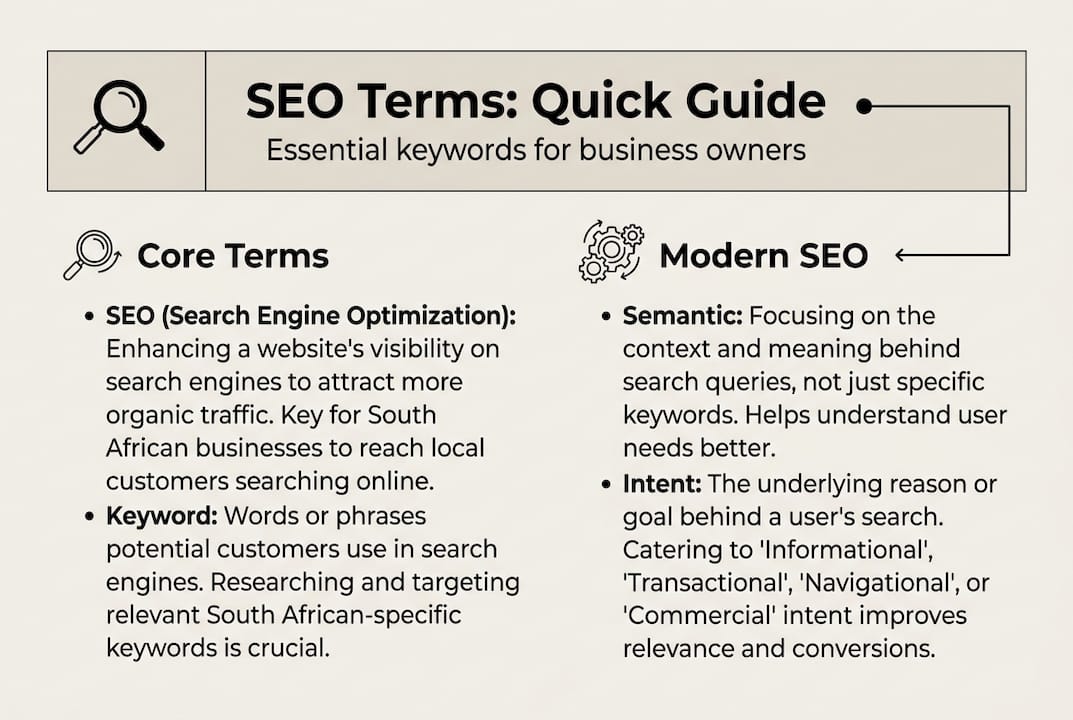
One term that trips up many business owners is semantic SEO. Traditional SEO focused heavily on repeating exact keywords. Semantic SEO is different. It means optimising for meaning, entities, and context beyond just keywords. Google now understands topics, not just phrases. So if your page thoroughly covers a subject, uses related terms naturally, and answers real questions, it ranks better than a page that simply stuffs in keywords.

Understanding search rankings becomes much easier once you see SEO as a system of signals rather than a single trick. Each term represents a lever your agency can pull to improve your position.
Modern SEO: semantic search, user intent, and local ranking factors
Having grasped core terms, let us examine modern SEO concepts shaping today’s search results. Google has changed dramatically over the past five years. Understanding these shifts will help you ask better questions and set realistic expectations.
User intent is the reason behind a search. Someone typing “best pizza Cape Town” wants recommendations. Someone typing “how to make pizza” wants a recipe. Google now matches results to intent, not just keywords. Your content needs to match what your audience actually wants, not just include the words they type.
Schema markup is code added to your website that helps Google understand your content better. Think of it as a label that tells Google: “This is a local business, these are our hours, this is our address.” It can help your listing appear with star ratings, opening times, and other rich details directly in search results.
Here are the local ranking factors that matter most for South African SMBs:
- NAP consistency: Your business Name, Address, and Phone number must match exactly across all online listings
- Google Business Profile: A fully optimised profile is non-negotiable for local visibility
- Local backlinks: Links from South African directories, news sites, and local businesses carry strong weight
- Reviews: Volume and quality of Google reviews directly influence local rankings
- Localised content: Pages that mention specific suburbs, cities, and local context rank better for nearby searches
| Modern SEO factor | What it means | Action for your business |
|---|---|---|
| Semantic relevance | Covering topics fully, not just keywords | Create content that answers real customer questions |
| User intent matching | Aligning content with search purpose | Check what top-ranking pages look like for your keywords |
| Schema markup | Structured data for Google to read | Ask your agency if schema is implemented on your site |
| Core Web Vitals | Page speed and user experience scores | Ensure your site loads fast on mobile |
Semantic SEO also means optimising for meaning, entities, and context using schema and related topics, which is why a well-structured South African SEO strategy covers far more than just keywords.
Pro Tip: Start with your Google Business Profile before anything else. It is free, it directly influences local search visibility, and it takes less than an hour to optimise properly.
Practical application: using SEO terminology to make smarter marketing decisions
Knowing what these terms mean is powerful when you put them to work in real-world business settings. Here is how to turn your new vocabulary into better decisions.
Steps to apply SEO knowledge in your business
- Request a baseline report: Ask your agency for a report showing your current organic traffic, keyword rankings, and backlink count. If they cannot provide this in plain language, that is a red flag.
- Set measurable goals: Use terms like “rank in the top 3 for [keyword] in Johannesburg” rather than vague goals like “improve SEO.”
- Review monthly: Track changes in your SERP positions, organic traffic, and enquiry volumes. Correlate these with what your agency is doing.
- Spot red flags early: If an agency promises “guaranteed number one rankings” or cannot explain what they are doing in simple terms, question it immediately.
- Connect SEO to revenue: Ask how many leads came from organic search each month. SEO should translate into calls, form submissions, and sales.
Common misinterpretations to clarify with your agency:
- “We are building backlinks” does not mean any links. Ask where the links come from and whether those sites are reputable.
- “We are optimising your content” should mean improving relevance and depth, not just adding keywords.
- “Your rankings improved” should be followed by data showing traffic and conversion changes, not just position movement.
Monthly SEO costs for South African SMBs typically range from R3,500 to R10,000, depending on the scope of work and your industry’s competitiveness. Knowing this helps you budget realistically and identify agencies that are either undercharging (and likely cutting corners) or overcharging without clear deliverables. Understanding the SEO challenges for SMEs also helps you set realistic timelines. SEO is not instant. Most businesses see meaningful results within three to six months of consistent effort.
Pro Tip: Always request a plain-language SEO report monthly. If a report is full of technical metrics but shows no connection to business outcomes like calls, leads, or sales, ask your agency to reframe it around results that matter to you.
Why most guides get SEO terminology wrong—and how you can do better
Most SEO guides fall into one of two traps. They either go so deep into technical detail that a business owner feels lost after the first paragraph, or they stay so surface-level that the content is useless for making real decisions. Neither approach serves you.
The real skill is not memorising definitions. It is translating terms into actions that support your business goals. A backlink is only useful if you understand it as a trust signal that helps you rank higher for searches your customers are making. A keyword is only useful if you know it represents real buying intent.
South African SMBs that succeed with SEO are not the ones who know the most jargon. They are the ones who ask the sharpest questions and require their SEO companies to connect every activity to a business outcome. Stay curious. When your consultant uses a term you do not recognise, stop them and ask for a plain-English explanation. A good agency will welcome that. A bad one will not.
Take your SEO knowledge further with expert support
Understanding SEO terminology is a genuine competitive advantage for your business. It helps you make smarter decisions, hold agencies accountable, and invest your budget where it actually works.
If you are ready to move from understanding to action, our team at Local SEO Agency works exclusively with South African businesses to build strategies that drive real, measurable growth. Explore our SEO packages to find the right fit for your goals, or browse our SEO case studies to see how businesses like yours have grown through focused, ethical SEO. Your next step starts with a conversation.
Frequently asked questions
What is SEO in simple terms?
SEO means improving your website so it appears at the top of Google when people search for your products or services. For South African SMBs, organic traffic drives 53% of total website visits, making it the most important channel to get right.
How much does SEO cost for a small business in South Africa?
Monthly SEO fees usually range between R3,500 and R10,000 depending on your goals, industry, and the level of competition in your area.
What does ‘semantic SEO’ mean?
Semantic SEO is about optimising your site for the meaning and intent behind searches, not just keywords. It involves optimising for meaning, entities, and context using schema markup and topic-based content strategies.
Why is local SEO important for my business?
Local SEO helps your business appear in search results for nearby customers, driving more visits, calls, and sales. Local-focused campaigns deliver 3 to 5 times higher conversions than broad national SEO efforts.
How can I tell if my SEO agency is doing a good job?
Ask for clear monthly reports showing organic search growth, keyword ranking changes, and leads or sales tied directly to SEO activity. If the numbers do not connect to business outcomes, push for clarity.
Recommended
- Unlock Growth with Top SEO Services in South Africa – LSA SEO Agency
- Unlocking Success: SEO Strategy South Africa Explained – LSA SEO Agency
- Unlock Growth with the Right SEO Optimization Service Provider – LSA SEO Agency
- SEO for Startups: Unlocking Growth in South Africa
- SEO in marketing: strategies for long-term growth
source https://localseoagency.co.za/seo-terminology-explained-unlock-business-growth-sa/



No comments:
Post a Comment