Measuring digital marketing ROI feels complicated until you realize it comes down to a handful of numbers that tell you exactly where your money is working. Many South African SME owners either skip tracking altogether or drown in data without knowing which figures actually matter. The result is wasted ad spend, missed growth, and a gut-feel approach to decisions that should be data-driven. This guide cuts through the noise. You will find clear definitions, practical benchmarks, and step-by-step methods to measure and improve ROI across both SEO and PPC campaigns, built specifically for the South African business context.
Table of Contents
- What is ROI in digital marketing and why it matters
- Key digital marketing ROI metrics every SME should track
- How to measure and interpret ROI for SEO and PPC campaigns
- Turning insights into action: Steps to improve your ROI
- Why most SME ROI reports miss the mark—and what actually works
- Take your ROI further with the right tools and partners
- Frequently asked questions
Key Takeaways
| Point | Details |
|---|---|
| Track actionable metrics | Focus on core ROI indicators like conversion rate, CAC, and ROAS for clear insights. |
| Measure and interpret results | Regular analysis of SEO and PPC performance turns data into better decisions. |
| Act on your insights | Apply campaign adjustments and use expert tools to boost long-term ROI. |
| Local context matters | Metrics and strategies should be tailored to the South African SME market. |
What is ROI in digital marketing and why it matters
ROI stands for Return on Investment. In digital marketing, it tells you how much revenue you generate for every rand you spend on a campaign. The formula is straightforward: (Net Profit / Cost of Investment) x 100. If you spent R10,000 on a Google Ads campaign and earned R30,000 in sales from it, your net profit is R20,000 and your ROI is 200%.
For SMEs operating on tight budgets, this number is not just useful. It is essential. ROI is a critical metric for understanding the effectiveness of your marketing spend, and without it, you are guessing. Guessing costs money.
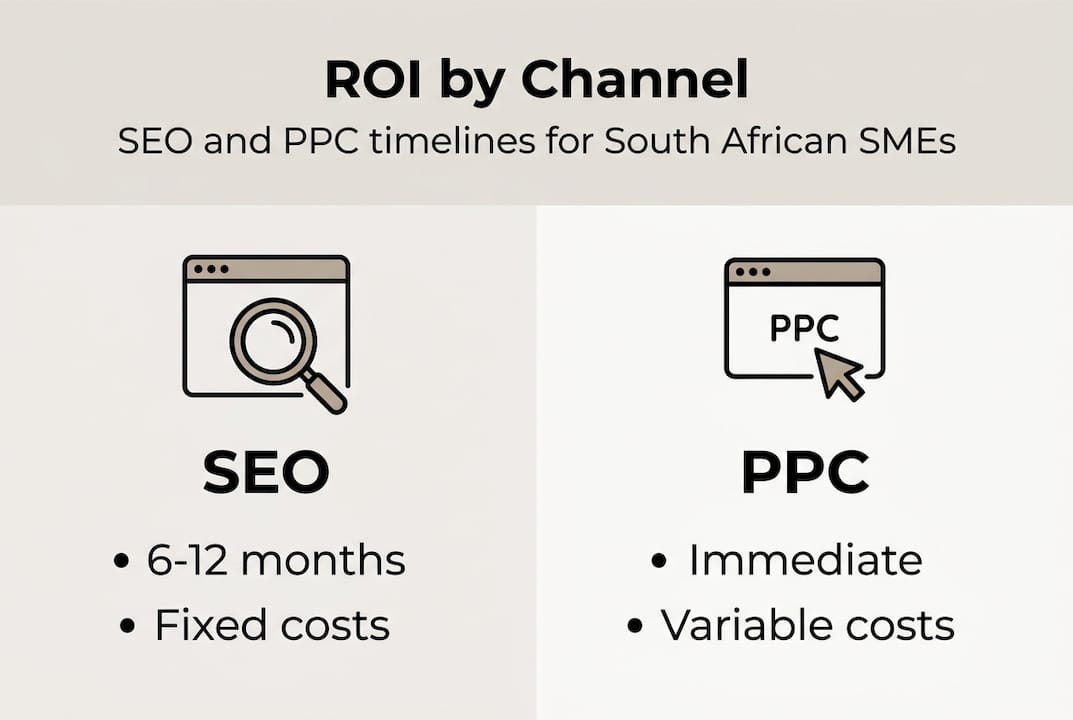
Different channels deliver ROI differently. SEO tends to build slowly over months but compounds over time, meaning the cost per lead drops as your rankings improve. PPC delivers results faster but stops the moment you stop paying. Understanding these differences helps you allocate budget with confidence rather than anxiety.
Here is a quick comparison to frame your thinking:
| Channel | Typical ROI timeline | Cost structure | Best for |
|---|---|---|---|
| SEO | 6 to 12 months | Fixed monthly retainer | Long-term lead generation |
| PPC | Immediate | Pay per click | Promotions and fast results |
| Social media ads | 1 to 3 months | Pay per impression or click | Brand awareness and retargeting |
| Email marketing | 1 to 4 weeks | Low cost per send | Existing customer retention |
Tracking ROI also prevents a common trap: spending more on what feels good rather than what performs. Many SMEs pour budget into social media because it is visible, while their real-world digital marketing examples show that organic search quietly drives three times the leads. Without ROI data, you would never know.
For those still getting familiar with the language of digital marketing, brushing up on marketing terminology basics will help you read reports and make decisions faster.
Pro Tip: Set a target ROI for each campaign before it launches. This gives you a benchmark to measure against and makes monthly reviews far more productive.
Key digital marketing ROI metrics every SME should track
ROI is the headline number, but it is built from several smaller metrics. Tracking these individually gives you the levers to pull when results are not where you want them.
Here are the five metrics that matter most:
- Conversion rate: The percentage of visitors who take a desired action, such as filling in a form or making a purchase. A low conversion rate means your traffic is not translating into revenue.
- Customer Acquisition Cost (CAC): How much you spend to acquire one new customer. Lower is better, but only if quality is maintained.
- Customer Lifetime Value (CLTV): The total revenue a customer brings over their entire relationship with your business. A high CLTV justifies a higher CAC.
- Cost Per Lead (CPL): What you pay for each potential customer who expresses interest. Useful for comparing channel efficiency.
- Return on Ad Spend (ROAS): Revenue generated for every rand spent on advertising. A ROAS of 4:1 means R4 earned for every R1 spent.
Tracking specific KPIs makes it possible to spot trends and adjust quickly, which is the difference between a campaign that recovers and one that bleeds budget for months.
Here is how SEO and PPC compare across these metrics:
| Metric | SEO performance | PPC performance |
|---|---|---|
| Conversion rate | Moderate (builds over time) | High (targeted intent) |
| CAC | Decreases over time | Stable or increases |
| CPL | Lower long-term | Higher but immediate |
| ROAS | Hard to isolate | Directly measurable |
| CLTV impact | High (organic trust) | Moderate |
Looking at South African SME examples shows that businesses combining SEO and PPC often achieve the best balance of immediate results and long-term growth. The digital marketing SME guide covers this balance in more detail.

For reliable tracking, HubSpot marketing statistics consistently show that businesses using dedicated analytics tools report significantly better campaign performance than those relying on manual tracking.
Pro Tip: Use Google Analytics 4 alongside Google Search Console for SEO data. For PPC, Google Ads conversion tracking is non-negotiable. Free tools exist, so there is no excuse to fly blind.
How to measure and interpret ROI for SEO and PPC campaigns
Now that you know what to track, here is exactly how to make sense of your numbers.
Measuring SEO ROI step by step:
- Identify all organic leads and sales using Google Analytics goal tracking.
- Assign a rand value to each conversion (average order value or lead value).
- Add up your total SEO costs: agency fees, content creation, and tools.
- Apply the formula: (Revenue from organic traffic minus SEO costs) / SEO costs x 100.
- Compare month over month and look for the upward trend, not just a single snapshot.
Measuring PPC ROI step by step:
- Set up conversion tracking in Google Ads before any campaign goes live.
- Record total ad spend for the period.
- Pull conversion data and multiply conversions by average transaction value.
- Subtract ad spend from revenue, then divide by ad spend and multiply by 100.
- Review attribution: did the PPC click start the journey or close it?
SEO and PPC deliver different ROI timeframes and types of value, which is why treating them as competing channels rather than complementary ones is a mistake most SMEs eventually correct.
Here is a sample ROI calculation to make this concrete:
| Channel | Monthly spend | Revenue generated | Net profit | ROI |
|---|---|---|---|---|
| SEO | R8,000 | R40,000 | R32,000 | 400% |
| PPC | R12,000 | R36,000 | R24,000 | 200% |
SEO shows a higher ROI here, but PPC delivered results in week one while SEO took six months to reach that level. Both numbers are useful. Neither tells the full story alone.
For context on what strong performance looks like, calculating SEO ROI benchmarks from Semrush suggest that well-executed SEO campaigns regularly return between 200% and 500% ROI over 12 months. You can see real local results in SEO agency case studies and link building case studies that reflect the South African market specifically.
Turning insights into action: Steps to improve your ROI
Knowing your numbers is not enough. Here is how to act on insights for real gains.
- Identify your top-performing channel and increase its budget by 15 to 20% while holding others steady. Let data lead the reallocation.
- Run split tests on landing pages. Change one element at a time: headline, call to action, or form length. Even a 1% improvement in conversion rate can meaningfully shift your ROI.
- Review attribution data monthly. Many conversions involve multiple touchpoints. A customer might find you via SEO, leave, then return through a PPC ad. Understanding this journey prevents you from cutting channels that are actually contributing.
- Pause underperforming ad groups rather than entire campaigns. Granular control saves budget without losing momentum.
- Build a quarterly review routine. Pull your CAC, CLTV, CPL, and conversion rate every three months. Compare to the previous quarter and set one specific improvement goal.
Consistent small tweaks often beat large overhauls.
Continuous improvement is essential for increasing long-term ROI, and the SMEs that grow fastest are the ones who review and adjust regularly rather than waiting for a crisis.
Local trends matter too. South African search behaviour shifts around events like Black Friday, load shedding cycles, and school holidays. Building these into your campaign calendar means your budget works harder when intent is highest. Tools like Google Trends and local keyword research tools help you stay ahead of these patterns.
For practical guidance on how to increase digital marketing ROI, Wordstream’s framework of test, measure, and scale applies directly to the South African context. You can also explore how to maximize your ROI with focused SEO strategies, or work with an SEO company for ROI that understands local market dynamics.
Pro Tip: Focus your energy on the channel with the highest ROAS first. Refine it until it is consistent, then apply the same discipline to the next channel.
Why most SME ROI reports miss the mark—and what actually works
Here is an uncomfortable truth: most SME ROI reports are measuring the wrong things. Business owners celebrate page views, follower counts, and impressions. These are vanity metrics. They feel good but they do not pay salaries.
The shift that changes everything is moving from “how much traffic did we get” to “how much revenue did each channel generate per rand spent.” That single change in perspective transforms your marketing from a cost centre into a growth engine.
Another pattern we see repeatedly is the annual strategy review. Businesses set their digital marketing plan in January and revisit it in December. By then, they have spent 12 months on a strategy that stopped working in March. The SMEs that outpace their competition review quarterly and adjust fast.
SMEs who translate data into quick action outpace their competition.
The answer is not more data. It is clearer data, acted on sooner. Start with understanding digital concepts so your team speaks the same language, then build a simple dashboard with five core metrics reviewed monthly. Clarity beats complexity every time.
Take your ROI further with the right tools and partners
Tracking ROI manually is possible, but it is slow and prone to gaps. The right tools and the right partners change the equation entirely.
At LSA SEO Agency, we work with South African SMEs to build measurement frameworks that connect every rand of marketing spend to real business outcomes. Whether you need local SEO strategies that drive consistent organic leads, or SEO optimization services that improve your rankings and conversion rates, we bring the tools and experience to make your numbers work harder. If you are ready to stop guessing and start growing, speak with our experts and let us map out a clear ROI strategy for your business.
Frequently asked questions
What is the most important digital marketing ROI metric for SMEs?
Conversion rate is a core metric for measuring ROI because it directly links user action to business results, making it the most impactful number to improve first.
How often should I review my digital marketing ROI metrics?
Review your metrics at least monthly and adjust your strategy quarterly. Frequent review of marketing metrics consistently leads to better campaign outcomes and faster course corrections.
What tools can help measure ROI for SEO and PPC?
Google Analytics and Google Ads provide built-in tracking for both channels. Local agencies provide specialized tools for ROI tracking that are tailored to the South African market and SME budgets.
Should South African SMEs prioritize SEO or PPC for better ROI?
SEO and PPC deliver different ROI types, so the best approach depends on your timeline and budget. SEO builds long-term value while PPC delivers fast, measurable results.
What is a quick win for boosting digital marketing ROI?
Optimizing your most visited landing pages can rapidly increase conversions. Page optimization boosts conversions and ROI faster than most other single changes you can make to a campaign.
Recommended
- Digital marketing examples for South African SMEs in 2026
- Digital marketing for South African SMEs: 2026 guide
- What Is Digital Marketing and Why It Matters for SMEs
- The Impact of South African SEO Companies on Business Growth – LSA SEO Agency
- Types de publicité en ligne pour booster votre ROI
source https://localseoagency.co.za/digital-marketing-roi-metrics-south-african-smes/



No comments:
Post a Comment