Many small business owners believe SEO is just about keywords and content. This misconception costs them valuable search rankings. Technical SEO significantly impacts how Google crawls, indexes, and ranks your website. Without solid technical foundations, even the best content struggles to appear in search results. This guide explains what technical SEO is, why it matters for South African SMBs, and how to implement it effectively to boost your online visibility in 2026.
Table of Contents
- What Is Technical Seo And Why It Matters
- Core Technical Seo Components Every Small Business Should Focus On
- How To Diagnose And Fix Common Technical Seo Issues
- Enhancing Your Website’s Visibility With Structured Data And Seo Strategies
- How Local Seo Agency Can Help Your Small Business Excel In Technical Seo
Key takeaways
| Point | Details |
|---|---|
| Technical foundations matter most | Site speed, mobile-friendliness, and crawlability directly determine how Google indexes and ranks your website. |
| Fix errors to unlock visibility | Resolving technical issues like broken links and crawl errors can increase impressions by 261% within weeks. |
| Structured data boosts clicks | Implementing schema markup can increase click-through rates by 30% through rich snippets. |
| Strategy beats tactics | Successful SEO requires integrating technical improvements with content and local SEO strategies rather than random fixes. |
| Tools make diagnosis simple | Free tools like Google PageSpeed Insights and Search Console help identify and fix technical problems quickly. |
What is technical SEO and why it matters
Technical SEO involves optimizing your website’s infrastructure so search engines can crawl, understand, and index your content efficiently. Think of it as building a solid foundation before decorating your house. Without this foundation, your beautiful content might never reach potential customers.
Core technical elements include site speed, mobile-friendliness, crawlability, and proper indexing. Technical SEO significantly impacts organic search visibility because these factors directly affect how Google processes your website. If Google’s crawlers can’t access your pages or if they load too slowly, your rankings suffer regardless of content quality.
Google’s mobile-first indexing makes mobile optimization particularly critical in 2026. The search engine primarily uses your mobile site version for ranking decisions. Many South African small businesses still neglect this aspect, losing potential customers to competitors with faster, mobile-optimized sites.
Technical SEO delivers several benefits for SMBs:
- Improved search rankings through better crawlability
- Enhanced user experience leading to higher conversion rates
- Reduced bounce rates from faster page loading
- Better indexing ensuring all valuable pages appear in search results
- Competitive advantage over businesses ignoring technical foundations
Pro Tip: Before investing in content creation or link building, audit and fix your technical SEO basics. A technically sound website amplifies every other SEO effort you make.
Understanding SEO importance for small businesses starts with recognizing that technical health determines whether your optimization efforts succeed or fail. You can’t rank well if Google can’t properly crawl your site.
Core technical SEO components every small business should focus on
Site speed stands as the most crucial technical factor. Page speed is a critical ranking factor because slow websites frustrate users and underperform in search results. Google PageSpeed Insights provides free analysis showing exactly where your site needs improvement. Aim for loading times under three seconds on both desktop and mobile.

Mobile-friendliness cannot be optional anymore. With mobile-first indexing, Google primarily evaluates your mobile site version. The Mobile-Friendly Test reveals whether your website passes Google’s usability standards. Responsive design, readable text without zooming, and touch-friendly buttons are essential requirements.
| Speed Metric | Typical Performance | Ideal Target | Impact |
|---|---|---|---|
| First Contentful Paint | 3-4 seconds | Under 1.8 seconds | User engagement and bounce rate |
| Largest Contentful Paint | 4-6 seconds | Under 2.5 seconds | Core Web Vitals ranking signal |
| Time to Interactive | 5-7 seconds | Under 3.8 seconds | Conversion rate optimization |
| Total Page Load | 6-10 seconds | Under 3 seconds | Overall user satisfaction |
Crawlability and indexing determine which pages Google discovers and ranks. Your robots.txt file controls crawler access, while XML sitemaps guide search engines to important content. Incorrect robots.txt settings can accidentally block Google from indexing your entire website. Noindex tags prevent specific pages from appearing in search results, useful for duplicate content or administrative pages.
Common technical errors sabotage rankings:
- Broken links creating poor user experience and wasted crawl budget
- 404 errors preventing access to valuable content
- Server errors (5xx codes) signaling unreliable hosting
- Redirect chains slowing page speed and diluting link equity
- Missing or incorrect canonical tags causing duplicate content issues
Pro Tip: Check Google Search Console weekly for crawl errors. Early detection prevents minor issues from becoming major ranking problems. The Coverage report shows exactly which pages Google cannot access or index properly.
Prioritize fixes based on user impact and ranking influence. Address server errors immediately, optimize your slowest high-traffic pages first, and ensure your most valuable content is crawlable. Free tools like Screaming Frog SEO Spider help identify technical issues across your entire website in minutes.
How to diagnose and fix common technical SEO issues
Diagnosing technical problems requires systematic investigation before attempting fixes. Random changes without understanding root causes often create new issues. Start by examining how Google actually sees your website rather than assuming everything works correctly.
Begin with robots.txt and sitemap verification. Navigate to yourwebsite.com/robots.txt to view your current file. Check whether it accidentally blocks important pages or entire sections. Then verify your XML sitemap at yourwebsite.com/sitemap.xml loads properly and contains all important URLs. Google Search Console’s URL Inspection tool shows exactly how Googlebot processes specific pages.
Top technical SEO issues plaguing small businesses include slow page speed, mobile usability errors, crawl access problems, and server configuration conflicts. Server or CDN settings sometimes override robots.txt directives, creating confusing situations where files say one thing but the server does another. This mismatch prevents proper crawling despite correct robots.txt syntax.
Follow these steps to diagnose and fix robots.txt and crawlability issues:
- Test your robots.txt file using Google Search Console’s robots.txt Tester tool to verify syntax and rules
- Check server response headers using browser developer tools or online header checkers for conflicting directives
- Verify CDN settings don’t add unexpected noindex headers or block crawlers through IP filtering
- Inspect critical pages using Search Console’s URL Inspection to see Google’s actual rendering
- Monitor Index Coverage reports weekly to catch new crawling or indexing problems early
- Update and resubmit your sitemap after fixing access issues to accelerate reindexing
Pro Tip: Use the live URL test in Search Console rather than relying on cached data. This shows real-time crawler access and rendering, revealing issues your local testing might miss.
Case studies demonstrate dramatic results from fixing technical errors. One business increased impressions by 261% and indexed URLs by 260% within three weeks simply by correcting robots.txt blocking. These system-level problems often have outsized impact because they affect your entire website simultaneously.
Conducting periodic technical SEO audits maintains performance over time. Website updates, plugin changes, and hosting migrations can introduce new technical issues unexpectedly. Quarterly audits catch problems before they significantly damage rankings and traffic.
Enhancing your website’s visibility with structured data and SEO strategies
Structured data markup helps search engines understand your content’s meaning and context beyond just keywords. This semantic information enables Google to display rich snippets, knowledge panels, and enhanced search features that attract more clicks. Small businesses using schema markup gain competitive advantages through more prominent, informative search listings.
| Feature | Without Structured Data | With Structured Data | Benefit |
|---|---|---|---|
| Search appearance | Plain text snippet | Rich snippet with ratings, prices, images | 30% higher CTR |
| Local visibility | Basic business listing | Enhanced with hours, reviews, photos | Improved local pack rankings |
| Content understanding | Keyword-based interpretation | Semantic context recognition | Better matching to search intent |
| Featured snippets | Lower probability | Higher selection likelihood | Position zero visibility |
Key structured data types valuable for South African small businesses include local business schema, product markup for e-commerce, review ratings, FAQ schema, and article markup. Local business schema particularly helps with local SEO strategies by providing Google with consistent business information across your website.
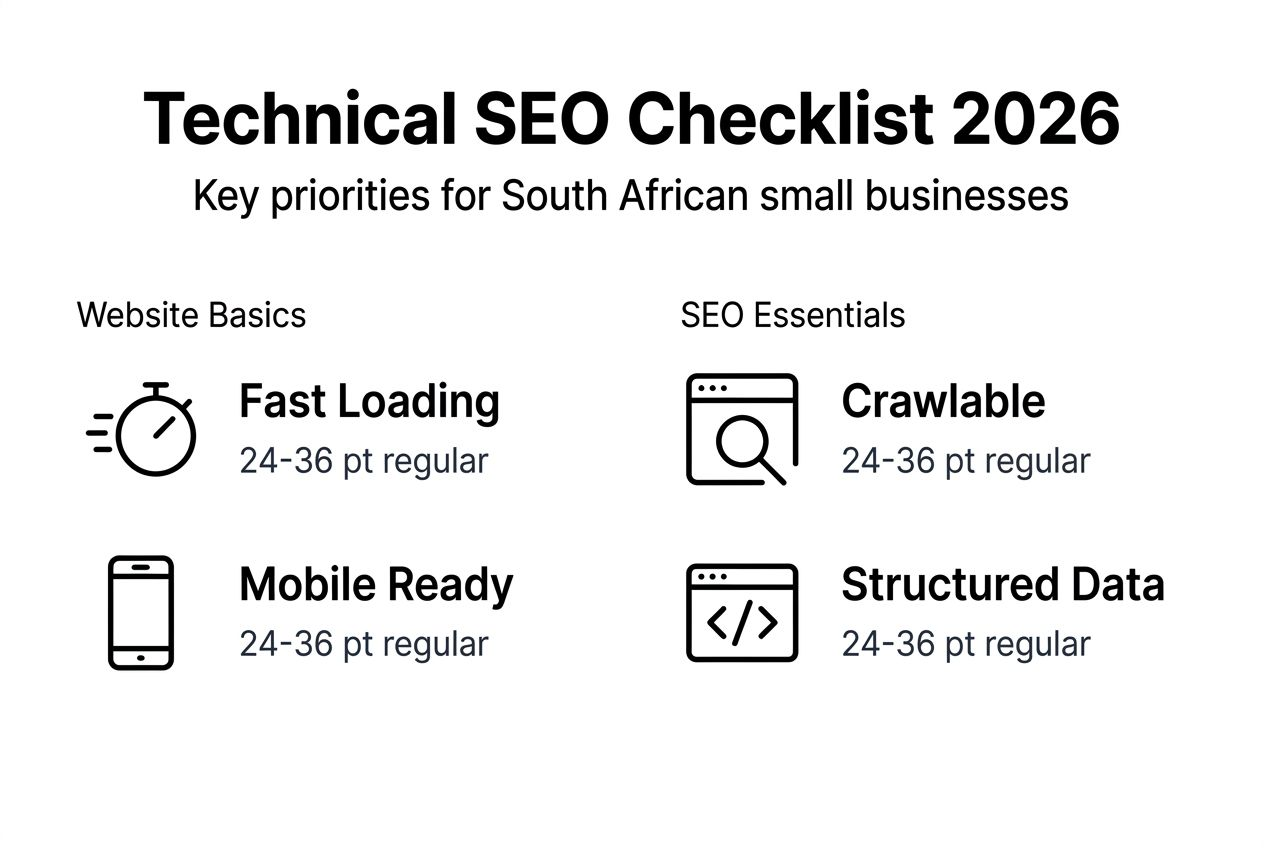
Technical SEO forms the foundation supporting broader optimization efforts. Perfect on-page content and authoritative backlinks cannot compensate for a technically broken website. Conversely, solid technical infrastructure amplifies every other SEO investment you make. Think of technical SEO as the engine, content as the fuel, and links as the accelerator.
Best practices for combining technical improvements with comprehensive strategy:
- Align technical fixes with business goals and high-value pages first
- Coordinate mobile optimization with local search targeting for maximum impact
- Implement structured data alongside content creation to enhance new pages immediately
- Monitor technical health metrics while tracking ranking and traffic improvements
- Integrate technical considerations into your SEO strategy development process
Pro Tip: Combine structured data implementation with local SEO optimization. Adding local business schema while improving Google Business Profile consistency creates powerful signals for local search rankings.
Avoiding common mistakes requires continuous education and strategy refinement. 96.55% of content gets no traffic from Google, often because businesses lack clear SEO strategies beyond random tactics. Successful SEO in 2026 demands integrating technical excellence with strategic content creation and local optimization tailored to South African market conditions.
How Local SEO Agency can help your small business excel in technical SEO
Navigating technical SEO complexities requires specialized expertise most small business owners lack time to develop. Local SEO Agency conducts comprehensive technical SEO audits identifying hidden issues blocking your search visibility. Our team fixes crawlability problems, optimizes site speed, implements structured data, and ensures mobile-friendliness meets Google’s standards.
We provide tailored local SEO services supporting South African small business growth through proven strategies. Rather than generic advice, we analyze your specific technical challenges and create prioritized action plans delivering measurable results. Our expertise in page indexing techniques ensures Google discovers and ranks your most valuable content. Partner with professionals who understand both technical requirements and local market dynamics.
FAQ
What is the most important technical SEO factor for small businesses?
Site speed stands as the most critical technical factor because page speed directly affects both rankings and user experience. Slow websites frustrate visitors who leave before pages load, increasing bounce rates and reducing conversions. Google recognizes this correlation and prioritizes faster sites in search results. Mobile-friendliness ranks second in importance, especially with mobile-first indexing determining how Google evaluates and ranks websites.
How can I check if my website is mobile-friendly?
Use Google’s Mobile-Friendly Test by entering your URL to receive immediate assessment of mobile usability. The tool identifies specific issues like text too small to read, clickable elements too close together, or content wider than the screen. Look for responsive design that adapts layouts automatically to different screen sizes. Test your website on actual mobile devices to verify fast loading and easy navigation beyond automated tool results.
What common technical SEO mistakes should small business owners avoid?
Ignoring technical fundamentals like fixing crawl errors, optimizing site speed, and ensuring mobile-friendliness represents the biggest mistake. Many businesses focus exclusively on content while neglecting the technical foundation enabling that content to rank. Operating without a clear, documented SEO strategy aligned with business objectives leads to wasted effort on low-impact activities. Lack of strategy explains why most content receives zero traffic. Neglecting mobile-first indexing requirements and failing to implement structured data markup also limit visibility unnecessarily.
Can structured data really improve my search traffic?
Yes, structured data demonstrably improves search performance by enabling rich snippets that attract more attention and clicks. Websites using schema markup can experience CTR increases up to 30% compared to plain text listings. Rich snippets display additional information like star ratings, prices, availability, and images directly in search results. This enhanced visibility makes your listing more appealing than competitors, driving higher click-through rates that translate to increased organic traffic over time.
Recommended
- The Essential South African SEO Strategy for Business Growth – LSA SEO Agency
- SEO fundamentals explained: boost your SA business in 2026
- Mastering South African SEO Techniques for Competitive Edge – LSA SEO Agency
- Boost Your Business with a Top SEO Specialist South Africa – LSA SEO Agency
source https://localseoagency.co.za/technical-seo-south-african-small-businesses/



No comments:
Post a Comment