More than 40 percent of south-african consumers now use voice-activated devices to search for local products and services. For local business owners in South Africa, understanding how voice search optimisation works could mean the difference between being found or forgotten online. This article breaks down essential strategies and tips to help your business stand out in voice search results, connecting you with more potential customers right in your community.
Table of Contents
- Voice Search Optimisation In South Africa Explained
- Types Of Voice Search And Devices Used
- How Voice Search Changes Local SEO
- Multilingual And Conversational Keyword Strategy
- Technical Setup For Mobile And Voice SEO
- Risks, Costs, And Mistakes To Avoid
Key Takeaways
| Point | Details |
|---|---|
| Voice Search is Essential for SMEs | South African SMEs must optimise for voice search to increase online visibility and engage customers effectively. |
| Emphasise Localisation | Content must reflect local language, pronunciation, and conversational patterns to meet the needs of diverse users. |
| Focus on Technical Optimisation | Implement responsive design, structured data, and mobile compatibility to enhance voice search performance and user experience. |
| Beware of Common Pitfalls | Avoid over-optimisation and generic content to prevent financial loss and search engine penalties. |
Voice Search Optimisation In South Africa Explained
Voice search optimisation represents a critical digital strategy for South African small and medium enterprises (SMEs) seeking to enhance their online visibility and customer engagement. As more consumers use voice-activated devices like smartphones and smart speakers, businesses must adapt their digital presence to capture these emerging search patterns. Voice search SEO tactics have become increasingly important for companies wanting to remain competitive in the digital marketplace.
In the South African context, voice search optimisation requires understanding local language nuances, pronunciation variations, and search behaviour unique to our diverse linguistic landscape. Unlike traditional text-based searches, voice queries tend to be longer, more conversational, and often phrased as complete questions. This means SMEs must develop content strategies that anticipate natural language patterns and provide direct, concise answers to potential customer inquiries.
Successful voice search optimisation involves several key technical and content-related strategies. Businesses need to focus on long-tail keywords, create FAQ-style content, ensure mobile responsiveness, and implement structured data markup. Local businesses particularly benefit by optimising for location-based voice searches, which often include phrases like “near me” or specific neighbourhood references. Implementing these techniques helps SMEs improve their chances of being the primary result when potential customers use voice search to find products or services.
Pro tip: Conduct regular voice searches using different devices and accents to understand how your business appears in results and refine your optimisation strategy accordingly.
Types Of Voice Search And Devices Used
Voice search technology in South Africa has rapidly evolved, encompassing multiple types and devices that are transforming digital interaction. The South African voice search market represents a complex ecosystem of technologies including text-to-speech, speech recognition, and multimodal search platforms. Smartphones remain the primary device for voice searches, with penetration rates increasing across urban and metropolitan areas.
Three primary types of voice search dominate the South African digital landscape. Text-to-speech technology enables devices to convert written content into spoken words, while speech recognition allows systems to understand and interpret spoken language. Multimodal search represents the most advanced category, integrating voice commands with visual interfaces, enabling more sophisticated user interactions across smartphones, smart speakers, and digital assistants.
The diversity of devices driving voice search is impressive. Smartphones lead the market, followed by smart speakers from brands like Google Home and Amazon Alexa. Digital assistants embedded in vehicles, smart home systems, and wearable technology are also gaining traction. Each device type offers unique capabilities, with South African consumers increasingly adopting these technologies for everything from basic internet searches to complex transactional interactions.

Here’s how the main types of voice search technologies used in South Africa compare:
| Technology Type | Core Function | Typical Usage Scenario | Example Device |
|---|---|---|---|
| Text-to-speech | Converts written content to speech | Reading news aloud | Google Assistant |
| Speech recognition | Processes spoken language | Voice-enabled commands | Amazon Alexa |
| Multimodal search | Integrates voice and visual input | Interactive app navigation | Samsung smartphones |
Pro tip: Experiment with voice search across different devices to understand nuanced performance and potential variations in search results.
How Voice Search Changes Local SEO
Voice search is fundamentally transforming local search engine optimisation strategies for South African businesses, creating new challenges and opportunities for small and medium enterprises. Local search engine optimization now requires a more conversational and contextually aware approach that goes beyond traditional keyword strategies. The shift towards natural language queries means businesses must rethink how they structure online content to capture voice-based search results.
The primary impact of voice search on local SEO involves significant changes in search query patterns. Unlike typed searches, voice queries tend to be longer, more conversational, and often include question-based phrases like “Where can I find…” or “What’s the best… near me”. This means local businesses must develop hyperlocal content that directly answers specific community-based questions, incorporating neighbourhood names, local landmarks, and colloquial language that reflects how people actually speak in different South African regions.
Technical optimisation has also become crucial in voice search local SEO. Businesses now need to focus on featured snippets, structured data markup, and Google My Business listings that provide precise, concise information. Mobile optimization has become even more critical, as most voice searches occur on smartphones. Local businesses must ensure their website loads quickly, displays correctly on mobile devices, and includes clear, easily accessible contact information and location details that voice search algorithms can quickly interpret and relay to potential customers.
Pro tip: Create a comprehensive FAQ page using natural, conversational language that mirrors how local customers might ask questions about your business.
Multilingual And Conversational Keyword Strategy
In South Africa’s diverse linguistic landscape, voice search optimization demands a sophisticated multilingual approach that transcends traditional keyword strategies. Local SEO services must now account for the complex linguistic variations that characterise our nation, including English, Afrikaans, Zulu, Xhosa, and other indigenous languages. This multicultural context means businesses cannot rely on a one-size-fits-all keyword approach, but must develop nuanced, context-aware content strategies.
Conversational keywords represent a fundamental shift in search optimization. Unlike traditional keyword strategies that focus on exact match phrases, voice search requires understanding natural language patterns and intent-based searching. This means developing content that anticipates how people actually speak, incorporating colloquial expressions, local slang, and question-based formats. For instance, instead of targeting “plumber Johannesburg”, businesses should optimize for conversational queries like “Who can fix my burst pipe in Sandton?”
The technical implementation of a multilingual conversational strategy involves several key techniques. Businesses need to develop long-tail conversational keywords that reflect natural speech patterns, create structured content that directly answers potential questions, and implement schema markup that helps search algorithms understand context. This approach requires deep linguistic understanding, including regional dialect variations, idiomatic expressions, and the subtle contextual differences that exist across South Africa’s diverse language communities.
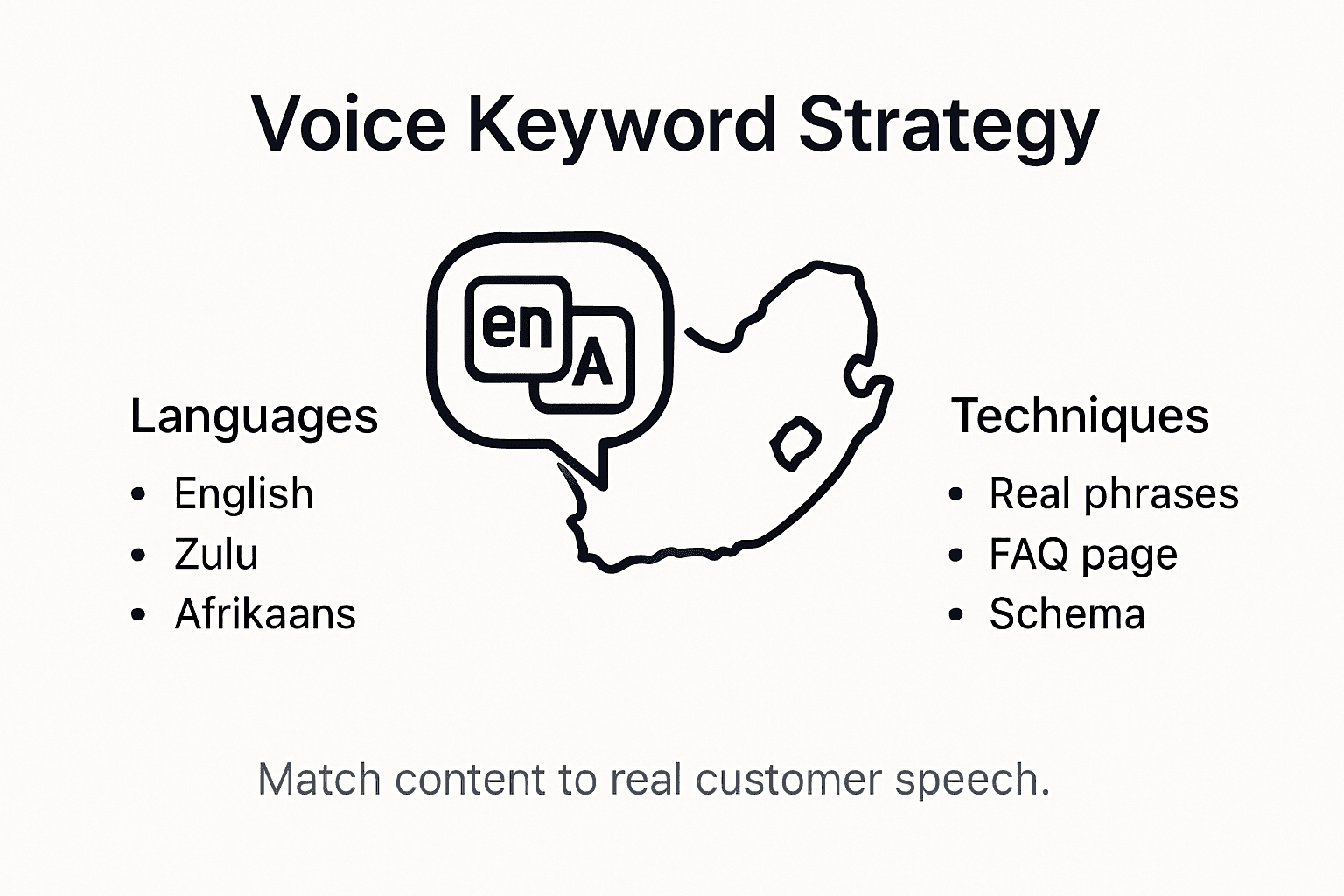
Pro tip: Record actual customer conversations and use their exact language as a basis for developing your voice search keyword strategy.
Technical Setup For Mobile And Voice SEO
Technical optimization for mobile and voice search requires a comprehensive approach that goes beyond traditional website design. Best practices for schema markup have become critical in helping search engines understand and interpret website content more effectively. South African SMEs must focus on creating a technical infrastructure that supports both mobile responsiveness and voice search compatibility.
The core technical requirements involve implementing responsive design, accelerated mobile pages (AMP), and structured data markup. Websites must load quickly on mobile devices, with page load times under three seconds being critical for both mobile and voice search rankings. This means optimising images, minimising code, leveraging browser caching, and ensuring a lightweight, efficient website structure that performs seamlessly across different mobile devices and network conditions.
Schema markup represents a crucial technical element for voice search optimization. Businesses need to implement local business schema, product schemas, and FAQ schemas that provide search engines with precise, structured information about their offerings. This technical approach helps voice assistants extract and deliver more accurate information when users make conversational queries. Additionally, ensuring mobile-friendly navigation, touch-friendly interfaces, and clear, concise content helps improve both mobile user experience and voice search discoverability.
Pro tip: Use Google’s Mobile-Friendly Test and PageSpeed Insights tools monthly to continuously monitor and improve your website’s technical performance for mobile and voice search.
Risks, Costs, And Mistakes To Avoid
Voice search optimization presents unique challenges and potential pitfalls for South African SMEs, requiring a strategic and measured approach. Local SEO services highlight that improper implementation can lead to significant financial and visibility risks. The most common mistakes include over-optimization, neglecting local language nuances, and failing to understand the technical complexities of voice search algorithms.
Financial risks are substantial for businesses approaching voice search optimization without proper planning. Implementation costs can range from moderate technical updates to complete website redesigns, potentially requiring investments between R20,000 to R100,000 depending on the business’s current digital infrastructure. Small businesses must carefully budget for technical modifications, content restructuring, and potential consulting fees. Common expensive mistakes include rushed implementations, generic content strategies, and neglecting mobile responsiveness, which can result in wasted resources and minimal return on investment.
Technical risks involve potential penalties from search engines for inappropriate optimization techniques. Businesses must avoid keyword stuffing, creating irrelevant content, and implementing deceptive schema markup. South African enterprises need to focus on authentic, contextually relevant content that genuinely answers user queries. This means developing natural language content, ensuring mobile compatibility, and maintaining strict adherence to search engine guidelines to prevent potential ranking penalties or complete removal from search results.
Here is a quick summary of potential risks and costly mistakes for South African SMEs in voice search optimisation:
| Risk Type | Common Cause | Business Impact |
|---|---|---|
| Financial | Over-investment without auditing | Wasted resources, poor ROI |
| Technical | Keyword stuffing, spammy schema | Potential ranking penalties |
| Content | Ignoring local language nuances | Irrelevant search results |
| Strategic | Rushed implementation, poor planning | Minimal improvement in visibility |
Pro tip: Conduct a comprehensive voice search audit of your current digital presence before investing significant resources in optimization strategies.
Elevate Your South African SME With Expert Voice Search Optimisation Support
Voice search optimisation presents real challenges for South African businesses trying to keep pace with evolving customer habits and complex multilingual demands. From mastering conversational keywords to perfecting technical setups like schema markup and mobile responsiveness ensuring your business stands out during local voice searches is critical. Struggling to adapt to these changes can cause you to miss valuable leads and fall behind competitors who have already invested in tailored, context-aware strategies.
Partner with a trusted expert who understands the unique voice search landscape in South Africa. Our local SEO services are designed to address your specific pain points from content creation through to technical SEO adjustments. We help you develop natural, conversational keyword strategies, optimise your Google My Business listing and implement precise schema to increase visibility on voice-activated devices. Don’t risk costly mistakes or wasted effort take action today and connect with our team at Local SEO Agency contact page to transform your digital presence and capture more local customers now.
Frequently Asked Questions
What is voice search optimisation?
Voice search optimisation involves adapting a business’s digital presence to improve visibility and engagement through voice-activated search queries. This includes strategies like using long-tail keywords, creating FAQ-style content, and implementing structured data.
How does voice search affect local SEO?
Voice search significantly changes local SEO by shifting focus to conversational, question-based queries. Businesses need to create hyperlocal content and optimize for featured snippets and mobile responsiveness to capture these searches effectively.
What are key strategies for optimising for voice search?
Key strategies include using long-tail keywords that reflect natural language, creating structured and FAQ content, ensuring mobile responsiveness, and implementing schema markup to help search engines understand the content more effectively.
Why is it important for SMEs to implement voice search optimisation?
Implementing voice search optimisation is crucial for SMEs as it enhances online visibility, improves customer engagement, and positions businesses competitively in a rapidly evolving digital landscape that increasingly relies on voice-activated technology.
Recommended
- Top Voice Search SEO Tactics for 2025 Success
- Unlocking Success: SEO Strategy South Africa Explained – LSA SEO Agency
- Your Go-To South African SEO Techniques for Online Success – LSA SEO Agency
- Master Local SEO South Africa to Outshine Your Competitors – LSA SEO Agency
- 8 Digital Marketing Tips for Small Businesses in 2025 – Go Online Now
source https://localseoagency.co.za/voice-search-optimisation-south-africa/



No comments:
Post a Comment