Running a small business in South Africa often means competing with well known brands for space on Google. Standing out in local search depends on how well your website speaks to both customers and search engines. By mastering on-page SEO basics from keyword research to creating smart content structure, you set the stage to attract more eyes from your community and turn online searches into actual business.
Table of Contents
- Stage 1: Conduct Keyword and Competitor Research
- Stage 2: Optimise Page Titles and Meta Descriptions
- Stage 3: Structure Content with Headings and Internal Links
- Stage 4: Enhance On-Page Elements for Local Seo
- Stage 5: Verify Seo Performance and Fix Issues
Quick Summary
| Key Insight | Explanation |
|---|---|
| 1. Conduct Keyword Research | Identify local keywords to attract relevant customers and improve your targeting strategy. |
| 2. Optimise Page Titles | Create unique, engaging titles and meta descriptions to increase click-through rates from search results. |
| 3. Structure Content Effectively | Use clear headings and internal links to enhance user experience and aid search engine indexing. |
| 4. Enhance On-Page Elements | Optimise schema markup, NAP consistency, and images to boost local SEO visibility and relevance. |
| 5. Regularly Review SEO Performance | Monitor site metrics and address technical issues to maintain or improve search rankings. |
Stage 1: Conduct Keyword and Competitor Research
Keyword research is your strategic foundation for attracting local customers through search engines. By understanding what potential clients actually search for, you can align your website content precisely with their needs. Competitive keyword analysis allows you to uncover opportunities your rivals might have overlooked.
Begin by using keyword research tools to generate a comprehensive list of relevant search terms specific to your local business. Focus on location-based keywords that include your city or region combined with your services. For instance, if you are a plumber in Johannesburg, target phrases like “emergency plumber Johannesburg” or “pipe repair Sandton”. Analyse each keyword’s search volume, difficulty rating, and potential traffic to prioritise your targeting strategy. Look for keywords with decent search volume but lower competition where you can realistically rank.
Study your top three local competitors carefully. Examine their websites to understand which keywords they target, what content they produce, and where potential content gaps exist. Use tools that reveal competitor keyword rankings to identify opportunities they might have missed. This research provides insights into your market and helps you develop a more strategic approach to content creation.
Practical Suggestion: Create a spreadsheet tracking keywords, their monthly search volume, difficulty score, and potential relevance to categorise and prioritise your keyword strategy effectively.
Here’s a comparison of key tools used for effective keyword and competitor research in local SEO:
| Tool Name | Main Purpose | Best For | Typical Output |
|---|---|---|---|
| Google Keyword Planner | Identifying keyword ideas | Local keyword searches | Search volume, suggestions |
| SEMrush | Analysing competitor keywords | Tracking rival strategies | Competitor rankings |
| Ahrefs | Keyword difficulty and backlinks | Site audit and competitor gap | Difficulty score, keywords |
| Moz | Local keyword recommendations | Businesses targeting locations | Relevance, volume data |
Stage 2: Optimise Page Titles and Meta Descriptions
Crafting compelling page titles and meta descriptions is crucial for attracting local search traffic and improving your website’s visibility. Google recommends creating unique, descriptive titles that accurately represent your page content and entice potential customers to click through from search results.

Start by developing page titles that are concise yet informative. Aim for 50 to 60 characters that include your primary local keyword and clearly communicate what the page offers. For a plumbing business in Johannesburg, a strong title might read “Emergency Plumber Johannesburg | Rapid Pipe Repairs”. Ensure each page has a distinct title that reflects its specific content. When writing meta descriptions, focus on creating a compelling summary that includes relevant keywords and communicates the unique value of your service. Limit these descriptions to 155 characters and make them engaging enough to encourage users to click.
Remember that your titles and meta descriptions are essentially your first point of contact with potential customers in search results. They should be clear, persuasive, and include a strong value proposition that sets you apart from local competitors. Regularly review and update these elements to maintain their effectiveness and alignment with your current service offerings.
Practical Suggestion: Use free online character count tools to precisely measure your title and meta description length before finalising them.
Stage 3: Structure Content with Headings and Internal Links
Organising your website content effectively is critical for both user experience and search engine optimisation. Structuring content with strategic headings helps search engines understand your page hierarchy and makes information more digestible for your local customers.
Start by creating a clear content structure using hierarchical headings. Your main page title should be an H1 heading, with subsequent sections using H2 and H3 headings to break down information logically. For a local business website, this might mean using an H1 like “Emergency Plumbing Services in Johannesburg”, followed by H2 headings such as “Residential Plumbing Repairs” and “Commercial Plumbing Solutions”. When writing content, ensure each heading provides a clear indication of the section topic and includes relevant local keywords where natural.
Internal linking is another powerful technique to improve your site’s SEO and user navigation. Connect related pages within your website using descriptive anchor text that helps both users and search engines understand the context. For example, within a plumbing services page, you might link to specific service pages like “residential pipe repairs” or “emergency call out services”. This approach not only helps distribute link equity across your site but also guides potential customers to more detailed information about your local business offerings.
Practical Suggestion: Create a spreadsheet mapping out your website’s content structure to visualise and plan your heading hierarchy and internal linking strategy.
Stage 4: Enhance On-Page Elements for Local SEO
Improving your website’s on page elements is crucial for attracting local customers and boosting your search engine visibility. On-Page SEO Fundamentals for Local Growth offer critical strategies to help small businesses stand out in local search results.
Start by optimising your website’s schema markup to help search engines understand your local business details. Include specific information like your business name, address, phone number, operating hours, and service areas. Ensure your NAP (Name Address Phone) information is consistent across your website and matches your Google Business Profile. Use local keywords naturally throughout your content, focusing on location specific phrases that potential customers might use when searching for services in your area.
Pay special attention to your image optimisation. Use descriptive file names and alt text that include local keywords. For instance, instead of “IMG1234.jpg”, use “emergency plumber Johannesburg service.jpg”. Add location specific content like neighbourhood names, local landmarks, and service area specifics to help improve your local search relevance. Include customer testimonials and local references that demonstrate your connection to the community and build trust with potential clients.
Practical Suggestion: Create a spreadsheet tracking your local SEO elements to ensure consistent and comprehensive optimisation across your website.
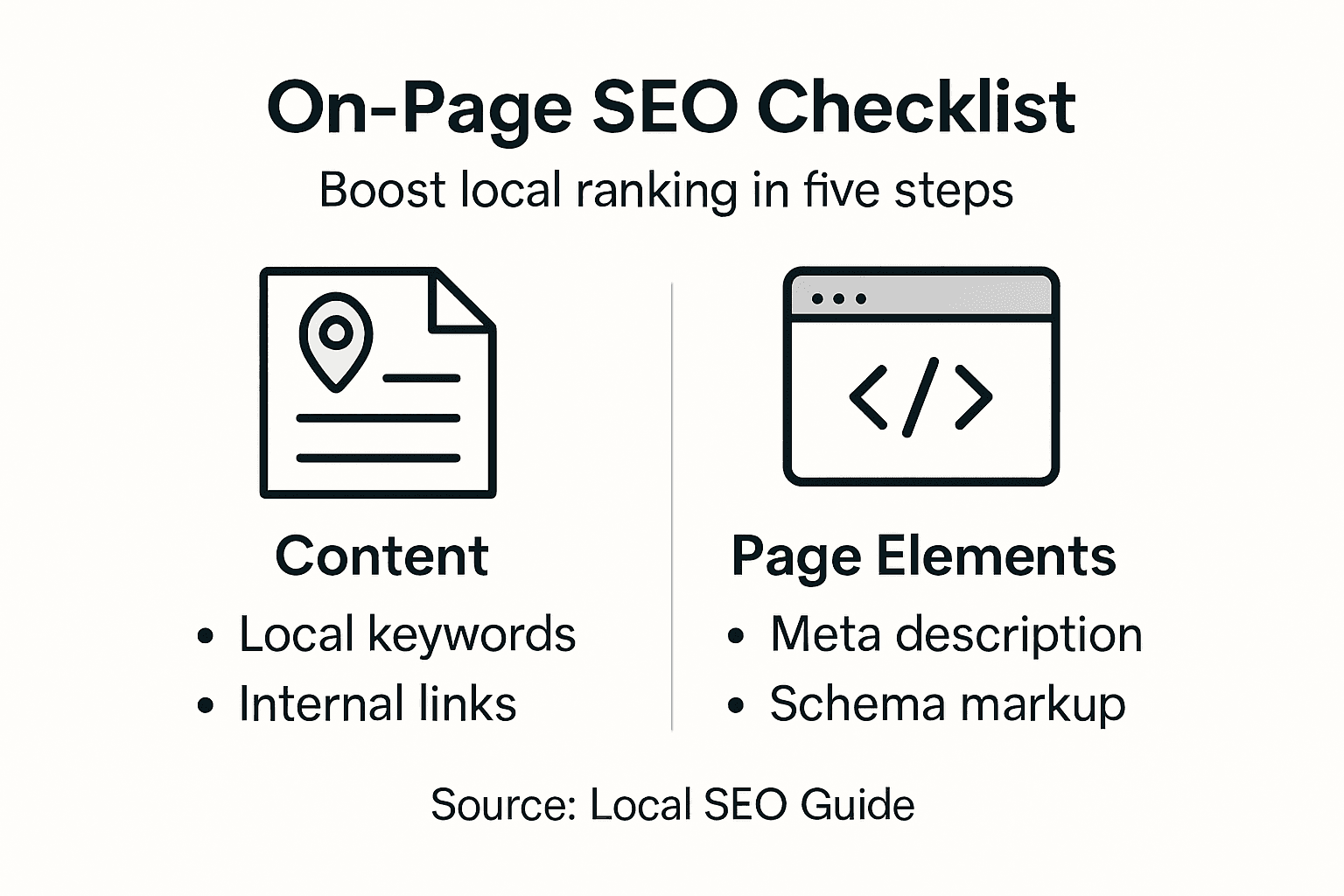
Below is a summary of on-page elements that influence local SEO results and their impact:
| On-Page Element | Impact on Local SEO | How to Optimise |
|---|---|---|
| Schema Markup | Improves search visibility | Add accurate business info |
| NAP Consistency | Boosts local trust signals | Ensure details match everywhere |
| Image Optimisation | Enhances location relevance | Use local keywords in file names |
| Customer Testimonials | Builds credibility and trust | Feature genuine local reviews |
Stage 5: Verify SEO Performance and Fix Issues
Regularly monitoring and improving your website’s SEO performance is essential for maintaining and enhancing your local search rankings. Performing a content audit helps you identify and address potential issues that might be hindering your website’s search engine visibility.
Utilise free and paid SEO tools like Google Search Console, Google Analytics, and specialised SEO platforms to conduct comprehensive performance reviews. Examine key metrics such as organic traffic, bounce rates, page loading speeds, mobile responsiveness, and keyword rankings. Look for potential issues like broken links, duplicate content, slow page load times, or pages with high bounce rates. Pay special attention to mobile performance, as Google prioritises mobile friendly websites in local search results.
When you identify problems, create a systematic approach to resolving them. Prioritise technical issues that directly impact user experience and search engine crawling. This might involve improving website speed, fixing broken links, optimising images, ensuring mobile responsiveness, and updating outdated content. Consider running regular technical SEO audits to catch and address potential issues before they significantly impact your search rankings.
Practical Suggestion: Schedule monthly SEO performance reviews and create a prioritised action plan for addressing any identified issues.
Take Control of Your Local SEO Success Today
Local businesses often struggle to not only rank well but also to stand out with effective on-page SEO tactics like optimising page titles, structuring content with headings, and maintaining NAP consistency. This can lead to missed opportunities for attracting customers who are searching for services nearby. If you find yourself overwhelmed by these challenges or unsure how to fix issues identified in your SEO audits, remember that expert help is available.
Implementing an On-Page SEO Checklist for Better Local Rankings takes time and precision, yet the right strategies can dramatically increase local visibility and build trust with your community. 
Don’t let your competitors outrank you because of technical obstacles or unclear content structure. Partner with a trusted South African SEO agency that offers tailored solutions including technical SEO, local optimisation, and content strategies designed to convert. Visit our contact page today and take the first step toward unlocking genuine local search growth by booking your personalised consultation now.
Frequently Asked Questions
What is the importance of local keywords in on-page SEO?
Local keywords help your website rank higher in local search results by connecting your content with specific geographic areas. To enhance your local visibility, incorporate location-specific phrases into your content, such as your city or neighbourhood.
How can I optimise my page titles for better local rankings?
To optimise your page titles, ensure they are concise, clear, and include your primary local keyword. Aim for a character limit of 50 to 60 characters, which can help improve click-through rates from search engine results.
What is the role of internal links in local SEO?
Internal links improve user navigation and help search engines understand the relationship between your web pages. Develop a linking strategy by connecting related content within your site using descriptive anchor text to guide visitors to relevant services.
How often should I update my meta descriptions?
Regularly updating your meta descriptions keeps them relevant and engaging for potential customers. Review and modify these every few months, or whenever you make significant changes to your services or content offerings.
What is schema markup and why should I use it?
Schema markup is structured data that helps search engines better understand your business information, enhancing your visibility in search results. Implement schema markup for your business name, address, and phone number to improve local SEO outcomes.
How can I track my website’s local SEO performance?
To track your website’s local SEO performance, utilise analytics tools to monitor organic traffic, keyword rankings, and engagement metrics. Conduct a monthly review to identify any issues and formulate an action plan for continuous improvement.
Recommended
- Unlock Success with This Local SEO Checklist for Owners – LSA SEO Agency
- Local SEO Strategy: Simple Tips to Get You Noticed – LSA SEO Agency
- Unlock Success: Local SEO for Small Businesses Made Easy – LSA SEO Agency
- The Secret to Success: Local SEO Optimization Service – LSA SEO Agency
- Local SEO Secrets Every Small Business Must Know Now – City Web Company | Digital Marketing Agency
source https://localseoagency.co.za/on-page-seo-checklist-local-rankings/



No comments:
Post a Comment